


- Research platform
Sources of information
Data analysis
Actions

- Solutions
For whom
Problems / Issues

- Materials
Materials
- About us
About us
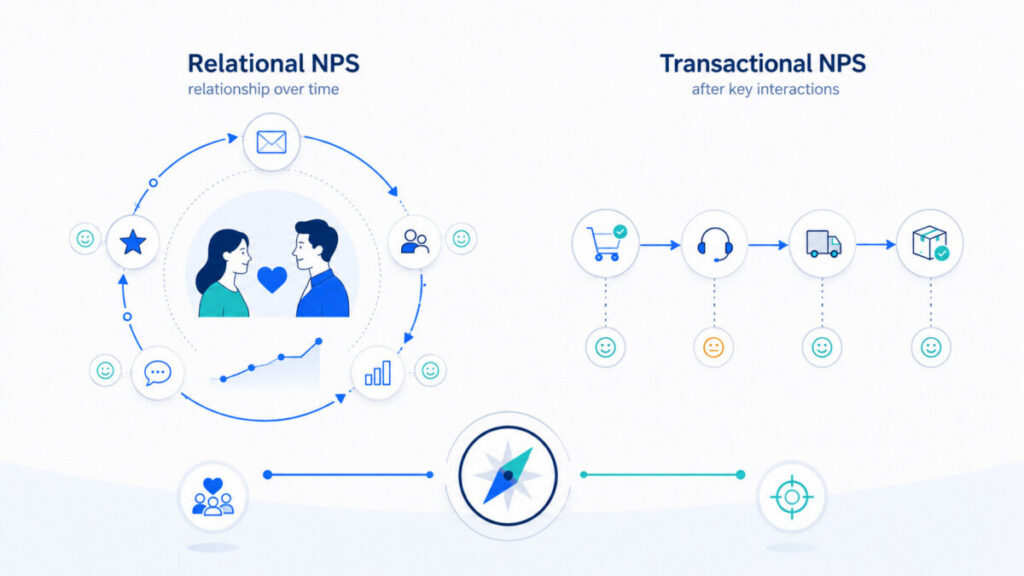
Relationship NPS measures the customer’s overall relationship with a company, brand, product, or service. It is typically conducted on a recurring basis, for example quarterly, semi-annually, or annually, to monitor customers’ likelihood to recommend and the overall health of the relationship with the brand.
Transactional NPS measures the customer’s experience after a specific interaction or event. It is sent after a purchase, delivery, customer service interaction, complaint, onboarding process, payment, store visit, or another important customer touchpoint.
The simplest difference is this: relationship NPS answers the question “how does the customer perceive their overall relationship with us as a company?”, while transactional NPS answers “how does the customer evaluate the specific experience that has just taken place?”.
In a mature Customer Experience program, both types of NPS should complement each other. Relationship NPS provides a strategic view of customer loyalty and advocacy, while transactional NPS helps identify the specific processes and touchpoints that strengthen or weaken that relationship.
Relationship NPS measures the customer’s overall attitude toward a brand. It does not refer to a single situation, but to the broader relationship: past experiences, trust, perceived value, quality of service, and the overall history of cooperation with the company. It is especially useful for monitoring customer loyalty, retention risk, and changes in how the company is perceived over time.
Transactional NPS measures the evaluation of a specific experience. It refers to a single interaction, such as a purchase, complaint, delivery, conversation with a consultant, service implementation, or store visit. It helps diagnose problems at specific points in the customer journey.
These two metrics are not interchangeable. They measure different levels of customer experience and answer different business questions.
Net Promoter Score, or NPS, is a metric used to measure a customer’s likelihood to recommend a company, product, or service. It is most commonly based on the question:
“How likely are you to recommend our company to a friend or colleague?”
The customer answers on a scale from 0 to 10. Responses are usually divided into three groups:
The NPS score is calculated as the difference between the percentage of promoters and the percentage of detractors.
However, the score alone does not tell the whole story. The key question is the context in which the score was collected. A rating from a survey sent every six months to the entire customer base should be interpreted differently from a rating given a few minutes after a conversation with a support agent.
That is why, in Customer Experience practice, two main types of NPS measurement are distinguished: relationship NPS and transactional NPS.
Relationship NPS is a survey that measures the customer’s overall relationship with a company, brand, product, or service.
In this approach, the customer is not evaluating a single transaction or one specific contact. Instead, they are assessing the overall experience to date: the quality of the offer, trust, communication, service, pricing, convenience, stability of cooperation, product value, and all previous interactions with the company.
Relationship NPS is particularly useful when a company wants to answer questions such as:
An example relationship NPS question:
“How likely are you to recommend [company name] to a friend or colleague?”
For a digital product, the question could be adapted as follows:
“How likely are you to recommend [product/platform name] to another person in your industry?”
In B2B, it is worth adapting the question to the context of the business relationship:
“How likely are you to recommend working with [company name] to another organization?”
Relationship NPS is most often conducted on a recurring basis: quarterly, semi-annually, or annually. Its purpose is not to evaluate a single event, but to observe trends and assess the overall health of customer relationships.
Transactional NPS is a survey that measures the customer’s experience after a specific interaction, transaction, or event in the customer journey.
In this case, the customer is not evaluating the entire brand. They are evaluating a recent experience: a purchase, customer service interaction, complaint, delivery, onboarding, store visit, conversation with an advisor, resolution of a support ticket, or another event that has just taken place.
Transactional NPS helps answer questions such as:
An example transactional NPS question after a customer service interaction:
“Based on your most recent contact with our customer service team, how likely are you to recommend our company to a friend or colleague?”
After an e-commerce purchase:
“Based on your most recent purchase in our store, how likely are you to recommend our brand to others?”
After SaaS onboarding:
“Based on the onboarding process, how likely are you to recommend our platform to another company?”
In transactional NPS, the timing of the survey is critical. The survey should reach the customer when the experience is still fresh, but only after the customer has had a real opportunity to evaluate it. After a conversation with a support agent, this may be within a few minutes or hours. After delivery, the survey should be sent only after the package has been received. After onboarding, it should be sent once the key implementation stage has been completed.
Relationship NPS measures the relationship. Transactional NPS measures an event.
Relationship NPS shows how the customer perceives the company from a broader perspective. Transactional NPS shows how the customer evaluated a specific moment in the journey.
Relationship NPS is a more strategic metric. It helps CX leaders, executives, marketing, sales, and customer success teams understand customer advocacy and the direction of change in the relationship with the brand.
Transactional NPS is a more operational metric. It helps teams responsible for service, product, logistics, e-commerce, sales, and processes improve specific experiences.
Relationship NPS should be analyzed over time and across customer segments. Transactional NPS should be analyzed by touchpoint, channel, process, case type, and customer journey stage.
| Area | Relationship NPS | Transactional NPS |
|---|---|---|
| What does it measure? | The customer’s overall relationship with a company, brand, product, or service | The customer’s experience after a specific interaction, transaction, or event |
| Main question | “Would the customer recommend us as a company?” | “Would the customer recommend us after this specific experience?” |
| Perspective | Strategic | Operational |
| Survey timing | Conducted periodically, independently of a single event | Triggered by a specific event, such as a purchase, contact, or complaint |
| Typical frequency | Quarterly, semi-annually, annually | Ongoing, after selected touchpoints |
| Main use case | Measuring customer advocacy and relationship health | Diagnosing the quality of processes and touchpoints |
| Main audience | Executive team, CX, marketing, sales, customer success | Operational teams, service, product, logistics, e-commerce |
| Greatest value | Shows trends and risk segments | Identifies specific areas for improvement |
| Greatest risk | Overly general interpretation without segmentation | Attributing one interaction to the entire relationship with the brand |
| Best complemented by | Comments, segmentation, retention data | Alerts, root cause analysis, closed-loop feedback |
Choose relationship NPS if you want to:
Choose transactional NPS if you want to:
In practice, the best organizations do not ask: “Which type of NPS should we choose?” A better question is: “How can we combine both types of NPS in one customer experience management system?”
Differences between relationship NPS and transactional NPS are natural. They are often one of the most valuable sources of customer insight because they show the gap between the customer’s overall attitude toward the brand and their evaluation of a specific experience.
This means the customer still evaluates the company positively overall, but a specific experience was poor.
Example: a customer likes the brand, regularly buys its products, and trusts the quality of the offer, but their most recent delivery was delayed. In the relationship survey, they give a score of 9, while after the delivery they give a 4.
Conclusion: the relationship is still strong, but a specific process needs improvement.
This means the most recent interaction was good, but it was not enough to rebuild overall trust in the brand.
Example: a customer has been experiencing problems with a banking app for several months. Their most recent conversation with a consultant was very good, so they give a 9 in the transactional survey. In the relationship survey, they still give a 5 because the overall frustration has not disappeared.
Conclusion: a single good interaction can improve the experience at a given moment, but it does not always repair the entire relationship.
This is a warning signal. The customer evaluates both the brand and the specific experience negatively.
Conclusion: a quick response, root cause analysis, and a closed-loop feedback process are needed, especially if the customer belongs to an important segment.
This is the best-case scenario. The company delivers good experiences both in everyday interactions and across the overall relationship.
Conclusion: it is worth identifying what works well and then strengthening those elements across other segments, channels, or processes.
In e-commerce, relationship NPS measures customers’ overall likelihood to recommend the store. The score may be influenced by pricing, product availability, shopping convenience, service quality, return policy, promotions, delivery, and communication.
Transactional NPS can be sent after a purchase, delivery, return, complaint, customer service interaction, or order pickup.
Example: an online store has a high relationship NPS but a low transactional NPS after delivery. Customer comments show that people like the brand and the products, but complain about the lack of information on shipment status. This does not necessarily indicate a problem with the entire brand. It is most likely a problem at a specific stage of the customer journey.
In SaaS, relationship NPS shows whether users see value in the product and are willing to recommend it to others. Results can be analyzed by plan, user role, company size, activity level, customer lifecycle stage, and churn risk.
Transactional NPS works well after onboarding, implementation, a support interaction, use of a new feature, subscription renewal, or resolution of a technical support ticket.
Example: a customer gives a low tNPS after onboarding because the configuration process was too complex. Three months later, churn risk increases. Thanks to transactional NPS, the company can react earlier, before the problem appears in sales or retention results.
In banking, relationship NPS measures overall trust in the bank. It is influenced by security, the quality of the mobile app, fees, advisory quality, service availability, communication, and the stability of the relationship.
Transactional NPS can be used after opening an account, contacting a call center, completing a loan process, visiting a branch, submitting a complaint, changing a limit, or speaking with an advisor.
Example: a bank has a good relationship NPS among premium customers, but a low tNPS after the loan process. Comments point to too many documents and a lack of information about the status of the decision. This is a concrete signal for the process owner, not just a general sign of customer dissatisfaction.
In insurance, so-called moments of truth are especially important. Customers often evaluate an insurer most clearly when they need to file a claim.
Relationship NPS shows whether the customer trusts the company as an insurer. Transactional NPS after filing a claim shows whether the company delivered on its promise at a critical moment.
Example: a customer pays premiums for years and has no strong opinion about the brand. After a fast, empathetic, and transparent claims-handling process, they become a promoter. Conversely, one poorly handled claim can weaken a long-standing relationship.
In retail, relationship NPS shows attachment to a store chain. The score is influenced by pricing, product quality, location, staff, app experience, promotions, and loyalty programs.
Transactional NPS can be measured after a store visit, online purchase with offline pickup, return, use of a promotion, interaction with an employee, or use of a self-checkout.
Example: a customer likes the store chain, but their most recent visit was frustrating because of a queue and lack of product availability. tNPS helps detect an operational issue before it starts to affect overall loyalty.
In customer service, transactional NPS is one of the most practical applications. After a phone call, chat, or email exchange, the customer can be asked to evaluate that specific experience.
However, it is important to remember that the customer is not always evaluating only the consultant. Sometimes they are evaluating company policy, regulatory constraints, waiting time, lack of decision-making authority, or the fact that their problem was not resolved.
That is why tNPS in customer service should be analyzed together with case type, contact channel, response time, resolution status, number of contacts in the same case, and the customer’s comment.
A good NPS question should be short, clear, and adapted to the context. The most important thing is that the customer understands exactly what they are being asked to evaluate: the overall relationship or a specific event.
For relationship NPS:
“How likely are you to recommend [company name] to a friend or colleague?”
For transactional NPS after a service interaction:
“Based on your most recent contact with our customer service team, how likely are you to recommend our company?”
For transactional NPS after a purchase:
“Based on your most recent purchase, how likely are you to recommend our store?”
For transactional NPS after a complaint:
“Based on how your complaint was handled, how likely are you to recommend our company?”
A common mistake is using an overly general question in a transactional survey. If the survey concerns a complaint, delivery, or service interaction, the question should clearly refer to that event.
An open-ended question is essential because the 0–10 score alone does not explain the reason behind the rating. Without a comment, it is difficult to understand whether the customer evaluated the price, product, service, communication, process, waiting time, or previous experiences with the brand.
The simplest and often most useful version is:
“What is the main reason for your score?”
Other good options include:
In transactional NPS, it is worth making the context more specific:
“What had the biggest impact on your rating of your most recent contact with our customer service team?”
In relationship NPS, a broader question usually works better:
“What has the greatest impact on your overall assessment of our company?”
This makes customer comments more precise and easier to translate into action.
NPS without comments, segmentation, and contextual data can lead to incorrect conclusions.
The average score may look good while hiding serious problems in one customer segment. A company may have a relationship NPS of 45, while among new customers the score may be 12. In that situation, the overall average masks a problem with onboarding, the first experience, or post-purchase communication.
The same applies to transactional NPS. A low score after a customer service interaction does not always mean that consultants are doing a poor job. The root cause may be long waiting time, a complicated process, lack of decision-making authority, unclear policies, or the need to contact the company multiple times about the same issue.
That is why NPS should be analyzed together with:
Only then does NPS become a tool for managing customer experience, rather than just a number in a report.
The best approach is to create a coherent measurement architecture. This means the company knows which type of survey answers which business question and how the results will be used.
An example model could look like this:
In this model, relationship NPS shows whether the customer relationship is improving, while transactional NPS shows which experiences are driving that change.
This matters because information about a decline in relationship NPS is usually not enough to make a decision. Only when combined with transactional results can the company see whether the problem relates to delivery, service, onboarding, product, communication, or another stage of the customer journey.
These are two different measurements. It is not valid to assume that a tNPS of 30 is “worse” than an rNPS of 45 if they refer to different groups, moments, and contexts.
In transactional NPS, the survey must be sent after the right event. A delivery survey should not arrive before the package has been delivered. An onboarding survey should not appear before the key stage of implementation has been completed.
Without a comment, it is unclear why the customer gave a particular score. This limits the value of the survey and makes it harder to translate the result into action.
Averages can hide problems. Results should be analyzed by segment, channel, product, region, journey stage, and case type.
Excessive surveying leads to survey fatigue and lower-quality responses. It is worth setting contact limits and exclusion rules.
The goal is not to “increase NPS” for the sake of the number. The goal is to improve customer experience, retention, loyalty, and process quality.
If a customer reports a negative experience and the company does not respond, the survey may deepen frustration. An NPS program should include a clear process for acting on feedback.
Promoters show what works well. Their comments help reinforce best practices, communication, and competitive advantages.
Before launching a survey, it is worth answering several questions.
Is the goal related to loyalty, churn, customer service, onboarding, complaints, delivery, sales, retention, or the quality of a specific process?
If we are measuring the relationship, we use rNPS. If we are measuring a touchpoint, we use tNPS. If we want to manage the entire customer experience, we usually need both.
Should the survey be recurring, or should it be triggered by a specific event?
All customers, a sample, selected segments, users after a specific event, or B2B decision-makers?
It is worth setting limits to avoid survey fatigue and unintentionally worsening the customer experience.
Without comments, it is difficult to translate the score into action.
By segment, channel, product, region, case type, and customer journey stage.
CX should not be the only owner of improvement initiatives. Process owners are needed across service, logistics, product, sales, e-commerce, and customer success.
Detractors, especially those from important segments, should enter a closed-loop feedback process.
Executives need trends, risks, and priorities. Operational teams need specific problems they can solve.
Not always. NPS is useful, but it should not be the only source of insight into customer experience.
In many situations, it is worth combining NPS with other metrics:
NPS answers the question of likelihood to recommend. CSAT and CES often explain specific elements of the experience better. That is why the best CX programs combine several metrics instead of relying on a single number.
Relationship NPS and transactional NPS differ mainly in the scope of measurement.
Relationship NPS measures the customer’s overall relationship with the brand. It is useful for monitoring customer advocacy, trends, customer segments, and the strategic health of the relationship.
Transactional NPS measures the customer’s experience after a specific interaction. It is useful for diagnosing touchpoints, operational processes, and moments that influence customer satisfaction and advocacy.
They should not be treated as competing methods. In a well-designed CX program, both types of NPS work together. Relationship NPS shows the overall direction, while transactional NPS explains which experiences strengthen or weaken that direction.
The greatest value of NPS appears when the company does not stop at the score. What matters most are comments, segmentation, root cause analysis, responses to detractors, and translating the voice of the customer into real process improvements.
Relationship NPS measures the customer’s overall relationship with a company, brand, product, or service. Transactional NPS measures the customer’s experience after a specific interaction, such as a purchase, delivery, complaint, or customer service contact.
Relationship NPS should be used when a company wants to measure customer advocacy, the health of the relationship with the brand, and changes in customer perception over time. It is usually conducted periodically, for example quarterly, semi-annually, or annually.
Transactional NPS should be used after specific events in the customer journey, such as a purchase, delivery, call center contact, complaint, onboarding, store visit, or support ticket resolution.
No. Both types of NPS serve different purposes. Relationship NPS is better for evaluating overall customer advocacy and the health of the relationship, while transactional NPS is better for diagnosing specific experiences and processes.
They should not be compared one to one because they measure different things. However, it is useful to analyze how transactional results influence the relationship NPS score.
Relationship NPS is most often measured quarterly, semi-annually, or annually. The frequency should depend on the customer relationship cycle, industry, and the company’s ability to act on the results.
A transactional NPS survey should be sent when the customer has had a real opportunity to evaluate the experience. After a customer service interaction, this may be within a few minutes or hours. After delivery, it should be after the package has been received. After onboarding, it should be after the key implementation stage has been completed.
Yes. NPS should often be combined with CSAT, CES, customer comments, operational data, retention, and churn. This allows the company to understand not only the likelihood to recommend, but also the reasons behind customer experiences.
The most universal question is: “What is the main reason for your score?” In transactional NPS, it is worth adding context, for example: “What had the biggest impact on your rating of your most recent contact with our customer service team?”
Yes, but in B2B it is important to select respondents and segments carefully. Product users, decision-makers, budget owners, and operational stakeholders may evaluate the relationship differently.
Copyright © 2023. YourCX. All rights reserved — Design by Proformat
