


- Research platform
Sources of information
Data analysis
Actions

- Solutions
For whom
Problems / Issues

- Materials
Materials
- About us
About us
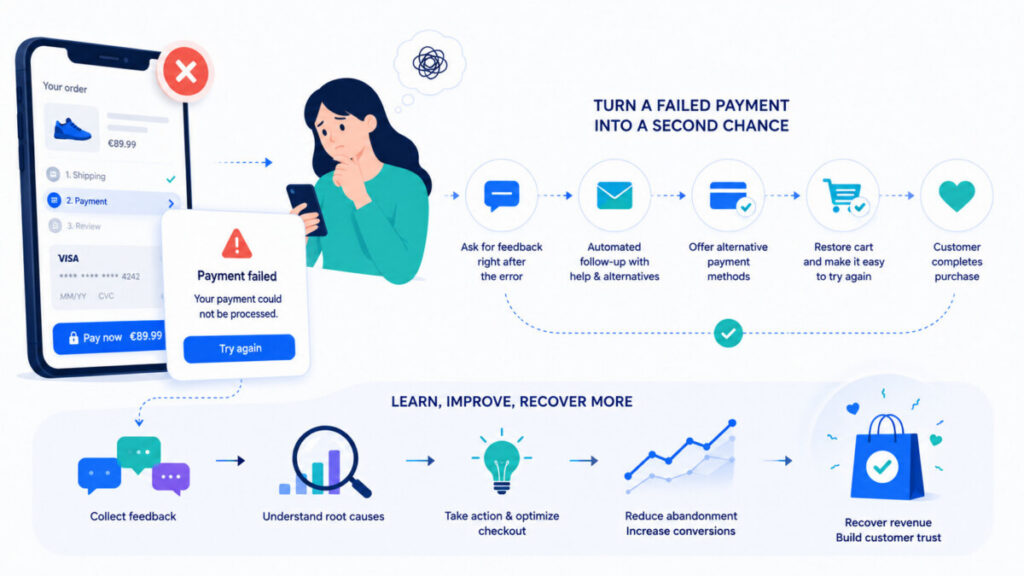
A failed payment in e-commerce is rarely just a technical status in the operator's panel. It is the moment when the customer was already close to the purchase, but the whole process stopped at the most sensitive point: at money, security and trust in the store.
If you manage checkout, CX or customer service, treat payment errors as a source of data, not just as lost transactions. This is when feedback is freshest and easiest to understand what is realistically blocking the completion of a purchase.

In an online store, a failed payment refers to a situation in which a customer cannot successfully pay for an order. It could be a declined card payment, a problem with 3DS/SCA, a payment gateway error, a session timeout, a failed confirmation in the banking app, or a user giving up after seeing the last checkout step.
From a business perspective, this is a doubly costly moment. First, there is the risk of lost revenue. Second, trust in the store drops, because the customer doesn't always know if the money has been collected, if the order has been saved and if he should try again. This directly affects sales performance, quality of service and customer relations.
According to a Baymard Institute analysis, the average percentage of abandoned shopping carts is 70.19%, which directly translates into lost revenue. The average percentage of abandoned shopping carts in online stores is 70.19%, which translates into significant financial losses for e-commerce. Some of these abandonments are due to problems in the last steps of the purchase path, including payment errors, unclear costs and an overly difficult process.
An optimized checkout process is a key element affecting the effectiveness of an e-commerce store, because the more customers complete the checkout process, the greater the store's effectiveness. A transparent and hassle-free transaction process drives higher conversion rates, but it requires looking beyond the payment technology.
This article is for e-commerce managers, CX managers, digital managers, product owners and customer care teams. We'll go from customer emotions, to collecting feedback after an error, to specific actions, metrics and closed-loop feedback that help improve checkout in a data-driven way.
After a payment error, a customer is in a peculiar state: he or she was ready to buy a product or service, but encountered a barrier. In this situation, what matters is not only the error itself, but also how the store explains it, whether it minimizes the effort, and whether it gives a clear path to finalize the order.
The following reasons for abandoning a purchase are the most common:
In practice, without talking to the customer, it is difficult to distinguish between a technical error and a psychological barrier. The same payment status can mean both a real refusal by the bank and a situation in which the customer was frightened by the message, closed the site and went to a competitor.
Transaction data is necessary, but not sufficient. Payment status, payment method, amount, error code and attempt time show what happened in the system. However, they don't show why the customer didn't try again, what he felt and what decisions he made after seeing the error.
Example: two shopping carts end up with the same error code after a card payment. In the first case, the bank rejected the transaction because of the limit. In the second, the customer didn't go through the confirmation in the app because he didn't understand why he had to leave the store's website. In the third case, the bank says the transaction was only temporarily blocked, but the customer doesn't know what that means and writes to support for complaints.
The limitations of the data itself can be seen in several areas in particular:
The source of the data | What it shows | What it does not show |
|---|---|---|
PSP logs | Status, error code, method, amount | Customer emotion, trust, message understanding |
GA4 / web analytics | Abandonment stage, path, traffic source | Reason for abandonment and subjective evaluation of the process |
Heatmaps and session recordings | Clicks, scroll, hesitation | Concerns about security, recovery, quality of service |
Ticket system | Support contacts | Those customers who did not write and simply gave up |
Behavioral analytics can show that users stop when choosing to pay. However, it won't tell whether they couldn't find BLIK, were afraid of redirection, a discount code didn't work, or simply the extra cost changed their assessment of the value of the offer.
Therefore, feedback after a failed payment should combine quantitative data with Voice of Customer. Combining logs, PSP data, GA4, shopping cart information and customer comments allows you to see the entire process, not just the technical outcome.
Feedback should be collected when the customer remembers the details. Brief notifications after a declined transaction can catch the customer's attention while emotions are still fresh. At the same time, quick response and minimizing customer effort are key to collecting valuable feedback after payment problems.
The best points of contact are:
When a payment error is detected, you can display a short survey in the checkout interface. It should not block further action or prolong frustration.
Good format:
Example:
What prevented you from completing the payment?
No payment method / technical error / unintelligible message / problem with the bank / other.
Automatic email campaigns that remind users of abandoned shopping carts can be effective, especially when they are personalized and include direct links to return to the cart. In the case of a payment error, the first message should arrive quickly, such as within 5-15 minutes.
Such an e-mail should include:
Text messages can also work, but should be used carefully, in accordance with marketing and transactional consents. Multi-channel communication with the customer increases the chance of a response after an unsaid transaction.
If a customer has not returned to checkout, a form can be sent after 24 hours. Collecting feedback from customers who have abandoned a shopping cart can help identify barriers to the shopping process and make appropriate improvements.
It is important that the response does not require an account login. If a customer has to retrieve their password first to tell you why they didn't buy, they probably won't respond.
Chat on the site, WhatsApp, Messenger or phone contact are more important when the customer does not know if the funds have been collected. At such a time, quick access to a human being can save the order.
The message may read:
Doubt if the payment has been collected? Write to us - we will check the status of the order and help you complete the purchase.
Every contact regarding payment should be tagged in the ticket system. Categories may include: "payment error", "problem with 3DS", "no payment method", "status of funds", "problem with discount code", "chargeback", "complaints".
Social media contacts are also worth considering. Some customers will not write an email, but will comment on the problem under the store's post or in a private message.
Comments from NPS, CSAT and CES surveys can reveal problems not seen in the checkout itself. The Customer Effort Score, or CES, is particularly useful because it measures customer effort. Customer Effort Score (CES) is a key metric for technical problems related to payments.
Collecting customer feedback should be done up to two weeks after the sales process is completed to get as much detailed information as possible. After this time, the retailer's memory fades and his opinion becomes more general.
Remember: feedback should be about experience, barriers and evaluation of the process, not sensitive data. We do not collect card numbers, PINs, SMS codes or passwords. Security and RODO compliance are important in every situation.
A good question after a payment error should be short, neutral and tailored to the context. A different set will work in a pop-up after an error, another in a recovery email, and another in a consultant-led conversation.
You can use the following set:
True feedback requires deepening the conversation with the customer to understand exactly what worked in the sales process and what needs improvement. If the customer responds with "payment doesn't work," it's worth asking further whether it was the bank, card, BLIK, message, mobile app or lack of a preferred option.
Format: yes / no / partially short comment field.
It's a good idea to link these answers to transaction data, but without asking the customer for details of card type, card number or account details.
Such ratings help track changes after optimization.
This helps distinguish between new customers and returning customers. New customers often have a lower level of trust and are quicker to give up if a problem arises. Conversations with customers should be flexible and questions tailored to the context to get as much valuable information as possible.

Simply gathering customer feedback is not enough. It is crucial to connect the feedback to a specific context: checkout stage, payment method, device type, browser, operating system, shopping cart value and traffic source.
The first step is to assign responses to operational data:
Next, it is useful to categorize the causes of problems:
Category | Examples of signals |
|---|---|
Technical | Timeout, PSP failure, redirection error, problem on bank side |
UX | Form too long, unreadable button, no autocomplete |
Communication | Unclear message, no information about funds, no instructions |
Offer | No payment method, additional costs, problem with discount code |
Trust | No reviews, no operator logos, security concerns |
Customer service | Long response time, lack of contact, inconsistent information from employees |
In segment analysis, it is worth comparing new and returning customers, large and small shopping carts, customers from paid campaigns and customers from newsletters. Direct contact with an important customer after a payment problem can help you locate technical errors faster, especially when it involves a high-value shopping cart or B2B account.
Look for patterns, not isolated anecdotes. Examples of patterns:
In practice, it is useful to tag comments by topic, emotion and barrier type. A CX platform such as YourCX can help combine surveys, comments, checkout data and operational alerts to identify causes of problems faster. For example, if the number of payment complaints increases in a short period of time, the team can receive an alert and respond before the problem severely impacts conversions.
Recovery from a payment error should be quick, calm and useful. The goal is not just to "push" the customer to pay, but to rebuild trust and show that the store understands the customer's needs.
A good message should answer three questions:
Example:
Payment failed. The money was not collected. If the bank has temporarily blocked the funds, it will release them automatically according to its rules. You can try again, choose another payment method or contact us.
Understanding the reason for payment rejection and providing clear information about the problem can help resolve the situation. The customer will appreciate a message that does not blame the customer and does not hide uncertainty.
If the card has been declined, don't make the customer go back to the beginning. Show alternatives in the same step:
Offering a "Buy now, pay later" option can increase e-commerce conversions, especially when a customer is unsure at a higher cart value or wants to maintain financial flexibility.
A failed payment should not mean a loss of data. A saved shopping cart, delivery address, selected delivery method and invoice data reduces customer effort.
Ideally, the customer should be able to return to the last step from a unique recovery link. This increases the chances of finalization because it doesn't force them to re-enter the same information.
The email or SMS message should appear within a short period of time, such as 5-30 minutes after a failed attempt. It should include:
Dynamic remarketing and retargeting are effective strategies for recovering abandoned shopping carts, which involve reaching users again with personalized messages. However, it is worth being careful that marketing does not overtake service. If a customer is worried about money, they need an explanation first, then a product reminder.
For more expensive orders, B2B customers or recurring problems, consultant support can make a huge difference. A quick chat, phone call or social media contact allows you to solve the problem before the customer chooses a competitor.
A direct conversation also helps to understand the vendor's position and the customer's position. If there was a failure on the store's side, it's worth making that clear. If the problem is on the bank's side, you also need to explain to the customer what he can do.
Offering compensation in exchange for feedback can increase customers' willingness to share comments. However, this does not mean that every payment error should end in a rebate.
Compensation makes sense when:
It doesn't make sense to give out discounts automatically in every situation, because it can lead to abuse. Sometimes all that is needed is quick help, an apology, clear information and a smooth completion of the order.
The topic of chargeback may come up in conversations about payments. The chargeback procedure covers transactions made with payment cards, such as Visa and MasterCard, and allows you to complain about payments in the event of fraud or a mistaken transaction.
A chargeback complaint must be filed with the bank that issued the card, and the maximum time for filing a complaint is usually 120 days from the date of the transaction. In order to successfully file a chargeback complaint, you must provide evidence, such as confirmation of the transaction, correspondence with the merchant, and other documents proving the validity of the complaint.
If the seller does not respond to the chargeback complaint, the complaint is automatically accepted and the customer receives a refund. Chargeback is a free service to recover money in case of fraud, and banks are obliged to accept and process the complaint.
For the store, however, the most important thing is not to escalate if the matter can be resolved more quickly. If the error lies with the store, it's better to acknowledge the complaint, refund the money or help repeat the purchase, rather than let the chargeback act as a last avenue for recovery.

Feedback after a failed payment is most valuable when it leads to product, operational and communication decisions. Collecting feedback without changing the process only increases customer and employee frustration.
Optimizing checkout is about simplifying forms, enabling payment by different methods, and providing clear information on costs and delivery options. This is not a one-time project, but an ongoing process.
The most common actions resulting from feedback:
Instead of technical code, the customer should see plain language:
A good message can reduce the number of contacts to support and improve the feeling of security.
Optimizing the purchase path, including simplifying forms and reducing the amount of data required, can significantly reduce the risk of shopping cart abandonment.
In practice, this means:
If customer feedback repetitively indicates the absence of BLIK, digital wallet, quick transfer, deferred payment or a local operator, it's not a detail. It's a conversion barrier.
Payment methods should match the market, segment and customer behavior. Different customer needs will arise in Poland, others in Germany, and others in B2B sales.
On mobile devices, every extra step hurts more. It is worth checking:
Testing should take place on real devices, not just emulators.
If the number of interrupted payments, error comments or support contacts increases in a short period of time, the operations team should get an alert. Then you can react before the problem affects a larger group of customers.
This is where closed-loop feedback comes in handy. CX platforms, such as YourCX, can support the entire process: from collecting checkout surveys, to analyzing comments, to integrating with development, service and customer support teams.
Feedback indicates where to look for a problem. A/B testing helps to see which solutions really work.
Testing can include:
It is important not to test everything at once. Each hypothesis should have a clear metric of success.
If you want to improve checkout, you need to measure both numbers and comments. The metrics alone will show the trend, but only the feedback will explain why something has changed.
The most important metrics are:
The CES is particularly important because it shows how much effort it took to complete the payment. If a customer had to enter data several times, change the method and contact support, even a successful sale can mean a poor e-commerce customer experience.
Data is worth reviewing weekly and monthly. Compare "before" and "after" periods of implementing changes, but be sure not to draw conclusions solely from correlations. Seasonality, campaigns, assortment changes, operator contracts and marketing activities can affect the result.
Collecting feedback should be an ongoing part of your sales efforts, not a one-time action, allowing you to continuously monitor and optimize your sales process.
A failed payment is not just a technical problem. It is the moment when the customer is close to a purchase decision, but at the same time can lose trust in the store very quickly. This is why feedback after a failed payment is so valuable for CX, sales and product management.
Systemic feedback collection allows you to see barriers that logs alone won't show: an incomprehensible message, concern about funds, lack of a payment method, mobile issues, hidden costs, too long a form or lack of quick support. Feedback from customers who have abandoned an offer is just as important as feedback from those who have made a purchase, as it can reveal key reasons for abandonment.
Companies that implement Voice of Customer and closed-loop feedback move more quickly from symptom to cause. This gives them a better basis for decisions: what to simplify, what message to improve, which payment methods to add, when to trigger an alert and how to win back the customer without increasing sales pressure.
In practice, those teams that treat the customer's needs, his opinion and real effort as operational data win. This approach not only improves checkout, but supports relationship building, reduces abandonment and helps create a more resilient sales process.
Feedback after a payment error reveals real barriers to checkout that are not visible in the transaction data itself. The error status will show that the payment failed, but it won't explain whether the customer didn't trust the message, didn't find the preferred method, had a problem with the bank or dropped out due to additional costs.
Such information helps reduce the number of abandoned shopping carts, improve the customer experience and make faster decisions on checkout changes.
It's best to start with short questions:
Keep your questions concise, neutral and safe. Do not ask for card details, PINs, SMS codes, passwords or bank login details.
First, show a clear message on the page after the error. Then save the shopping cart, suggest an alternative payment method and send an email or SMS with a link to renew the payment. If the customer is worried about the status of the funds, enable a quick contact with a consultant.
A goodwill gesture can be considered in selected cases, but transparency, security and minimal effort on the customer's part are key.
Customer comments indicate specific items for improvement: message content, form length, number of steps, lack of payment methods, problems on mobile devices, or showing delivery costs too late.
With feedback, you can prioritize solutions according to the real scale of the problem, rather than solely according to the team's hypotheses. This makes it easier to plan A/B tests and effectively optimize checkout.
It's worth monitoring conversion rate, checkout abandonment rate, cart abandonment rate, payment success rate, number of support contacts related to payments, CES/CSAT for the payment process, and share of recovered shopping carts.
The best results come from combining numerical trends with customer comments. This makes it easier to distinguish a real improvement in the experience from a random change in the data.
Copyright © 2023. YourCX. All rights reserved — Design by Proformat
