


- Research platform
Sources of information
Data analysis
Actions

- Solutions
For whom
Problems / Issues

- Materials
Materials
- About us
About us
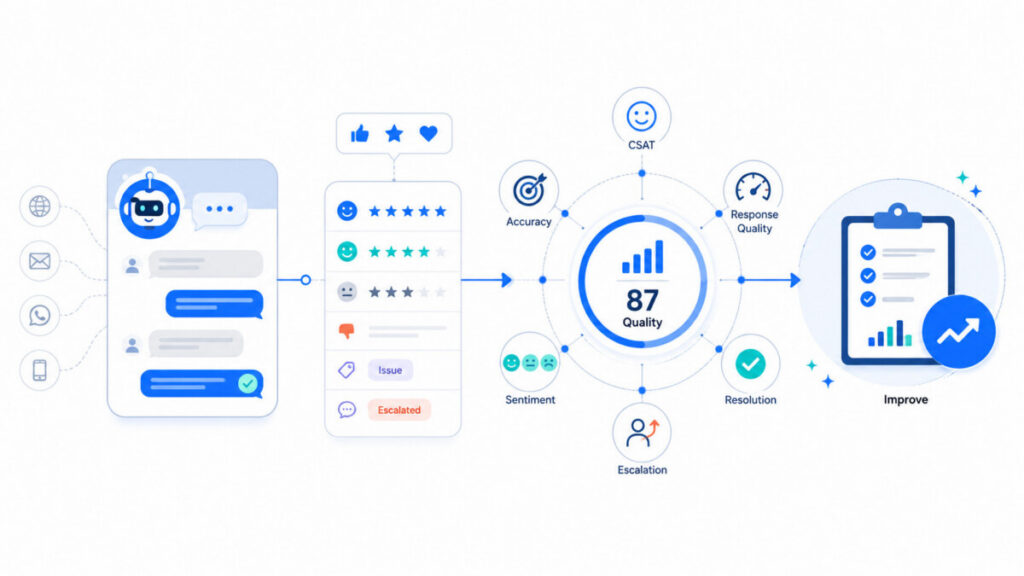
Feedback after a chatbot contact should not be an add-on to an automation report. It is the primary source of knowledge about whether automated customer service actually solves problems or just reduces the number of calls going to consultants.

Simply implementing a chatbot in a customer service department does not yet mean that service has become better. A chatbot can work faster than an employee, it can provide answers around the clock and it can take over repetitive tasks, but the key question is: did the customer actually resolve their issue?
Between 2022 and 2026, many e-commerce, SaaS, banking and contact center companies deployed chatbots as the first line of customer service. They often reported an increase in deflection rate and a decrease in the number of calls to consultants, but at the same time there was negative feedback, a lower CSAT or a decrease in NPS. The problem was not the technology itself, but that automation was judged by cost, not customer experience.
Customers expect fast and efficient service, and ai can help meet those expectations, which affects their satisfaction with the service. At the same time, a poorly designed customer service chatbot can become a "gateway" that blocks contact with a consultant. If a customer asks for a refund, a payment error or an order number, and the bot circles the loop, the customer hits a wall rather than immediate help.
In the B2B sector, the average cost of handling one complaint is 60-100 zlotys, which includes not only staff costs, but also time spent on errors and correspondence. Studies also show that 15-25% of customers abandon after a poorly handled complaint, highlighting the importance of effective complaint handling for customer retention.
Companies often struggle to strike a balance between reducing costs and improving customer service, leading to uncertainty about the ROI from AI implementation. Therefore, before implementing automation, it is necessary to define what success means: fewer calls, shorter service times, higher satisfaction, better conversion, or a real effect in terms of fewer repeat contacts?
Implementing AI in customer service requires precise definition of goals to be able to later assess whether the project is having the intended effect, which is often overlooked. True automated service quality requires a combination of operational data, such as bot logs, containment rate and escalation rate, with customer feedback, i.e. CSAT, CES, NPS, text comments and sentiment analysis.
A chatbot's service quality doesn't just mean that the bot answered a question. It means that the bot understood the intention, gave the correct answer, reduced the customer's effort and - if it could not help - efficiently transferred the matter to a human.
It is worth separating the two levels of evaluation:
Evaluation level | What does it measure? | Example |
|---|---|---|
Effectiveness of automation | How many cases the bot has handled without human involvement | Containment rate, deflection rate |
Quality of experience | How the customer rated the entire process | CSAT chatbot, CES chatbot, comments, sentiment |
Customer service automation can significantly improve customer satisfaction through faster responses and consistency in service quality. Customer service automation can also significantly reduce response times, which increases efficiency and customer satisfaction. However, this doesn't happen automatically - you need a well-designed process, integrations and regular quality analysis.
Introducing AI into customer service can improve the personalization of interactions, resulting in higher levels of customer satisfaction. If the bot uses purchase history, account status, product data and previous contacts, it can better anticipate customer needs. If, on the other hand, it acts like a static FAQ database, its strengths end with simple answers.
Automating customer service processes using AI allows for greater consistency in service quality, which is key to building customer relationships. This is especially important in organizations where traditional service methods lead to different quality responses depending on the channel, employee or time of day.
Industry examples show the differences in expectations:
A well-designed complaint handling process should be minimal to reduce customer frustration and increase the number of completed requests. This means fewer steps, less repetition of data and a clear transition from question to solution.
Measuring chatbot quality requires a set of metrics, not a single indicator. It's different to measure performance, it's different to measure satisfaction, and it's different to measure the bot's impact on sales, retention or the cost of handling requests.
The most important metrics after interacting with a chatbot:
To be able to measure the impact of AI on customer service, you need a simple process map that allows you to assess how many inquiries the bot handles to completion, how many it has to pass on to a human, and how the average service time changes. Without such a map, it is difficult to distinguish between saving money and moving the problem elsewhere.
In classic terms, ROI is the ratio of profit to cost, and with AI in customer service, the definition expands to include harder-to-measure elements, such as the impact on customer loyalty and satisfaction. If a company pays less per contact, but loses customers after bad complaints, ROI is apparent.
In mature organizations, performance and experience metrics are analyzed together. Number of sessions, FAQ volume or average time are important, but only by combining them with CSAT, CES, NPS, FCR and tone-of-voice analysis does it show the real quality of automated service.

Feedback after a chatbot conversation should be short, simple and asked exactly when the customer remembers the interaction. A micro-survey displayed in the same chat frame, without switching to an external form, works best.
Short transactional surveys increase the effectiveness of chatbot analysis and optimize the cost of service. In practice, this means a maximum of 1-3 closed questions and one comment field. If the survey requires too many clicks, the response rate drops, and mainly extremely satisfied or extremely dissatisfied people respond.
Sample questions after interacting with a chatbot:
One click may be enough to gather a basic evaluation. However, the comment field gives context: a customer can write that the bot didn't understand the question, asked for the same data twice, or couldn't find an order from the marketplace.
It's worth differentiating questions based on the type of issue. For e-commerce order status, it will be important whether the bot found the order number. For banking - whether it safely transferred the case to a consultant. For SaaS - whether the instructions were specific enough for the user to complete the next steps on his own.
CSAT, CES and NPS are standard metrics that measure chatbot user satisfaction, but each answers a different question. CSAT tells whether the customer was satisfied with a particular conversation. CES measures effort. NPS shows willingness to recommend a brand.
The most important rule: you need to count the results separately for the chatbot and separately for the consultant. If you combine these channels, you won't see whether the CX chatbot improves the experience or just benefits from good agent ratings.
CSAT rates satisfaction with a specific interaction on a scale of 1-5 or with emoticons. You can ask: "How would you rate the chatbot's assistance in this conversation?". The score is worth analyzing not only globally, but also by intention: order status, return, complaint, password reset, payment problem.
If a chatbot's CSAT is significantly lower than the CSAT of a live chat or hotline for the same issue, automation should not be considered a success. Market reports indicate that well-optimized bots often achieve a lower CSAT than human contact, so comparison between channels is crucial(sample benchmarks).
CES measures customer effort in solving a problem and is important for building loyalty. The question might be: "How easy was it to resolve the issue with the help of the chatbot?". Low effort is especially important when automation is meant to replace repetitive tasks previously performed by consultants.
A high CES, or high effort, may mean that the customer had to repeat data, went through too many steps, or the chatbot did not understand customer questions. In this case, the bot can formally "handle" the conversation, but it does not improve the quality of customer service.
NPS examines willingness to recommend services to friends and is used in the long-term evaluation of brand experience. In the context of a chatbot, it is useful to compare the NPS of customers who have used a bot in the last 30 days with the NPS of customers who have only contacted a consultant.
Such segmentation shows whether automation supports loyalty building or downgrades the brand. This is important especially when the chatbot is present in multiple channels: on the website, in the app, on social media, Messenger or WhatsApp.
The First Contact Resolution (FCR) metric measures how often an issue was resolved in a single session with a chatbot. In the context of a bot, it is worth adopting a stricter definition: no escalation, no repeat contact within 24-72 hours and a positive rating in the micro-survey.
FCR should be measured at the intent level. A bot may have a very high FCR for "order status" but a low one for "complaints" or "technical problems." Only this breakdown shows where the automation is working and where it needs improvement.
Operational metrics are most often reported to management because they are easy to translate into cost and performance. The problem begins when they are interpreted without customer satisfaction data.
Key operational metrics for monitoring the effectiveness of AI in customer service include average cost per contact, average handling time (AHT), number of calls handled per consultant, and % automated (containment rate). These metrics are needed, but not enough to assess whether service is good.
Containment rate is the percentage of calls that the chatbot handled without human involvement. A high score is desirable for simple processes: order status, business hours, product availability, frequently asked questions.
However, it can be misleading. If a customer ends a call because the bot doesn't understand the problem, and the system considers it "handled without a consultant," the score looks good only on paper. Therefore, containment rate needs to be combined with CSAT, CES, FCR and abandonment rate.
Deflection rate represents the percentage of contacts that went to a bot or self-service instead of to a consultant. For contact centers, it's an attractive metric because automation can lower the average cost per contact and reduce helpline queues.
Implementing automation in customer service can lead to operational cost savings, as it reduces the need to hire large numbers of employees to handle simple inquiries. However, this does not mean that every increase in deflection rate is a good thing. If a customer later calls the hotline with the same problem, the cost only shifts between channels.
The escalation rate is the percentage of calls that the chatbot had to transfer to a consultant. The escalation rate itself is neither good nor bad. What is important is the reason for escalation.
Typical reasons for escalation:
In banking, a high escalation on complex cases may be a sign of responsible design rather than failure. In the online store, on the other hand, a high escalation at order status may indicate a lack of integration with the erp system or order database.
The average conversation time with a chatbot needs to be juxtaposed with the time to real resolution. A short conversation is not a success if it is followed by a customer having to write an email or call a consultant.
The abandonment rate indicates the percentage of users who aborted the conversation before it ended. Abandonment can mean that the customer got an answer and left the chat, but it can also mean a long wait time, a loop of questions, a lack of answers or annoyance.
Implementing a customer self-service portal allows for automatic processing of complaints, which increases efficiency and reduces wait times. However, such a portal should be measured similarly to a chatbot: not only the number of requests, but also FCR, CES, abandonments and comments.
Numbers alone are not enough. Bot service quality analysis should combine quantitative analysis with quality of intent research. Only then will you know if the problem is a poor knowledge base, poor topic recognition, lack of integration, or the wrong moment of escalation.
Natural language processing (NLP) can categorize textual comments and identify users' emotions. In practice, natural language processing, machine learning and business rules help analyze customer inquiries, recognize intentions and detect moments of frustration.
It's useful to monitor which customer questions have not been classified correctly. If a customer asks for a "refund for a canceled order" and the bot recognizes "order status," the answer may be quick but wrong.
Precision and recall are technical metrics that assess whether the bot correctly understands user intent. Precision shows how often the bot is right when it assigns a given intention. Recall shows how often the bot finds all instances of a given intention.
Problems are worth classifying in logs as:
Not every bad conversation is due to NLP. Sometimes the bot recognizes the intent well, but uses an outdated knowledge base. Sometimes the answer is technically correct, but the language is so unclear that the customer doesn't know what to do.
That's why every negative call should be linked to a comment, a CSAT/CES rating and an error type. This allows the bot team to distinguish a model problem from a content, process or integration problem.
Tone-of-speech analysis allows users to assess their emotions without having to fill out a survey. Ai systems can classify utterances as positive, neutral or negative, and then link the sentiment to the stage of the conversation.
Examples of high-risk phrases:
Such a signal should trigger a quick response: escalation to a consultant, marking the call as high risk or alerting the manager. A University of South Florida study noted that an overly empathetic chatbot after a negative experience could be perceived as unnatural or intrusive, so the tone of the response should be carefully tested(source).
Many bad customer experiences do not arise in the conversation with the bot itself, but at the point of transition to a human. The customer has provided data, described the issue, gone through several steps, and the consultant starts with: "Please describe the problem from the beginning."
A good handoff should convey to the consultant:
Handoff quality metrics include time from request for a consultant to real call, number of repeat requests for the same data, and CSAT after an escalated call. It's worth adding a separate question, "Did the consultant know the context of your case after the chatbot call?"
In a bank or fintech, security forces verification, but a well-designed handoff minimizes the impression of starting from scratch. If the bot has gathered information, the consultant should see it right away. If a customer has sent a document, the consultant should not ask for it again.
In a contact center, this has a direct impact on service time, satisfaction and cost. Each repeated question increases the average time, increases frustration and reduces confidence in automation.
A chatbot quality dashboard should be a working tool, not just a monthly report. The CX manager, product owner, contact center and marketing automation team should be able to see on one screen where the automation is working and where it is generating problems.

A practical dashboard should include five blocks:
The dashboard should allow you to filter data by communication channels, case types, customer segments and time periods, allowing you to quickly identify areas for improvement. It is important that it presents both historical data and real-time metrics, allowing you to respond to current issues and optimize the chatbot's performance.
In addition, the dashboard can integrate with CRM, ticketing systems and Voice of Customer platforms, allowing for a more complete understanding of context and better analysis of the impact of automation on customer experience. Visualizations should be clear and intuitive, with the ability to quickly drill down to details such as specific conversations or customer comments.
Regular reviews of dashboard data should be part of the automation quality management cycle, involving CX, product, contact center and IT teams. This approach not only allows you to monitor the effectiveness of the chatbot, but also to quickly implement fixes and improvements that directly impact customer satisfaction and operational efficiency.
1. Why does the implementation of a chatbot alone not guarantee an improvement in service quality?
Implementing a chatbot is only the first step. Without measuring the quality of the customer experience and analyzing feedback, it's impossible to know whether the bot is realistically helping or merely reducing contact with the consultant, leaving unresolved issues.
2. What metrics are most important for assessing chatbot quality?
The key metrics are satisfaction (CSAT, CES, NPS), case resolution success (FCR), operational metrics (containment rate, deflection rate, escalation rate), sentiment and call content analysis, and abandonment rates.
3. What questions are worth asking customers after a chatbot conversation?
Sample questions include: "Did the chatbot help solve your issue?", "How easy was it to get help?", "Was the answer understandable?", "Did the chatbot correctly identify the topic?", "Was it timely to offer to contact a consultant?" and an open-ended question for suggestions for improvement.
4. What is containment rate and why shouldn't it be the only metric of success?
Containment rate measures the percentage of calls handled completely by a chatbot without human intervention. A high rate is desirable, but it can be misleading if the customer ends the conversation without resolving the issue. That's why you should always combine this metric with CSAT, CES and abandonment analysis.
5. How do you measure the quality of the referral to the consultant?
You should evaluate the completeness of the information provided, the time from request for a consultant to the call, the number of repeat inquiries, and customer satisfaction after an escalated call. A good handoff minimizes frustration and reduces service time.
6. How to use feedback to improve a chatbot?
Feedback should be analyzed regularly for errors, frustrations and misunderstood intentions, then improve the knowledge base, train NLP models and optimize scenarios. It is also important to respond quickly to reported problems and communicate changes to customers.
7. Can a chatbot replace a consultant?
A chatbot should handle simple and repetitive issues, while more difficult or sensitive ones should be seamlessly transferred to a consultant. The goal is to support and ease the burden on the team, not to completely replace humans.
8. How often should the chatbot quality dashboard be updated?
The dashboard should be updated in real time, or at least daily, to allow for quick problem detection and ongoing optimization of the automated service.
9. What are the most common mistakes in implementing chatbots?
The most common mistakes are a lack of clear goals and quality metrics, over-automation without the ability to escalate, ignoring customer feedback, improper integration with systems, and a lack of sentiment and content analysis of conversations.
10. How does a CX platform such as YourCX support measuring the quality of automated service?
The CX platform integrates data from various sources, collects post-chat feedback, enables topic tagging, comment analysis, satisfaction monitoring, problem detection and service quality reporting for comprehensive automation quality management.
Copyright © 2023. YourCX. All rights reserved — Design by Proformat
