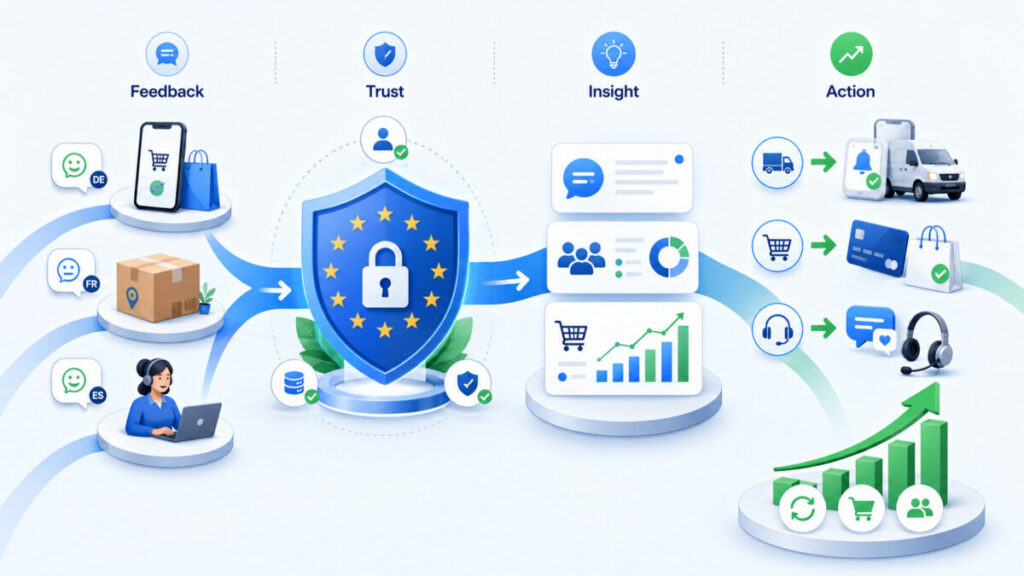
Local Voice of Customer ROI in European E-commerce

The ROI of Local Voice of Customer Strategies in European E-commerce

27.07.2026

Extracting valuable local customer insights to drive ROI is central to European e-commerce success, but the real challenge lies in balancing actionable data collection with strict GDPR requirements. Businesses cannot afford to treat Voice of Customer (VoC) as a generic initiative. Instead, they must localize VoC for each market’s language and cultural specifics, rigorously measure outcomes, and bake privacy compliance into every feedback touchpoint. This is no longer simply a legal necessity—it's also a powerful differentiator and trust lever.

This article outlines how European e-commerce leaders can operationalize local Voice of Customer strategies that maximize ROI and safeguard privacy. You'll find actionable frameworks for VoC measurement, clear guidance on GDPR compliance, as well as decision criteria for trade-offs that are often downplayed in mainstream commentary.

In brief

  • Localization of VoC is non-negotiable: Feedback must match local languages, cultural expectations, and purchasing behavior for real business impact.
  • ROI measurement should be disciplined and direct: Link VoC changes to KPIs (repeat rates, NPS, AOV) using robust attribution—not wishful thinking.
  • GDPR must underpin all VoC data flows: Embed data minimization, granular consent, and privacy-by-design, or risk trust and regulatory action.
  • Strategic integration is key: Connect VoC to behavioral and transactional analytics for closed-loop, iterative improvements.
  • Mature operationalization remains rare: Too many VoC programs generate siloed or unused data—focus on real-time insights, agile action, and continuous ROI tracking.

The Strategic Value of Localized Voice of Customer in European E-commerce

Directly engaging customers at a local level is no longer an optional layer in the feedback stack—it's the primary route to fresh insight, practical improvement, and sustainable ROI.

Why VoC Must Be Local

European e-commerce is anything but monolithic. Markets vary not only in language but also in shopping motivations, digital adoption, and even feedback norms. For instance, a “highly satisfied” customer in Sweden may use language and scoring patterns that map differently from shoppers in Spain or Poland. Running centrally scripted VoC programs across multiple countries leads to signal dilution and, ironically, can undermine both the quality of findings and customers' perception of the brand.

Localization involves more than translation. It means:

  • Designing surveys in native languages and idioms, based on input from local customer-facing teams.
  • Accounting for cultural norms, such as comfort with sharing negative feedback, or expectations about follow-up.
  • Adapting touchpoints to match behavioral patterns: In a market where most orders occur through mobile, mobile-optimized feedback channels are essential.

Tangible Business Impact

A robust local VoC program drives:

  • Higher retention: Addressing country-specific pain points keeps local customers coming back.
  • CX improvements rooted in reality: Local complaints or suggestions feed directly into journey mapping and operational adjustment.
  • Competitive differentiation: Brands seen as “listening” and acting locally stand apart, especially in crowded marketplaces.

Operational Enhancement

Localized feedback doesn't just add color to strategy decks; it enables sharper segmentation, refinement of local logistics and support, and, if shared cross-functionally, faster root-cause analysis. The downstream effect is operational agility—changes can be rolled out quickly to specific regions, intercepted preemptively, or tested with control groups.

When VoC is designed for local context, it shifts from a compliance-driven checkbox to a proactive driver of real-world business gains.

Quantifying ROI of Local Voice of Customer Initiatives

Measuring how local VoC moves the business needle means confronting the complex interplay between direct feedback and commercial results.

Key Metrics for Measuring VoC ROI

Robust VoC programs are disciplined in their measurement, selecting KPIs that directly reflect customer behavior and experience improvements:

  • Repeat purchase rate: Strong indicator of successful service recovery or CX optimization driven by local feedback.
  • Customer Satisfaction (CSAT) and NPS: If tracked at local levels, these metrics reveal whether market-specific actions drive perception and advocacy.
  • Churn reduction: Attrition rates before and after key initiatives, especially in subscription or replenishment models.
  • Average Order Value (AOV): Useful for assessing whether VoC-driven improvements are prompting larger baskets in certain regions.
  • Issue resolution time: Particularly where VoC is tied to service recovery close-looping.

The discipline lies in not only tracking these metrics, but also linking shifts directly back to VoC-generated insight and subsequent business changes.

Linking Feedback to Outcomes

This requires intentional data design:

  • Attribution tagging: Feedback must be clearly tied to specific customer segments, channels, and, where possible, actions taken.
  • Closed-loop documentation: When feedback prompts an intervention, record it—then track associated customer behaviors and future feedback cycles.

Methods for Attributing Revenue Uplift to VoC

There’s nuance (and skepticism) here. Attribution models commonly used include:

  • Pre–post analysis: Measure business outcomes before and after implementing VoC-driven changes within the same market segment.
  • Control/test groups: Run improvements for a localized “test” region while holding others steady, isolating VoC impact.
  • Regression analysis: For heavy data teams, statistical models can parse out the unique contribution of VoC interventions versus other concurrent changes.

Challenge: Correlation does not imply causation. In multi-channel, multi-market e-commerce, many variables influence outcomes. Mature teams supplement quantitative analysis with qualitative investigation—often through deep-dive customer interviews or journey stage mapping—to validate the root cause of observed changes.

Embedding GDPR Compliance in VoC Data Collection and Management

Local Voice of Customer programs must operate within the full rigor of GDPR. Compliance is not just a regulatory shield—it’s a substantial trust-builder with European consumers.

GDPR Principles Affecting VoC

Four core GDPR tenets are most relevant for VoC:

  • Lawful basis for processing: Usually explicit consent for customer feedback. Implied consent rarely suffices, especially when collecting open-text responses.
  • Informed consent: Customers must know exactly what data is being collected, how it will be used, and with whom it may be shared.
  • Storage limitation and data minimization: Collect only what you truly need—wide-ranging demographic questions or sensitive fields (health, ethnicity) add risk and require further justification.
  • Data subject rights: Customers have the right to access, rectify, and demand deletion of their feedback—even open-text comments.

Specific Challenges for VoC Programs

  • Open-text feedback: Free-form responses often include unsolicited personal or sensitive data, which must be identified, classified, and, if necessary, removed.
  • Sensitive personal data: Even “optional” fields can bring GDPR obligations if they touch on protected categories.

Compliance Practices and Privacy-First Design

Leading organizations embed GDPR alignment early in VoC program design:

  • Just-in-time notices: Display privacy information contextually, immediately before data collection—for each feedback channel.
  • Granular consent: Separate consents for contact, analysis, or sharing with partners—not just a blanket checkbox.
  • Secure processing: Ensure data collected through VoC platforms is encrypted at rest and during transfer, with controlled access.

Anonymized vs. Pseudonymized Feedback

  • Anonymization: Data no longer traceable to an individual. Lower regulatory risk, but limits follow-ups or closed-loop action.
  • Pseudonymization: Keys exist to re-identify (under strict controls); enables journey analysis, but raises the stakes on data leakage or misuse.

Trade-off: True anonymization offers compliance comfort but constrains business impact. Most mature programs use pseudonymization, strict access controls, and robust deletion processes to balance privacy with actionable insight.

Customer Trust Dividend

Few compliance practices are as visible as privacy-respectful VoC. Brands that over-communicate on data use, deletion rights, and privacy design move the conversation from risk to trust—a major advantage in privacy-conscious Europe.

Integrating VoC with E-commerce Analytics for Strategy Refinement

The real power of Local Voice of Customer comes from pairing it with the rich behavioral and transactional data already resident in e-commerce ecosystems.

Synthesis: The Practical Journey

Linking structured VoC data (survey scores, coded text themes) with user actions (cart abandonment, customer lifetime value, product returns) enables:

  • Customer pain point identification: For example, combining purchase drop-off analytics with post-abandonment survey comments to pinpoint site issues.
  • Differentiator discovery: When NPS drivers are tied to specific local fulfillment experiences, the business can double down on positive gaps versus competitors.
  • Barrier analysis: Mapping negative feedback to specific journey stages for targeted remediation.

Workflow for Iterative Improvement

The process at its best looks like this:

  1. Collect local VoC feedback across all high-impact touchpoints.
  2. Integrate this data with customer journey maps and transactional analytics.
  3. Identify and prioritize actionable insight clusters.
  4. Deploy targeted improvements (UX tweak, process change, communication fix) in select markets or segments first.
  5. Rapidly measure impact through business KPIs and renewed VoC cycles.
  6. Scale, refine, or retire interventions based on tracked ROI and customer response.

The net: This closed-loop approach fuses agile experimentation with disciplined measurement. Brands that treat VoC as an operational resource, not just a data silo, see the greatest strategic lift.

Trade-offs and Common Mistakes in Local VoC Implementation Under GDPR

Most e-commerce teams over-index on either localization, compliance, or operational efficiency—and make costly mistakes by underestimating trade-offs or complexity.

Pitfall 1: Over-Customizing vs. Standardizing Surveys

Too much localization, and survey data becomes fragmented—horizontal analysis across markets is impossible. Too little, and you lose local resonance, sacrificing response rates and insight accuracy.

What works: A modular approach, with core standardized questions plus a bank of locally relevant modules that reflect known differences in customer context.

Pitfall 2: Underestimating Language and Cultural Diversity

“Localized” does not just mean translating a survey. Idiomatic phrasing, right-sizing scales, and respecting cultural taboos are essential. Ignoring this leads to misunderstanding and survey fatigue.

Pitfall 3: Risks of Non-Compliance

  • Regulatory fines: Especially around open-text fields, where personal data may be unwittingly collected.
  • Erosion of customer trust: Data collection that feels invasive or non-transparent triggers opt-outs, negative reviews, even complaints to authorities.
  • Operational drag: Investigating, remediating, and reporting data breaches absorb enormous resources post-incident.

Pitfall 4: Failure to Operationalize Feedback

VoC data gathered but never used is wasted effort, and worse, damages internal credibility for future investment. Data should flow to all stakeholders, not just insights teams.

Pitfall 5: Feedback Depth vs. Privacy Preservation

Pushing for more detailed data may conflict with “data minimization.” Brands must interrogate whether each field or open-response prompt is essential, and be prepared to forego information that creates outsized risk.

Framework: Checklist for GDPR-Compliant, ROI-Focused Local VoC Programs

StepKey ActionsSuccess Criteria
Local context assessmentMap customer segments, behaviors, and journey stages by marketFeedback design tailored for each region’s reality
GDPR-compliant consentBuild modular consents tied to feedback types and usageAudit logs, revocation flows, clear privacy language
Feedback collection designStructure for standard/core + local/question modulesData harmonization, culture-fit phrasing, high response rate
Data integration & analysisConnect VoC with e-commerce and journey analyticsInsight flows to product, ops, and CX teams
Continuous improvementDeploy closed-loop tests, track impact, iterate per marketDocumented ROI gains, continuous feedback cycles
Compliance auditingSchedule regular audits, breach simulations, process reviewsNo major findings, ongoing adherence to GDPR updates

This checklist is an operational template for bridging the compliance–insight–ROI gap.

Transforming Local VoC Insights into Agile Business Decisions

VoC’s ultimate value lies in its ability to drive rapid, customer-informed changes across the e-commerce journey.

Real-Time Feedback Loops

Feedback shouldn’t disappear into spreadsheets. High-performing organizations route issue-specific signals from local customers directly to:

  • CX hotfix teams: For broken flows, confusing comms, or payment issues.
  • Product managers: For regionally-specific pain points or feature gaps.
  • Customer care: For swift recovery actions (personalized outreach, refunds, apologies).

Fast VoC-to-Action Examples

  • Post-purchase friction: Immediate escalation of negative delivery feedback in a specific country triggers a localized logistics partner review that same week—reducing complaint volumes on subsequent deliveries.
  • Catalog localization: Negative comments on sizing or description ambiguities in a particular language are automatically flagged, leading to prioritized content updates within days, not months.
  • Checkout abandonment: Open-text reasons for drop-off, when paired with analytics, inform a test of simplified payment options in the affected market, tracked minute-by-minute over the first week.

Measuring Speed and Impact

  • Lag time from feedback to action: Shorter cycles correlate with higher customer satisfaction, especially when explicit acknowledgment or closure communication is provided.
  • Quantified uplift: Immediate pre–post tracking of abandonment, CSAT, repeat rates, and associated attribution to localized VoC-driven interventions.

When local Voice of Customer data is routed into agile business decision workflows—rather than annual reviews—the ROI becomes both visible and sustainable.

FAQ

How does GDPR specifically impact Voice of Customer programs in European e-commerce?

GDPR requires that all customer feedback—especially open-ended responses—be collected with explicit, informed consent that is easily revocable. Organizations must offer privacy notices at the point of data capture, limit storage duration, and allow customers to access or request deletion of their responses. Open-text feedback commonly includes personally identifiable or sensitive data, raising the bar for classification, minimization, and controlled access.

What’s the best way to measure the ROI of local VoC initiatives?

ROI measurement hinges on linking VoC-driven improvements to market-level KPIs. Key metrics include: repeat purchase rates, CSAT or NPS by region, churn rates, average order value, and turnaround time for issue resolution. Reliable methods are pre–post comparisons, control/test group experimentation, and multivariate analysis to isolate the impact of VoC initiatives amidst other business changes.

How can companies localize VoC programs without creating data silos?

Use a hybrid approach: standardize core survey elements across markets, then layer on local questions based on journey mapping and in-market insights. Harmonize data structures and taxonomies so all feedback can be analyzed both locally and globally. Data governance teams must establish processes for unified reporting and cross-market insight sharing, under strict compliance controls.

What are best practices for obtaining and managing consent in VoC feedback?

Implement just-in-time privacy notices, clear language around data use, and granular consent options (for feedback, follow-up, research). Provide easy ways for customers to review and revoke consent. Store consent logs and consent withdrawal flows for auditability, and regularly review privacy policies to match evolving regulatory interpretations.

Are anonymized surveys enough to guarantee GDPR compliance in VoC?

Anonymized surveys reduce some regulatory risk, but are not a complete solution—especially if surveys still include open-text fields where re-identification is possible. Rights such as access and deletion may still apply if data can be linked back to an individual, even indirectly. Complete compliance requires attention to process, governance, and deletion rights across all data classes.

What trade-offs exist between collecting detailed feedback and ensuring privacy?

The more granular or open-ended the feedback, the higher the privacy risk and compliance workload. Highly detailed data enables better root-cause and segment analysis, but increases the risk of capturing sensitive information. Best practice is a privacy-by-design approach: ask only for what’s essential, use pseudonymization or strict access controls, and balance insight depth with data minimization.

Key Takeaways

Understanding how to optimize the Local Voice of Customer (VoC) in European e-commerce is essential for boosting ROI while adhering strictly to GDPR requirements. The following takeaways illuminate how to balance effective customer feedback strategies, regulatory compliance, and measurable business outcomes.

  • Prioritize local context for actionable VoC insights: Customizing Voice of Customer programs to local cultures and languages leads to richer, more relevant feedback, directly impacting conversion rates and long-term customer loyalty.
  • Quantify ROI of VoC initiatives for clear business value: Rigorous measurement of VoC impact—linking feedback to specific KPIs such as repeat purchases, customer satisfaction scores, and reduced churn—enables precise calculation of ROI from local initiatives.
  • Embed GDPR compliance at every data touchpoint: Integrate GDPR principles into VoC data collection by ensuring informed consent, secure storage, and transparent processing, turning compliance into a customer trust advantage rather than a compliance burden.
  • Leverage e-commerce analytics to drive VoC strategy refinement: Cross-referencing VoC data with e-commerce analytics uncovers trends in purchasing behavior and customer pain points, powering iterative improvements in products and CX.
  • Adopt privacy-first feedback mechanisms to maximize participation: Employ privacy-conscious survey designs and anonymized data practices, which increase response rates and build trust without compromising GDPR compliance.
  • Transform VoC insights into agile business decisions: Use real-time VoC feedback to rapidly optimize site experience, product offerings, and support, delivering higher ROI through timely, customer-driven improvements.

These insights equip e-commerce leaders to harness local Voice of Customer programs effectively—balancing data privacy with business impact.

Other posts:

SHOW OTHER POSTS

Copyright © 2023. YourCX. All rights reserved — Design by Proformat

linkedin facebook pinterest youtube rss twitter instagram facebook-blank rss-blank linkedin-blank pinterest youtube twitter instagram