


- Research platform
Sources of information
Data analysis
Actions

- Solutions
For whom
Problems / Issues

- Materials
Materials
- About us
About us
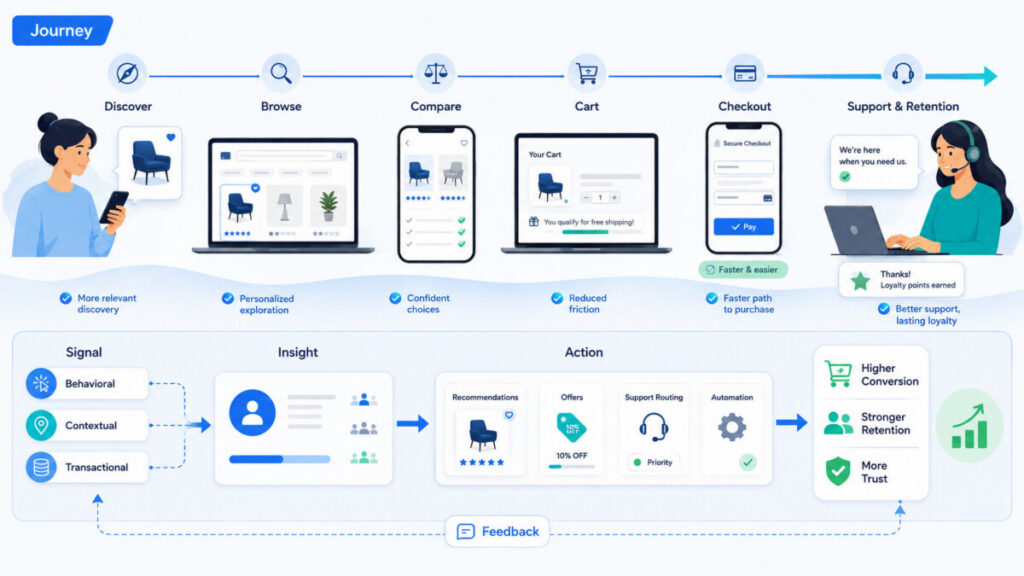
AI in e-commerce is fundamentally reshaping how online retailers understand, serve, and convert customers. At the core, artificial intelligence enables businesses to personalize at depth, automate at scale, and adapt in real time—raising conversion rates and customer satisfaction while better aligning business operations with actual customer needs. This article examines how AI-driven customer personalization and automation are setting a new standard in digital retail, with a precise look at technologies, strategies, decision pitfalls, and frameworks for intelligent implementation.
AI in e-commerce is the deployment of intelligent algorithms and technologies, such as machine learning, natural language processing (NLP), and recommendation engines, throughout the digital commerce journey. These systems ingest vast data streams—from browsing clicks and search queries to purchase history and real-time context—and interpret patterns that would be impossible for humans to track at scale.
Personalization vs. Customization: In e-commerce, these are often blurred, but the distinction is critical. Customization lets users manually express preferences—think filter controls or wishlists. Personalization, by contrast, means the system dynamically adapts the experience for the user, surfacing relevant products, offers, and content based on inferred intent, preferences, and micro-context.
What’s powerful about AI is its ability to integrate both behavioral data (what customers do), contextual data (where, when, and how they interact), and technical data (device, channel, system signals) to bridge the gap between what users say they want and what they actually do—moving beyond basic rules to precise, intent-driven experiences.
Impact:
Yet, without the right data infrastructure and governance, AI-enabled personalization can veer into irrelevance, bias, or even privacy risk, making implementation discipline as important as technical capability.
Hyper-personalization is only as strong as the data behind it. Leading online retailers no longer settle for generic segment data (age, location, gender); they build unified customer profiles using a blend of:
To orchestrate this, robust data pipelines consolidate raw touchpoint streams into actionable profiles. Modern Customer Data Platforms (CDPs) are the operational backbone, blending online and offline signals, resolving identities across devices, and powering downstream decisioning engines. For enterprises, connecting these dots is nontrivial—requiring investment in data quality, stitching, and privacy-safe architecture.
Recommendation engines are the most visible face of AI in e-commerce—and still one of the most potent. Their power lies in:
Iconic platforms like Amazon elevated their conversion rates by deploying ever-more sophisticated recommendation layers: personalized carousels, “Inspired by your browsing history,” and real-time deal surfacing. While smaller retailers rarely have Amazon’s proprietary tech, plug-and-play SaaS engines now offer the core capacities—if fed quality data.
Personalization doesn’t stop at recommendations. AI dynamically adapts content blocks, banners, and offers across:
Done well, this deepens relevance and raises conversion. But over-personalization or “creepy” triggers can erode trust—especially if the logic isn’t transparent or the data signal is weak.
AI isn’t just about the end-customer interface—it’s just as transformative behind the scenes.
AI-powered automation in marketing replaces guesswork with precision, shrinking the gap between insight and action.
The performance impact is twofold: engagement rates rise (since content is more relevant); manual intervention drops (as machines learn and adjust campaigns autonomously).
Operational AI runs in the background, but its impact is felt at the checkout.
For retailers, these capabilities mean fewer manual bottlenecks, lower operational costs, and agile adaptation to shifting consumer patterns.
Support bots have shifted from basic FAQs to conversational assistants that can:
The best systems do not simply react, but anticipate—preemptively guiding customers before friction builds. Yet, human-in-the-loop handoffs remain crucial for loyalty moments and complex issues.
Static journeys leave money on the table. AI’s real advantage is its ability to optimize in real time:
Consider this scenario: A major retailer integrates an AI-driven engine that detects when a shopper hesitates at checkout. Instantly, a just-in-time incentive appears, tailored to their recent behavior—raising conversion rates measurably, not just marginally.
For mature teams, these systems power closed-loop feedback cycles. Customer actions inform immediate model retraining; outcomes (conversion lifts, abandonment reductions) are measured obsessively against control groups. Incremental gains here compound into significant revenue shifts.

Traditional segmentation—age, gender, location—is background noise to modern AI models. Deep segmentation now captures:
By forecasting purchase timing and propensity, AI empowers marketing to focus firepower where impact and ROI are highest—not just where volume looks tempting.
AI-enabled platforms aren’t just segmenting—they’re also closing the loop on what really works.
This data discipline enables more efficient spending, faster learning, and sharper allocation of resources—especially in fragmented media environments.
While the advantages of AI-powered personalization and automation in e-commerce are clear, implementation isn’t a “set and forget” exercise.
Build vs. Buy:
Data privacy and compliance:
Cost, scalability, and integration:
Trade-off: Effective AI in e-commerce demands not only technical fit, but strategic alignment with brand, customer promise, and service model.
Even sophisticated teams can falter. Frequent mistakes include:
Too much adaptation can backfire—creepy offers, “stalker” retargeting, or irrelevant auto-suggestions that don’t match true intent. Customer trust is eroded when signals overstep boundaries.
If the training data is homogenous or incomplete, AI will perpetuate skewed outcomes—pushing products, offers, or experiences that only serve a subset of customers well.
Automated decisions without active management can lead to out-of-control campaigns, embarrassing errors, or insensitive responses in a crisis.
AI systems that don’t learn from ongoing customer feedback or VoC signals stagnate—causing personalization to degrade over time rather than improve.
A pragmatic approach is to audit where your e-commerce operation sits on the AI maturity curve:
| Capability Layer | Maturity Signals | Key Questions |
|---|---|---|
| Readiness | Unified data model, privacy policies | Is data architecture fit for purpose? Is governance in place? |
| Insight Generation | Multivariate personalization, propensity modeling | Are recommendations, segmentation, and triggers AI-driven and explainable? |
| Operationalization | Automated campaign/supply workflows | Is automation integrated in both marketing and back office? |
| Measurement | Granular KPIs, iterative A/B testing | Are results analyzed for true impact vs. noise? |
| Continuous Improvement | Feedback loops, human oversight, bias checks | How are lessons applied from customer signals and exceptions? |
Checklist for leaders:
Brands that mature along these axes tend to see multiplying returns—not only in higher conversions, but also in customer lifetime value, richer journey analytics, and, ultimately, competitive defensibility.
AI empowers e-commerce companies to deliver individualized recommendations, tailor content, and orchestrate seamless journeys at scale. By mining behavioral, contextual, and transactional data, AI discerns what each customer actually wants—often before they articulate it—and adjusts interactions in real time. This data-driven cycle increases relevance, raises conversion rates, and narrows the gulf between what customers experience and what they expect.
AI automation in e-commerce touches inventory forecasting, dynamic pricing, campaign deployment, and customer support. For instance, AI systems can predict which products are likely to spike in demand, auto-adjust prices to stay competitive or protect margins, launch targeted campaigns to relevant segments, and power chatbots that resolve basic or complex queries—freeing up human capacity for value-added tasks.
Striking the right balance is essential: monitor for overpersonalization that turns helpfulness into intrusion, ensure data is diverse and representative to avoid algorithmic bias, build in robust privacy controls, and maintain routine human checks on automated decisions. Furthermore, connect AI interventions with customer feedback loops so that the system continually evolves in step with shifting expectations and sentiment.
Absolutely. The emergence of cloud-based SaaS tools allows even smaller businesses to access sophisticated AI capabilities without massive upfront investment. These platforms offer modular recommendation engines, automated campaign tools, and chatbot solutions that scale with business growth. The key is to prioritize integration with the core tech stack, ensure data hygiene, and calibrate the scope of personalization to match operational resources.
Results are best tracked through a layered approach:
Sustained measurement, benchmarking, and calibration distinguish mature AI deployments from trial-and-error initiatives.
AI in e-commerce is no longer about isolated use cases—it underpins the entire journey, from the first pixel of a landing page to automated support and replenishment. The ability to personalize at depth, automate intelligently, and adapt in real time means higher conversions, leaner operations, and—when governed well—stronger trust and loyalty. But the biggest wins accrue to teams that pair technical ambition with measurement discipline, regulatory vigilance, and customer-centric feedback loops.
As AI’s capabilities proliferate, the dividing line won’t be between who “has AI” and who doesn’t—it will be between those who operationalize it for customer value and business intelligence, and those who bolt it on as a surface enhancement. The future of e-commerce belongs to the former.
Copyright © 2023. YourCX. All rights reserved — Design by Proformat
