


- Research platform
Sources of information
Data analysis
Actions

- Solutions
For whom
Problems / Issues

- Materials
Materials
- About us
About us
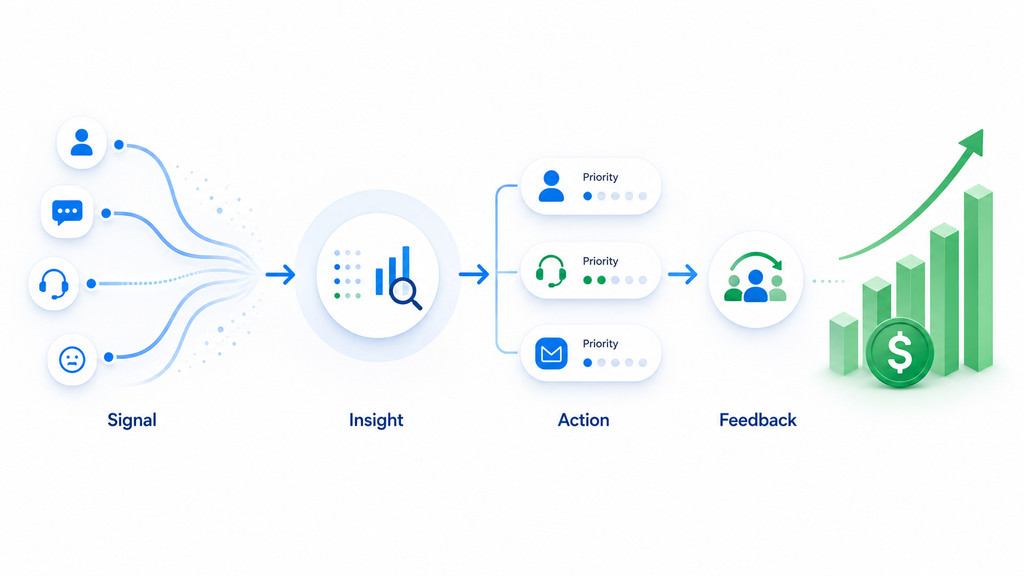
AI in customer experience creates measurable ROI when customer data leads to a better decision, that decision changes customer or employee behavior, and the change produces a financial outcome. The relevant chain is:
customer data → AI insight → operational intervention → behavioral change → financial result
Organizations should therefore measure retention, conversion, expansion, cost to serve, productivity, and customer lifetime value—not automation activity alone.
Common AI activity metrics include:
These measures indicate adoption and operational readiness, but they are not ROI. A recommendation can be accepted without improving conversion. A chatbot can contain contacts while increasing repeat contacts or customer effort. Agent assist can reduce handle time while lowering resolution quality or increasing escalations.
AI in CX ROI measures the financial value created by AI-supported decisions and interventions. Value may appear as:
AI is an enabling capability, not an outcome. It creates value only when integrated into journey design, service delivery, feedback management, and commercial decisions.
A practical CX program should document the full path from signal to value:
For example, a model may identify churn risk from declining usage, unresolved cases, and reduced engagement. The insight becomes financially meaningful only when it triggers a relevant intervention and retention improves relative to a valid comparison group.
This chain also reveals common gaps: sentiment analysis without issue ownership, propensity scores disconnected from frontline workflows, or friction insights with no mechanism for process improvement.
Strong AI in CX business cases often combine:
These outcomes are not interchangeable. Retained revenue differs from new revenue, and reduced handle time differs from realized labor savings. Higher NPS may indicate better relationship quality, but should not be converted into financial value without a validated behavioral link.
Churn models use behavioral, transactional, service, and engagement data to identify weakening relationships. Signals may include declining usage, missed payments, unresolved complaints, reduced purchase frequency, lower engagement, or repeated service failures.
The model creates value when it leads to a differentiated response, such as:
Measure incremental retention, revenue retained, intervention and offer costs, and false-positive impact. Offers to customers who would have stayed anyway can destroy margin, while generic or intrusive interventions can increase fatigue and reduce trust.
Personalization uses customer segments, intent, history, and real-time context to tailor content, recommendations, routing, offers, and service interactions. The goal is a more relevant and useful interaction—not the maximum number of personalized experiences.
AI may determine:
Compare incremental conversion, order value, repeat purchase, or retention with personalization costs. Control groups are important because high-intent customers may convert without the intervention. Also monitor fatigue, irrelevant offers, inconsistent treatment, trust, and long-term lifetime value.
Agent-assist tools can provide knowledge retrieval, response recommendations, case summaries, next-step guidance, and quality support. Value depends on workflow design and knowledge management as much as the model.
Use a balanced scorecard including:
A shorter interaction that fails to resolve the issue is not an efficiency gain. It may shift cost into a second contact, escalation, complaint, or lost relationship.
Include integration, training, human review, knowledge-base maintenance, monitoring, and change management in the business case. Distinguish direct labor savings from capacity gains. Additional capacity becomes financial value only when it supports more volume, redeployment, avoided hiring, or a documented budget reduction.
AI can analyze surveys, transcripts, reviews, social feedback, complaints, and open-text responses to detect:
Value is usually indirect. A recurring theme may lead to a product change, process improvement, clearer communication, or better service recovery. Measure ROI by linking the insight to an intervention and outcomes such as fewer complaints, lower repeat contact, improved retention, or increased usage.
VoC should not end with a dashboard. Assign issue owners, escalation thresholds, corrective actions, and feedback loops. Monitor classification errors, biased feedback, and language changes that can distort trends.
Next-best-action systems recommend the most relevant service, education, offer, or product action for a customer’s context. Recommendations should consider:
The best action may not be a sale. It could resolve an open issue, increase adoption of an existing product, or prevent an avoidable contact.
Measure incremental revenue, acceptance, order or account value, downstream service cost, and long-term relationship effects. High acceptance can be misleading if recommendations create low-margin sales, complaints, or cancellations.
Relevant data may come from:
Resolve duplicate identities and define whether the customer, household, account, or user is the analysis unit. Document freshness, completeness, consent, source systems, and ownership. A prediction based on stale or incomplete data can be confidently wrong; data quality is therefore part of the ROI case.
AI supports three levels of analysis:
Useful insights include intent, churn risk, sentiment, friction, purchase propensity, and expansion potential. Each should include appropriate confidence information, relevant explanation factors, and a recommended intervention.
A risk score without an action rule is unlikely to create value. Define thresholds, owners, response times, and procedures for uncertainty.
Insights should appear where decisions are made: CRM, contact-center desktops, case-management systems, marketing platforms, product workflows, or digital journey tools. Each workflow should specify:
This closes the insight-to-action gap and reduces employee context switching and duplicate entry.
Track whether the intervention changed behavior relative to a baseline or control. Include customer, operational, experience, and financial outcomes.
Feed results back into the system. Overrides, complaints, failed interventions, and unexpected behavior may reveal issues with the model, knowledge source, workflow, or assumptions about customer needs.
| Metric layer | Example measures | What it tells you |
|---|---|---|
| Adoption | Usage, recommendation acceptance, automation, agent utilization | Whether the capability is being used |
| Operational | Handle time, first-contact resolution, cost per contact, backlog, escalations | Whether processes are changing |
| Experience | CSAT, NPS, effort, sentiment, complaints, resolution quality | Whether CX is improving |
| Behavioral | Retention, renewal, conversion, repeat purchase, expansion, channel migration | Whether customer behavior is changing |
| Financial | Retained revenue, incremental revenue, validated savings, lifetime value, payback | Whether value is being created |
No layer is sufficient alone. Define primary, diagnostic, and financial metrics and how they relate to the use case.
ROI = (financial benefits − total AI costs) ÷ total AI costs × 100
Financial benefits may include:
Apply contribution margins when using revenue. Report gross benefit, net benefit, ROI percentage, and payback period separately.
Reduced handle time is not automatically a saving. If staffing or vendor fees remain unchanged, it may represent capacity. Count it as financial value only when capacity supports additional volume, redeployment, avoided hiring, or a documented budget reduction.
Include:
Separate one-time implementation costs from recurring operating costs, and update assumptions as usage, pricing, model requirements, and governance obligations change.
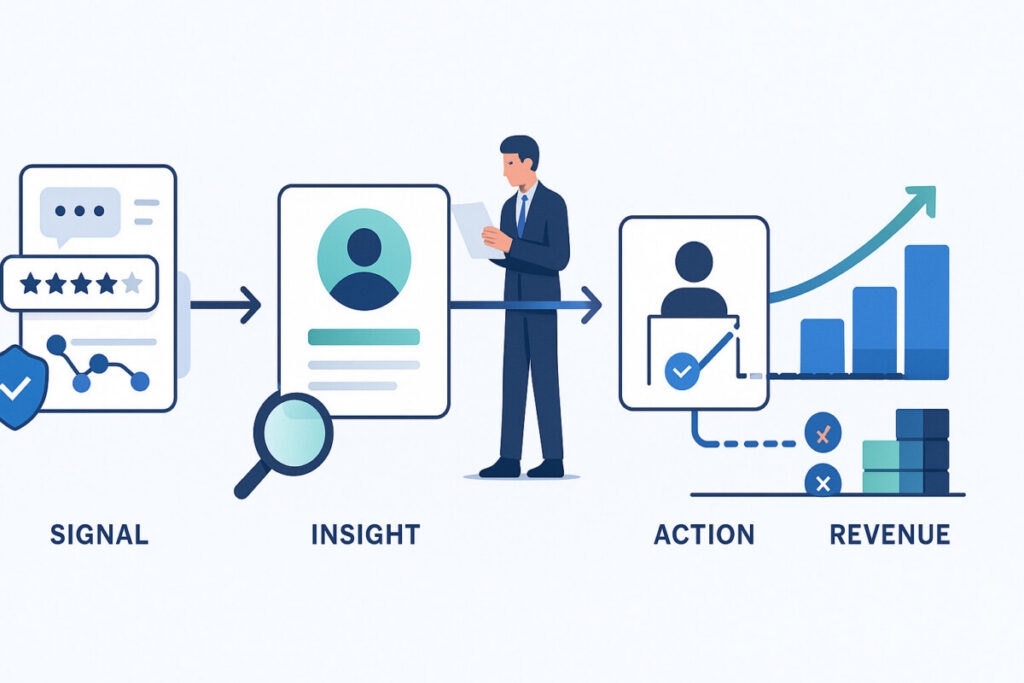
Capture pre-AI performance by segment, channel, product, and service use case. Account for seasonality, promotions, pricing, staffing, and market conditions. Define the measurement period and attribution window before launch.
Randomly assign eligible customers or interactions to treatment and control groups where possible. For personalization, retention, and next-best action, maintain holdouts.
If randomization is impractical, use geographic groups, account cohorts, time-based comparisons, or matched cohorts. These are less robust but can improve decision quality when carefully designed.
Possible methods include:
The aim is to separate AI influence from agent behavior, campaigns, seasonality, market changes, and unrelated improvements. A favorable post-launch trend does not prove causation.
Compare outcomes by value tier, tenure, channel, product, geography, and risk level. Assess whether the model performs differently across groups and whether gains in one segment create cost or experience degradation elsewhere.
Fairness, accessibility, and service quality are part of the business case. Short-term conversion gains do not justify inappropriate exclusion or poorer service for another group.
Prioritize use cases by:
| Use case | Value potential | Time to impact | Data maturity | Main complexity | Key risk |
|---|---|---|---|---|---|
| Churn prediction | High when retention value is material | Medium | High | Connecting scores to retention workflows | False positives and irrelevant offers |
| Personalization | Medium to high | Medium | Medium to high | Coordinating data, content, and channels | Fatigue and inconsistent treatment |
| Agent assist | Efficiency and quality | Fast to medium | Medium | Knowledge integration and adoption | Incorrect guidance |
| VoC analysis | Indirect but broad | Medium to long | Medium | Linking themes to owners and actions | Misclassification |
| Next-best action | High for expansion and retention | Medium | High | Eligibility, timing, and orchestration | Over-selling and trust erosion |
The best starting point is measurable, actionable, financially material, and relatively low risk. Select one priority journey, segment, or workflow rather than deploying enterprise-wide.
Define the target outcome, intervention, owner, baseline, control method, and success threshold. Scale if economics and experience are validated, redesign if results are mixed, and stop if incremental value is absent.
Embed recommendations in existing employee systems. Assign owners and service-level expectations, and minimize context switching and duplicate entry.
Use human oversight for high-value, sensitive, ambiguous, or emotionally charged interactions. Define when employees may accept, modify, or reject recommendations, and record override reasons to improve models, rules, knowledge, and training.
Monitor for:
Create escalation paths for cases requiring judgment or recovery. Efficiency must not replace resolution quality and trust.
CX, operations, analytics, finance, IT, risk, and product teams should regularly review customer outcomes, employee feedback, complaint themes, overrides, and ongoing economics.
Resolve incomplete profiles, duplicate records, inconsistent attributes, and stale data. Define source systems and data owners, and monitor drift as products, behavior, and channel usage change.
Use data only for documented purposes and approved permissions. Apply access controls, retention rules, minimization, and audit trails. Assess how vendors handle customer data, prompts, inputs, and derived insights.
Provide understandable reasons for scores and recommendations when they affect customer treatment. Test for disparate outcomes and review biased data, feedback, or model behavior.
Assign owners for model performance, customer impact, security, and ROI reporting. Set thresholds for accuracy, drift, escalation, and financial performance. Document costs, benefits, assumptions, experiments, attribution methods, and scaling decisions.
Automation rate and chatbot volume show activity, not value. Verify effects on resolution, retention, conversion, and cost per contact, including repeat contacts, transfers, complaints, and escalations.
Reduced handle time is not automatically a labor saving. Assess rework, quality, escalations, adoption costs, and how capacity will be redeployed. State whether the benefit is a budget reduction, increased throughput, or revenue capacity.
Do not expand based on correlation or favorable aggregate trends. Require control evidence, stable data quality, repeatable economics, and segment-level validation.
Balance conversion with relevance, fatigue, complaints, retention, lifetime value, vulnerability, and brand risk.
Integration, governance, human review, maintenance, monitoring, and change management can materially reduce ROI. Track one-time and recurring costs separately.
Map priority journeys, pain points, revenue leakage, and service costs. Identify data, decision points, owners, and root causes. Quantify the baseline opportunity before selecting technology.
Define target metrics, financial assumptions, attribution window, and success threshold. Establish treatment, control, holdout, or matched-cohort methods, with clear reporting responsibilities.
Integrate the insight into one workflow with human oversight. Train employees and document exceptions, overrides, and escalation handling. Monitor adoption, quality, customer response, and early financial signals.
Compare incremental results with the baseline and control group. Recalculate ROI using actual costs and benefits. Scale only when customer, operational, risk, and financial criteria are met.
Maintain model monitoring, retraining, governance, and value reviews. Refresh assumptions as behavior and economics change. Retire or redesign capabilities that no longer produce measurable value.
AI identifies intent, friction, sentiment, churn risk, and opportunity at scale. When these insights trigger relevant service recovery, personalization, proactive support, or workflow improvements, they can increase retention and conversion while reducing avoidable service costs. ROI depends on linking insight to action and outcome.
Use:
ROI = (financial benefits − total AI costs) ÷ total AI costs × 100
Benefits may include incremental, retained, and expansion revenue and validated savings. Costs include software, integration, data preparation, training, governance, human review, monitoring, maintenance, and operations.
Churn prediction, personalization, agent assist, VoC analysis, and next-best action are strong candidates. Prioritize the use case with clear data, an actionable workflow, measurable outcomes, manageable risk, and sufficient financial value.
Organizations can convert sentiment, intent, friction, behavioral, and usage signals into proactive service, tailored offers, workflow changes, or product improvements. Customer outcomes, overrides, complaints, and failed interventions should feed back into models and processes.
Establish a pre-launch baseline and use controls, holdouts, matched cohorts, difference-in-differences, or another suitable attribution method. Define the attribution window in advance and account for seasonality, campaigns, pricing, staffing, and market conditions. Analyze results by segment, not only in aggregate.
Poor data, duplicate identities, weak adoption, inaccurate recommendations, hallucinations, privacy failures, bias, model drift, customer fatigue, and incomplete cost accounting can reduce ROI. Controlled pilots, human escalation, governance, monitoring, and regular financial validation help manage these risks.
AI in customer experience creates ROI when customer insights change decisions and those decisions produce better customer and business outcomes. The most credible programs connect predictive analytics and feedback intelligence to service design, journey execution, commercial action, and closed-loop measurement.
Organizations should begin with a focused use case, establish a baseline and control method, integrate insight into an accountable workflow, and calculate benefits against the full cost of ownership. Done rigorously, AI in CX can demonstrate revenue growth, retained revenue, expansion, lower cost to serve, and stronger customer lifetime value—not merely automation activity.
Copyright © 2023. YourCX. All rights reserved — Design by Proformat
