


- Research platform
Sources of information
Data analysis
Actions

- Solutions
For whom
Problems / Issues

- Materials
Materials
- About us
About us
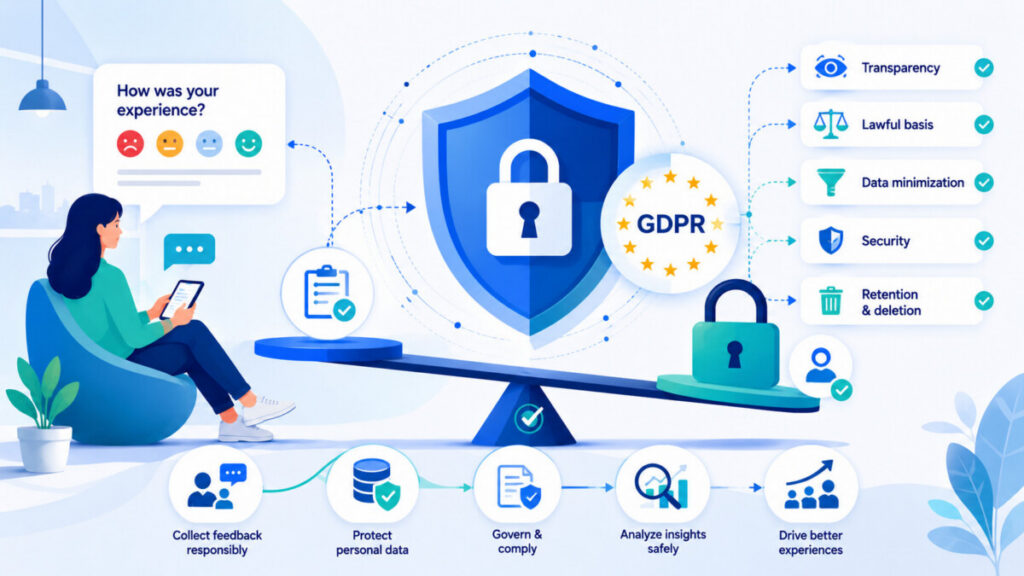
The increasing regulatory scrutiny on data privacy—especially under the EU General Data Protection Regulation (GDPR)—means that collecting rich Voice of Customer (VoC) insights is no longer just about surveying and analyzing. It’s about designing feedback operations that are not only actionable, but also fully privacy-compliant. For data protection officers, CX professionals, marketers, and compliance leads, the core challenge is this: how do you collect, process, and use customer feedback without risking privacy violations that can damage trust and reputation?
Below, we break down GDPR’s specific implications for VoC programs, unpack essential strategies for data minimization and lawful processing, and examine how advances in customer data technology create both risks and vital governance opportunities.
GDPR is not a general IT protocol; it’s a regulation with teeth, designed to give EU residents meaningful control over their personal data. Yet the implications for customer feedback programs—long regarded as goldmines for customer-centric decision-making—run deeper than many realize.
Three foundational GDPR principles directly impact how organizations collect and use customer feedback:
VoC programs frequently combine structured (ratings, drop-downs) and unstructured (comments, voice recordings) data—each with different risk profiles. Unstructured feedback can trigger unexpected exposure of personal or even special-category data, escalating legal responsibilities. Robustly documenting what feedback is collected, how it is processed, and under what grounds is essential for both auditability and accountability.
Achieving GDPR compliance in customer feedback starts before the first response arrives. Privacy by design—the requirement to embed privacy controls throughout the data lifecycle—must be visible from form field selection to data retention settings.
Instead of asking: > “Please provide your name, email, order number, and any comments about your experience.”
Ask: > “Please provide your order number (required). Share any comments on your experience (do not include personal identifiers).”
The placement and content of privacy notifications matter. A short, plain-language notice before feedback submission clarifies:
Pro tip: Test privacy notices with real customers for clarity; regulatory compliance is not synonymous with customer comprehension.
GDPR compliance and customer trust go hand in hand. Customers who understand and agree with how their feedback will be used are more willing to share candid insights—and less likely to object if contacted later for follow-up.
Be explicit—both before and after collecting feedback—about how responses will be stored and for how long. Avoid open-ended retention (“for as long as necessary”); instead, define specific timeframes or review processes.
For example: > “Your feedback will be stored securely for up to 12 months, then deleted. It will only be used to improve your experience and will not be shared outside our company.”
Auditability is a GDPR cornerstone. For every VoC process:
Regulators (and customers exercising their rights) expect to see clear audit trails.
Providing control mechanisms—such as view/delete request portals or self-service consent management—does more than tick compliance boxes. It signals respect for customer agency and can differentiate the brand’s VoC program in competitive markets.
Complex organizations are turning to Customer Data Platforms (CDPs) to unify and govern customer feedback data. But a CDP is not a compliance panacea; its effectiveness depends on implementation and integration with CX priorities.
A CDP centralizes all customer-related data (including feedback) from multiple sources. This centralization enables data stewards to:
CDPs typically use identity resolution—algorithmically linking customer data from surveys, transactions, digital channels, etc.—to create a unified profile. At their best, these solutions reduce duplicate or fragmented feedback records, lowering the risk of processing inconsistencies or privacy breaches.
However, over-aggressive identity stitching can inadvertently combine data beyond lawful use cases or retention limits, so controls are essential.
A robust CDP provides:
This is invaluable when regulators audit VoC operations or when customers request a copy or deletion of their feedback history.
Consent is the lawful basis most often relied upon for VoC programs. But “click to proceed” checkboxes without context or an opt-out link buried in the fine print do not satisfy GDPR.
Best-in-class feedback surveys employ:
For Voice of Customer touchpoints within ongoing digital journeys (such as in-app NPS prompts), embedding consent dialogs that map to specific survey instances is crucial for retroactive audit compliance.
GDPR requires not only easy opt-in but also frictionless opt-out and consent withdrawal. Mechanisms should include:
Every consent action—whether granted, denied, or modified—must be timestamped and tied to the customer’s unique identifier (not a loose session token) for inspection if challenged by regulators.
The operational challenge is clear: How do you collect enough detail to drive meaningful CX improvement, while retaining only what is strictly necessary?
Not all VoC data is equal. Some metrics, like NPS scores, can be anonymous. Others, like closed-loop case management, require identifiers for follow-up. The key is evaluating—not assuming—necessity for each feedback element.
Ask: Does this field drive a meaningful, testable business action? Or is it a “nice-to-have” born from legacy surveys or internal inertia?
A practical method:
| Data Field | Action Enabled | Legal Basis Needed | Retention Period | Risk Level |
|---|---|---|---|---|
| Email Address | Follow-up, Service Recovery | Consent | 30 days (then anonymized) | Medium |
| Order Number | Link to Transaction | Legitimate Interest | 90 days | Low |
| Free Text | Root Cause Discovery | Consent | 60 days (review for PII) | High |
Recommendation: Review each data field in your VoC program quarterly; remove or further restrict those that fail the “actionability” test.
The administrative overhead of GDPR can be daunting. Automation—thoughtfully applied—not only drives efficiency but also reduces the risk of human error.
DSARs (Data Subject Access Requests) for feedback data can be time-intensive if managed manually, especially when feedback exists in siloed systems.
Modern VoC and CDP platforms now offer:
Integrating DSAR workflows directly into VoC platforms (not just broader CRM tools) is vital. This ensures:
Best-in-class platforms provide:
Automation does not eliminate the need for human oversight, but it does turn episodic compliance fire-fighting into a steady, defensible process.
Real-world experience reveals key decision points and recurring pitfalls that differentiate mature, compliant programs from risky or ineffective efforts.
Many public enforcement actions have stemmed not from malicious intent, but from overlooked processes: a survey tool logging extra device identifiers, or responses retained long past their business use. Effective mitigation starts with mapping every data flow and building rapid, repeatable incident response procedures.
GDPR compliance is not a one-time checkbox. Regulatory expectations—and customer attitudes—are moving targets.
True future-proofing means building compliance as an active function, not a reactive one.
For data protection officers and CX leaders, operationalizing GDPR compliance in feedback collection requires systematic discipline—below is a practical, stepwise checklist.
| Feature/Control | Legacy Survey Tool | Modern VoC Platform | Integrated CDP |
|---|---|---|---|
| Field-level Minimization | Optional/Manual | Built-in Prompts | Enforced by Rules |
| Consent Management | Basic/None | Granular, Auditable | Centralized Registry |
| DSAR Automation | Manual Export | Automated Flow | Full-Orchestration |
| Retention Enforcement | User-Defined | Automated Deletion | Policy-Driven Purge |
| Audit Trails | Fragmented/None | Session-based Logs | Complete Lineage |
Adopt privacy-by-design principles—design every feedback form and channel with minimal data collection, explicit consent, and transparent data usage statements. Use secure, centralized systems to store and process responses, and regularly review data handling against GDPR requirements.
Risks include collecting unnecessary or sensitive PII, obtaining insufficient or non-compliant consent, retaining data longer than justified, failing to audit data access, and lacking rapid response to data subject rights requests.
CDPs help by centralizing all feedback data, tracking lawful basis and consent at a granular level, supporting identity resolution without overexposure, and generating audit trails of data usage and access for compliance checks.
Offer clear, explicit opt-in checkboxes (not pre-ticked), present granular choices for specific data uses, enable easy withdrawal or amendment at any stage, and maintain time-stamped records of all consent actions linked to each feedback instance.
Leverage automated workflows within feedback and data management platforms to quickly fulfill requests for data access, rectification, erasure, or restriction. Ensure that all feedback-linked data is included in searches and that actions are logged for audit purposes.
At least twice a year—or whenever adding new feedback tools, channels, or processing workflows. Regular, structured audits and policy updates are critical for ongoing compliance given regulatory and business changes.
Copyright © 2023. YourCX. All rights reserved — Design by Proformat
