


- Research platform
Sources of information
Data analysis
Actions

- Solutions
For whom
Problems / Issues

- Materials
Materials
- About us
About us
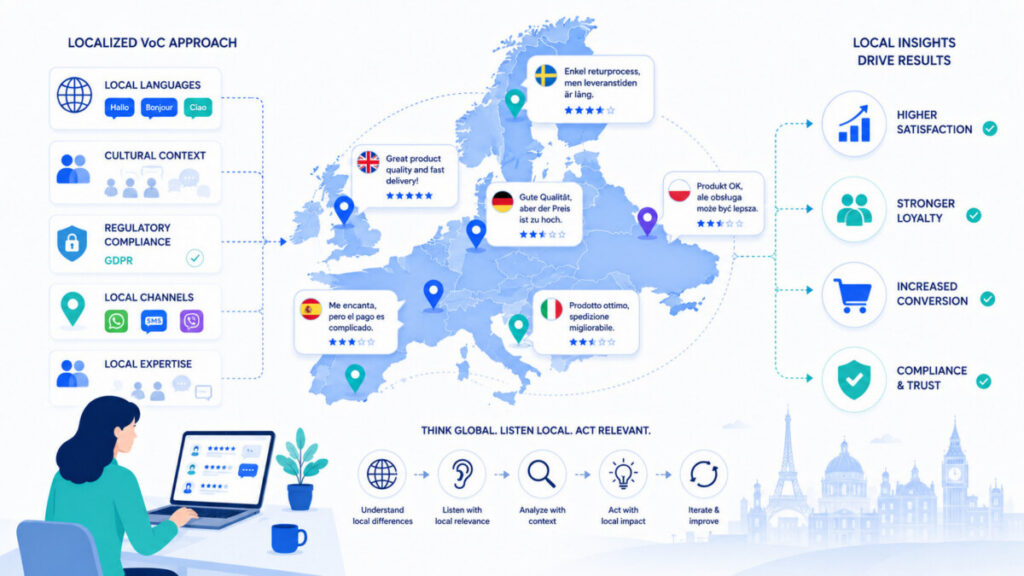
Many customer experience programs struggle to deliver value in Europe because they rely on generic Voice of Customer (VoC) methods—ignoring critical differences in language, regulation, and culture. A one-size-fits-all approach often means misinterpreted feedback, compliance risks, and missed opportunities for delight. To outperform, businesses must deploy local Voice of Customer strategies designed for Europe's diverse markets—tailoring survey design, analysis, and action to reflect local realities and regulations.
Generic VoC programs routinely underperform in Europe due to the continent's dense patchwork of languages, cultures, and expectations. There is no such thing as a "typical" European customer experience.
First, linguistic variety is more than a translation challenge. Customers respond differently depending on how well feedback instruments fit local idioms, humor, and etiquette. Misaligned wording can miss subtle cues—especially in markets such as France or Germany, where directness and formality vary greatly from, say, the Netherlands or Ireland.
Cultural expectations shape what is considered good service, what feels intrusive, and how criticism is expressed. A feedback channel that is popular in Spain may see little engagement in Denmark, even for identical products.
From a regulatory standpoint, GDPR fundamentally alters acceptable feedback practices. Local data protection authorities in Germany, France, and Italy may interpret compliance differently, adding further complexity. Consent mechanisms, data processing standards, and even NPS survey distribution can trigger regulatory debate if mishandled.
Ignoring these nuances leads to several risks:
A local Voice of Customer strategy is not "nice to have" for European markets. It is foundational to delivering actionable insights and safeguarding reputation.
Tailoring your VoC approach means meeting customers where they are—on their terms, not yours.
Feedback program customization: Forget the notion that a survey or feedback app that works in London will work seamlessly in Warsaw or Milan. Each country (and sometimes region) warrants its own survey logic, language, and distribution tactics.
Cohort segmentation: The most effective programs segment by nationality, language, regional customs, and even demographic or usage profiles. A Spanish customer in Barcelona may require a different touch than a Catalan speaker in the same city or a Basque customer in the north.
Local stakeholder involvement: Empowering local voices in the design and rollout of VoC programs pays dividends. National CX leaders or even front-line teams help ensure that feedback methods match cultural preferences—whether it's tone, timing, or channel strategy.
Centralized oversight vs local execution: Striking this balance is tricky. Central CX or marketing teams maintain overall standards, metrics, and technology stack. Local teams adapt language, set appropriate incentives (e.g., sweepstake norms vary widely), and can close feedback loops in culturally resonant ways. Trade-offs include some loss of cross-market comparability for a gain in engagement and actionable results.
What this demands is operational agility—not just a local translation, but localized program design, governance, and frontline ownership.
Hyper-local VoC programs require more than correctly spelled translations. Feedback must reflect the realities and preferences of each market.
Basic survey translation leads to superficial, often misleading data. Instead:
Interviews benefit equally from local adaptation—matching interviewer style to respondent expectations (e.g., more indirect probing in some countries).
Many standard feedback platforms either lack nuanced European localization or rely on superficial language packs. Instead:
Not all customers feel equally empowered to give feedback.
Methods that succeed in France could underperform in Poland if local specifics—down to payment methods and trust in digital platforms—are ignored.
A disciplined approach is needed to systematically adapt VoC programs for Europe. The following framework outlines each essential phase:

| Aspect | Generic VoC | Localized VoC (Europe) |
|---|---|---|
| Language | Standardized, translated | Tailored, context-adapted |
| Regulatory Fit | Uniform, risky | GDPR + local compliance |
| Cultural Resonance | Often tone-deaf | Matched to norms, values |
| Participation Rates | Lower | Higher (when well-localized) |
| Feedback Interpretation | Prone to error | Nuanced, actionable |
| Operational Overhead | Lower | Higher but value-adding |
| Cross-market Comparison | Easier | Requires harmonized design |
| Innovation Enablement | Limited | High (region-specific inputs) |
A local Voice of Customer strategy involves higher up-front effort, but prevents missteps and provides far richer business value.
Gathering feedback is only the first step. The value emerges in localized analysis and response.
Multilingual feedback analysis tools: Choose text analytics platforms with proven multilingual semantic engines (capable of “reading” nuance beyond direct translation). Look for vendor certifications in European language coverage—not all sentiment algorithms handle Polish sarcasm or Portuguese idiomatic speech equally.
Legal and data privacy filters: European VoC operations must route open-text and structured feedback through GDPR-compliant processes at all stages: storage, analysis, sharing, and reporting. Anonymization, data minimization, and local data residency should be default settings.
Closing the loop, locally: Action plans must match the market. A recurring shipping complaint in Italy may prompt an entirely different service redesign from a similar-sounding complaint in Finland. Local product managers and CX leads need ownership for implementing changes—and reporting results back to the relevant customer cohorts.
Examples of product/service adaptations: Localized feedback might reveal that German customers expect more proactive aftersales updates, while Italian customers value immediate chat support. Feedback integration should not merely inform “global” product strategy, but trigger specific regional or even city-level adjustments.
In short, European markets punish “set-and-forget” VoC. A dynamic, region-adapted stance is the only reliable path to sustained customer satisfaction and regulatory safety.
The endgame is not survey completion—it is actionable, market-relevant change.
Link insights to innovation: Data from Spain may drive mobile app tweaks that are not needed in Belgium. Regional NPS or CSAT changes signal where to double down on product or service enhancements.
Measure satisfaction and business KPIs locally: Keep NPS, customer effort (CES), or loyalty scores disaggregated by market. Global averages hide warning signs and victories alike.
Build loyalty through ongoing adaptation: Customers notice consistent, market-relevant change: local language app updates, service tweaks in response to recurring complaints, even seasonal content. Feedback programs that demonstrate tangible improvements build trust and retention.
From insight to advocacy: A well-run local Voice of Customer initiative turns passive customers into promoters—telling friends and colleagues that your brand “gets” their market. In complex European arenas, this advocacy is a durable moat against global competition.
Feedback openness, preferred channels, and even what counts as “good service” vary by country. For instance, Dutch customers are often direct and value brevity, while French respondents may express dissatisfaction more diplomatically. Some regions prefer WhatsApp for surveys, others email or phone. Local stakeholder input is key to navigating these differences.
Look for platforms supporting broad European language coverage, with semantic analysis tuned for cultural context (e.g., Qualtrics, Medallia, or local/regional CX platforms). Prioritize tools able to comply with data residency and processing regulations. For open-text, native-language text mining beats pure machine translation.
Set quarterly reviews involving local CX leaders. Regularly refresh survey content and channels, monitor shifts in digital habits and legal constraints, and engage cross-functional teams to action new insights.
By embedding local Voice of Customer approaches throughout your European operations, you can expect sharper insights, stronger loyalty, and business outcomes aligned with the real needs of diverse markets. The complexity is non-trivial—but so are the rewards.
Copyright © 2023. YourCX. All rights reserved — Design by Proformat
