Home / Blog / The New Normal: How GDPR Shapes Voice of Customer Strategies in Europe
The New Normal: How GDPR Shapes Voice of Customer Strategies in Europe
29.05.2026
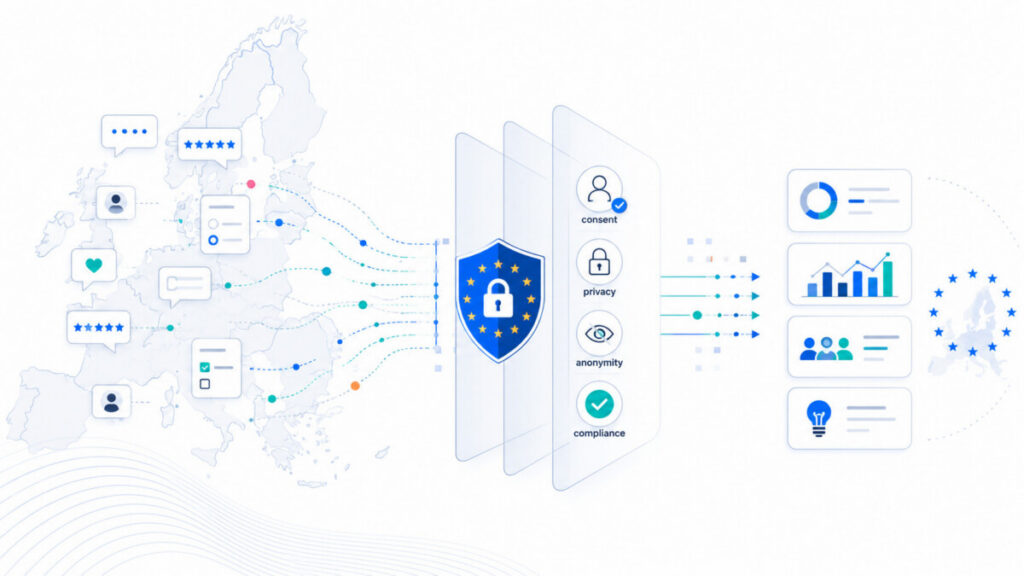
Voice of Customer (VoC) strategies are essential for European organizations aiming to deliver superior customer experiences—and effective VoC now means designing every interaction in full compliance with the General Data Protection Regulation (GDPR). The objective isn’t simply to win customer insights; businesses need to create value while rigorously protecting personal data, building trust, and ensuring every touchpoint stands up to both regulatory scrutiny and public expectations. In this environment, the quality and impact of your customer feedback programs depend as much on privacy as on insight generation.
What matters most
VoC in Europe must be privacy-centric by design. GDPR compliance is inseparable from responsible feedback collection and analysis.
AI and advanced analytics amplify VoC value—but bring extra compliance scrutiny. Choose tools purpose-built for privacy and transparency.
Consent, documentation, and ongoing training aren’t optional. Immature programs consistently stumble here.
Continuous evolution is required. Regulations, technology, and customer expectations will keep shifting. Treat compliance as a living process, not a box-ticking exercise.
The Foundations of Voice of Customer Strategies in Europe
Voice of Customer programs aggregate feedback across channels—surveys, interviews, social media, call center transcripts—to bring the authentic customer perspective into business decision-making. In theory, it’s simple: listen to customers, learn what works and what doesn’t, and adapt operations to close those gaps.
In practice, the European VoC landscape is complicated by GDPR’s strict controls on personal data. Standard methodologies—structured surveys, open-text analysis, ethnographic interviews, ongoing sentiment tracking—now carry an added layer of scrutiny. Every data point needs a legal basis; every reporting process, a privacy impact assessment.
Yet GDPR does not just introduce barriers; it raises the bar for trust, forcing organizations to craft more thoughtful, targeted, and respectful interactions. Brands that embrace this rigor benefit from clearer data sets, improved feedback authenticity, and a reputational edge.
European Context: Challenge Meets Opportunity
Jurisdiction matters: Multinational brands face patchwork regulatory interpretations; local leaders often benefit from greater agility.
Customer skepticism: Years of data scandals have made EU consumers hyper-aware of privacy rights. Programs lacking transparency often flounder.
Opportunity: Those who truly operationalize GDPR in their VoC function are rewarded with higher-quality engagement and more actionable insights.
Treat GDPR as a forcing function that sharpens—not limits—the discipline of Voice of Customer strategy.
Core GDPR Compliance Requirements for VoC Programs
Any serious VoC program must start with an understanding of GDPR’s core principles:
Consent: Freely given, informed, specific, and unambiguous consent for data collection—especially for sensitive feedback.
Data Minimization: Collect only what is strictly necessary for clearly defined VoC objectives. Avoid the “just in case” temptation.
Purpose Limitation: Data collected for CX insight must not be repurposed for unrelated analytics or marketing.
Transparency: Inform customers—directly and in plain language—about what is collected, how it is processed, and for what purpose.
Storage Limitation: Define and document data retention periods. Collectors must not keep feedback data indefinitely.
Data Protection by Design and by Default: Embed controls early, not retroactively.
Lawful Bases for Processing Customer Feedback
For most VoC programs, the lawful basis is either:
Explicit consent (especially for surveys, open comments)
Legitimate interest (occasionally applicable for unsolicited feedback or aggregated, non-sensitive data—but only with robust balancing tests)
When “legitimate interest” is invoked, a Legitimate Interest Assessment (LIA) is mandatory, addressing potential impacts on data subjects.
Roles & Responsibilities
Data Controllers: Decide why and how feedback data is collected; bear ultimate accountability.
Data Processors: Handle data on behalf of controllers—e.g., survey platforms, analysis vendors. Controllers must ensure all processors provide GDPR-level guarantees.
Joint Controllers: For collaborative VoC initiatives (e.g., brand partnerships), responsibilities must be contractually explicit.
Don’t underestimate the need for dedicated Data Protection Officer (DPO) involvement, particularly for large-scale or multi-jurisdictional studies.
Mapping the Customer Feedback Data Journey for Compliance
GDPR adherence hinges on concrete operational practices—not just policy statements. Here’s how to shape each step of the customer feedback data lifecycle.
Data Collection and Consent Management
Obtaining Consent:
Granularity matters. Request consent for each specific feedback use-case (e.g., “May we use your comments in reporting?” vs. broad “contact me” permission).
Layered notices. Provide summary then detail; avoid legalese.
No forced participation. Genuine voluntariness means no negative impact if declined.
Managing Withdrawal:
Consent is revocable, at any time, without penalty.
Implement mechanisms for customers to easily withdraw consent—links in emails, portal options, explicit survey disclaimers.
Upon withdrawal, ensure downstream erasure from all platforms (including backup systems—to the extent practicable).
Common Error: Relying on pre-ticked boxes or passive “by continuing you consent” banners; these do not constitute valid GDPR consent.
Data Storage, Protection, and Deletion Protocols
Secure storage: Encrypt feedback data at rest and in transit; limit access strictly to need-to-know personnel.
Pseudonymization: Consider pseudonymizing or fully anonymizing feedback by default, where identification isn’t essential for actionability.
Automated deletion: Set retention schedules in advance (e.g., “Survey responses are deleted 18 months after collection”); document and enforce with audit trails that demonstrate compliance.
Data Access and Subject Rights Fulfillment
Access requests: Provide straightforward processes (“Contact our DPO at…”), with timely response guarantees.
Rectification and erasure: Fix inaccuracies or delete feedback data quickly upon request, unless retention is lawfully justified.
Portability: For certain VoC scenarios (e.g., longitudinal patient feedback), be prepared to export data in a commonly used format upon user request.
Record every request and outcome. For complex programs, empower a DPO or privacy champion to oversee compliance and resolve edge cases.
Leveraging Technology: AI and NLP in GDPR-Compliant VoC Analysis
AI and Natural Language Processing (NLP) have revolutionized VoC analytics, turning unstructured feedback into actionable real-time insights. This transforms operational agility—provided privacy is not compromised.
Opportunities and Risks
Automated sentiment and theme detection accelerate time-to-insight and allow issue triage at scale.
Yet, AI models can inadvertently process more personal data than necessary, sometimes including sensitive inferences or inadvertently re-identifying individuals.
Profiling risks: Automated decision-making (e.g., flagging dissatisfied customers for proactive contact) may trigger GDPR Article 22 obligations, requiring additional safeguards and transparency notifications.
Technology Selection and Due Diligence
Favor platforms purpose-built for GDPR regions, not just “global-compliant” badgeware.
Insist on:
Data minimization controls (selectable fields, anonymization options)
Configurable data retention settings
Transparent explanations for algorithmic outputs (increases trust and reduces compliance risk)
Vendor documentation: GDPR-compliant processing agreements and third-party access logs
Practical Tip: Regularly audit tools to verify that non-permissive data (such as sensitive attributes unintentionally included in open-text feedback) are not being processed or stored.
Designing Multi-Channel Customer Feedback Mechanisms within GDPR Limits
Your VoC program must gather feedback wherever customers interact. Each channel poses different compliance risks and operational needs.
Surveys and Forms
Clarity first: Plain-language privacy notices before any data entry.
Minimum necessary fields: Every mandatory data field must serve a defined purpose (justifying, for example, why age or name is required).
Anonymous options: Allow feedback submission without identity when possible. For transactional surveys (e.g., post-support), provide at least partial anonymity.
Progressive profiling: Where deeper insight is needed, collect data over multiple interactions, seeking new consent each time.
Social Media, Call Centers, and Unstructured Feedback Sources
Unsolicited data (e.g., public social posts): Processing is subject to GDPR but context matters. If you aggregate or analyze personal data from social or open reviews, a privacy notice is still required somewhere in the flow—usually via terms or a prominent website notice.
Recorded calls and manual notes: Always inform participants up front; ensure scripts or pre-recorded messages communicate recording, purpose, and rights.
AI-driven social listening requires controls to (a) segregate public from private data, and (b) avoid storing unnecessary personal identifiers.
For omnichannel VoC, conduct Data Protection Impact Assessments whenever combining data sets could create new re-identification risks.
Operationalizing GDPR-Compliant VoC: Practical Decisions and Common Pitfalls
Trade-Offs in the Real World
Insight depth vs. data minimization: Rich, open-ended feedback yields more actionable insights but complicates privacy (risk of unsolicited personal data).
Anonymization vs. actionability: Fully anonymized data protects privacy yet limits ability to close the loop or resolve customer-specific issues.
An advanced VoC function often deploys a layered approach: anonymized full-database analysis for trend spotting, with only targeted, consent-based follow-ups for resolution.
Common Mistakes
Generic consents: “Tick all that apply” forms, blanket privacy disclaimers—often invalid under GDPR, especially with multi-purpose surveys.
Over-collection: Asking for personal details with every feedback intake, “just in case.” This is indefensible if challenged.
Process gaps: Missing mechanisms for swift subject rights fulfillment; poor documentation of data flows and consents.
Change Management Essentials
Training: CX and VoC teams need hands-on, scenario-based training on both regulations and practical application.
Internal communication: Share changes in feedback protocols and the rationale, reducing resistance from frontline and technical staff.
Governance: Establish cross-functional committees (CX, IT, Legal, Operations) to periodically review VoC program compliance and effectiveness.
Checklist: Building a GDPR-Compliant VoC Program
Use this step-by-step framework to design, review, or improve your customer feedback program.
Map Data Journey (collection, access, storage, deletion)
Hidden data copies, shadow IT
4
Integrate Technology with Privacy Controls (encryption, retention)
Legacy systems without GDPR features
5
Document Recordkeeping & DPO Involvement
Ad hoc documentation
6
Train Teams & Communicate to Customers
One-off training sessions
7
Establish Audit & Incident Response Plan
Lack of scheduled audits
8
Regularly Update Protocols (post-regulatory changes, new channels)
Static, outdated policies
Pro Tip: Conduct tabletop exercises for subject rights requests and simulate data breach scenarios involving customer feedback data. This exposes gaps in process and communication that rarely surface during normal operations.
Measuring the Impact: Trust, Participation, and Quality of Feedback
Transparent data handling boosts more than compliance metrics—it fundamentally increases customer willingness to share detailed, honest feedback.
What Changes When Privacy Comes First
Participation rates trend up post-GDPR—particularly among demographics most affected by prior privacy abuses.
Feedback richness (NPS verbatims, complaint narratives) improves as customers know their responses aren’t exposed or misused.
Trust metrics (e.g., survey opt-in rates, permission for follow-up contact) become leading indicators of VoC effectiveness.
Monitoring and Optimization
Key KPIs: Consent drop-off rates, subject rights requests completed, time-to-delete post-withdrawal, percentage of anonymized responses.
Qualitative checks: Monitor feedback about the feedback process itself. If customers express confusion or distrust, revisit both design and communication.
Value isn’t just about insights gained. When GDPR compliance is visible and explainable, organizations reap both richer data and reputational benefit.
Future-Proofing VoC Programs: Evolving Regulations and Customer Expectations
GDPR is not static. Enforcement priorities, industry codes, and public expectations all change—sometimes rapidly.
Stay Proactive
Regulatory Monitoring: Subscribe to updates from European Data Protection Authorities and sectoral guidance bodies.
Legal Collaboration: Work closely with in-house or external counsel on any new VoC initiative, particularly cross-border or AI-enhanced programs.
Continuous Training: Refresh team education annually—include real-world incident reviews, not just statutory updates.
Test and Adapt: Run pilot programs for new feedback channels before broad rollout; iterate protocols based on initial findings.
Culture Matters
Privacy-first isn’t just a compliance slogan. Mature organizations embed this throughout the customer insight function—with empowered VoC leads, regular review cycles, and CX-focused feedback about the feedback process itself.
FAQ
How does GDPR specifically affect the collection of customer feedback?
GDPR requires organizations to establish a lawful basis (most often explicit consent) for every act of customer feedback collection. It restricts the types of data that can be collected (especially sensitive data), mandates clear privacy notices, and gives customers the right to withdraw consent or request data erasure at any time. Organizations must also justify and document any use of “legitimate interest” as a lawful basis.
What are best practices for ensuring GDPR compliance in VoC strategies?
Start by embedding consent management at every feedback collection point. Limit data collection to what’s necessary for stated objectives, communicate clearly about data use, ensure secure storage and deletion, and perform regular program audits. Establish protocols for subject rights requests (access, rectification, erasure) and ensure vendor technology is GDPR-ready.
Can AI and NLP tools be used for VoC feedback in a GDPR-compliant way?
Yes—but only if data minimization is built into the tool, processing is transparent (with clear explainability and opt-out options), and profiling isn’t used for automated decision-making without additional safeguards. Choose vendors whose platforms offer GDPR-compliant encryption, retention, and access logs.
What operational mistakes do companies make with GDPR and VoC?
The most common: relying on over-broad or generic consents, collecting more data than necessary (“just in case”), failing to document consent and data flows, neglecting subject rights processes, and leaving VoC-specific privacy impact assessments to later stages.
How should customer feedback data be securely stored and deleted?
Use encryption and, where possible, pseudonymization for both storage and transfer. Define clear data retention schedules aligned with each feedback use-case. On withdrawal or end of retention period, delete all copies (including backups) and document the process, keeping audit trails for compliance review.
How can GDPR compliance improve the quality of customer feedback?
When customers see that feedback processes are transparent and privacy-conscious, they are more likely to participate and provide honest, detailed, and actionable responses. This not only mitigates compliance risk but directly enhances the business value extracted from VoC insights.
By treating GDPR as a foundation for trust, not a mere constraint, organizations can collect richer, more actionable feedback—while setting themselves apart as diligent stewards of customer experience and data protection. A mature, privacy-first VoC function is now both a compliance requirement and a strategic asset for any European business seeking lasting competitive advantage.