


- Research platform
Sources of information
Data analysis
Actions

- Solutions
For whom
Problems / Issues

- Materials
Materials
- About us
About us
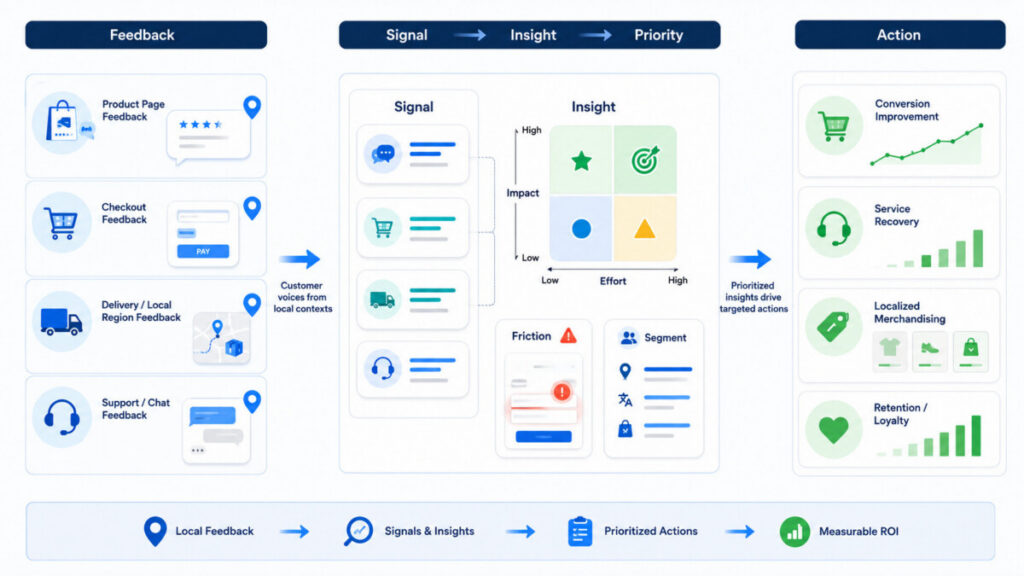
Local Voice of Customer (VoC) analytics—the disciplined capture and use of region-specific customer feedback—are giving e-commerce brands a measurable edge in customer experience (CX) ROI. By focusing on hyper-local insights instead of catch-all, global data, managers can adjust product, service, and communication strategies in ways that demonstrably increase conversion, retention, lifetime value, and localized revenue impact.
The premise is straightforward: If you want to increase the ROI of your e-commerce CX initiatives, analyze customer feedback through a local lens. Local Voice of Customer analytics focus on region- and community-specific data, turning generic feedback streams into a system for precise action. For businesses selling across geographies—be it states, zip codes, or city clusters—this is the fast route to meaningful, measurable impact.
Why? Because customer experience is local, even when your store isn’t. What delights shoppers in Berlin might frustrate those in Barcelona. With resource constraints and intensifying competition, e-commerce leaders can no longer afford to treat feedback as a global average. Instead, region-specific insights inform sharper decisions, allowing teams to prioritize fixes, allocate service resources, iterate products, or target marketing with a far higher degree of ROI clarity.
This article breaks down how local VoC analytics work, how to connect them to return on investment, tools and best practices for operationalizing them at scale, common mistakes, and how to embed local insights into broader business strategy.
A local VoC program makes a clear departure from generic or global feedback efforts by focusing on regionally segmented, context-aware feedback. Unlike monolithic NPS scores or lump-sum satisfaction indices, local initiatives create a feedback fabric unique to each target market, whether you define that by state, city, or even neighborhood.
A traditional VoC program aggregates feedback and reports findings at a company-wide level, obscuring nuance critical to action. Local VoC analytics, by contrast, parse customer feedback by distinct geographies, allowing the business to:
Actionable CX improvements depend on knowing where and why the experience deviates from expectation. For example, returns spiking in one region may flag logistical issues, while high customer effort scores in another may relate to missing payment methods or cultural mismatches. The more granular your data, the sharper your interventions.
E-commerce brands with complex footprints—multi-country, multi-region, or operating in culturally diverse markets—find the standard “global metric” approach especially hazardous. Treating French and Italian customers as interchangeable because global CSAT averages are similar often results in missed opportunities and wasted CX investment.
The business case is only as strong as the metrics prove. The ROI of CX investments depends on demonstrating that local feedback—collected, analyzed, and acted upon—moves numbers leadership cares about.
To quantify the link between local VoC and ROI, you need disciplined measurement. This includes:
Customer Lifetime Value (CLV): Are regionally tailored improvements resulting in longer, higher-value customer relationships?
Conversion Rates: Did a local website UX change or payment method rollout actually convert more browsers in a region?
Retention/Churn Rates: Does hyper-local engagement—like language-localized support—impact customer stickiness?
Regional Revenue Impact: Are revenue trends improving in markets where VoC-driven CX adjustments have been implemented?
Suppose post-purchase survey data in a coastal city indicates persistent delivery time complaints. By reallocating dispatch resources locally, follow-up analytics might show:
Although not every step yields clean causation, successive local feedback loops let you progressively tighten the ROI narrative.
Regional VoC excellence is built on more than just good analytics. It requires fit-for-purpose feedback collection, closed-loop practices, and the discipline to avoid “insight fatigue.”
Customer touchpoints differ by region, so feedback mechanisms must adapt:
Nuance matters. Feedback prompts should reflect local sentiment norms (e.g., indirect feedback cultures vs. direct criticism), regional languages, and varying digital engagement habits.
Collecting feedback is one aim; showing customers it’s acted upon is another. To close the loop:
Speed and transparency can transform feedback from wasted data into a differentiator, especially when competitors are still managing aggregate sentiment at headquarters.
Ecommerce platforms generate a deluge of structured and unstructured data—purchase logs, clickstreams, survey results, chat transcripts, and reviews. The challenge is to translate this into local insight and, ultimately, action.
The gold standard? A feedback analytics layer that dynamically surfaces high-impact local issues—like a spike in “out-of-stock” mentions in Quebec—so action can be prioritized and communicated.
Feed VoC insights directly into product, logistics, and marketing sprints. For example:
Where this works best, CX, analytics, and line-of-business leaders partner in regular “CX operational reviews” with region-specific action lists and progress tracking.
To bridge feedback with financial outcomes, employ a disciplined ROI framework for local VoC programs. Example comparison table:
| Metric | Before Local VoC | After Local VoC | Change |
|---|---|---|---|
| NPS (City A) | 39 | 53 | +14 points |
| Conversion (%) | 2.4 | 3.1 | +0.7 pp |
| Churn Rate (%) | 18 | 13 | –5 pp |
| AOV ($) | 54 | 62 | +8 |
| Ticket Volume | 900/month | 650/month | –250 |
What’s essential isn’t absolute numbers, but the relative change directly attributable to a local intervention—like improved shipping, a new regional inventory system, or a customer care language adjustment.
Fail to connect these dots, and local VoC becomes a reporting tool, not a business driver.

Building in-house VoC analytics allows for maximum customization but stretches time-to-value and requires significant data/UX resources—not ideal for most mid-market brands.
Buying a best-in-class VoC or ecommerce analytics platform allows fast deployment, robust segmentation, and proven integrations. Look for:
Hybrid solutions—using bought analytics engines with deeply customized survey inputs, or layering proprietary logic atop vendor platforms—can deliver the best of both worlds, if resourced for ongoing maintenance.
Local VoC programs touch analytics, product, CX, ops, marketing, and often regional GMs. Without cross-functional alignment, three issues derail success:
High-performing teams build feedback pipelines with automated triage, flagging urgent region-specific issues for “fast-track” resolution and strategic themes for roadmap integration.
Local VoC cannot live in a silo. Tying regional insights into the greater business plan is the only way to earn sustained investment and avoid “CX theater.”
Recurring, concise reporting on local VoC wins helps CX leads secure resources for both tooling and local staffing.
In short, decision-quality local customer feedback becomes the glue connecting experience management to operational, marketing, and financial performance.
Local Voice of Customer programs prioritize feedback collection and analytics at a geographic, demographic, or cultural segment level—delivering actionable insights specific to each community. In contrast, global programs aggregate feedback into broad averages, often masking region-specific needs and opportunities.
Measuring the ROI of local VoC involves tracking region-segmented metrics such as conversion rates, retention/churn, NPS, and revenue before and after initiative rollouts. Cohort and A/B testing, combined with clear control groups, establish the direct financial impact of local CX interventions driven by feedback.
Look for VoC and ecommerce analytics solutions that allow geo-segmentation, tie structured/unstructured feedback to customer records, and provide dashboarding by region. Common platforms include Qualtrics (with location tagging), Medallia, InMoment, and major ecommerce suites like Shopify Plus or Salesforce Commerce Cloud with feedback integration layers.
Agile organizations collect customer feedback after every significant interaction but formalize local analysis on a weekly or monthly basis—enough to spot emerging issues without overwhelming teams. High-velocity markets or those undergoing active experimentation may need faster cycles.
The most common pitfalls are ignoring local context (e.g., sending global forms to local markets), failing to respond to customer input, letting data sit unused, and reporting at too high a level (missing actionable detail). Slow, non-transparent resolution of issues erodes trust and ROI quickly.
When local VoC metrics are mapped to operational and financial KPIs—like cost to serve, retention value, or market share—feedback becomes a strategic lever, prioritized and resourced by leadership. This alignment accelerates both the velocity and impact of CX improvements.
Understanding the impact of local Voice of Customer (VoC) analytics is essential for e-commerce professionals aiming to maximize the ROI of customer experience (CX) programs. The following key takeaways distill data-driven insights and practical strategies for leveraging customer feedback and analytics to drive measurable business outcomes.
Local Voice of Customer analytics is not just a reporting exercise—it’s the artery connecting granular, actionable CX insight to measurable business growth. For e-commerce organizations with regional diversity and growth ambitions, local VoC is the strategic multiplier for both customer loyalty and ROI.
Copyright © 2023. YourCX. All rights reserved — Design by Proformat
