Home / Blog / Harnessing AI for Personalized Customer Journeys in SaaS Products
Harnessing AI for Personalized Customer Journeys in SaaS Products
30.06.2026
AI in customer experience (CX) is fundamentally reshaping how SaaS providers understand, adapt, and retain customers. By enabling real-time personalization at every stage of the customer journey, AI is shifting retention from a function of luck and generalized best practices to a deliberate, data-driven design. The result: higher engagement, lower churn, and the agility to meet user expectations as they evolve.
For SaaS organizations—whether product, CX, or analytics leads—the critical question is less "Should we use AI in CX personalization?" and more "How do we operationalize it to affect actual retention metrics?" This article will unpack where AI has moved beyond talk, provide actionable deployment frameworks, and draw a nuanced line between value, complexity, and technical debt.
What matters most
Personalization powered by AI increases SaaS retention by adapting to individual behaviors in real time.
Shifting from static segments to dynamic, AI-driven journeys leads to fewer drop-offs and higher satisfaction.
True value lies not just in collecting data, but in real-time orchestration—interventions, recommendations, and adaptive flows.
Strategic deployment requires clarity on business goals, data governance, and continuous evaluation against retention KPIs.
AI in CX is a force-multiplier, but complexity and over-customization can erode ROI if not checked by operational discipline.
How AI in CX Transforms SaaS Customer Journeys
AI in CX refers to applying machine learning, natural language processing, and predictive modeling to customer experience management—shifting away from manual or fixed logic toward continuous, automated improvement. In a SaaS context, this means the platform no longer treats its audience as broad segments updated quarterly, but as a constantly shifting blend of micro-cohorts and behavioral fingerprints.
The core shift: Traditional SaaS CX relied on static segments ("power users," "at risk," "prospects"). These groups, typically based on registration date, plan level, or basic activity, can’t keep pace with how users actually behave. AI enables SaaS products to interpret signals—clickflows, feature adoption patterns, support requests, or even sentiment in open-text feedback—on a rolling basis, reshaping experiences as needs surface.
Technical capabilities now in play:
Machine learning algorithms uncover latent behavioral patterns, predicting which users are likely to churn or convert.
Natural language processing (NLP) parses feedback at scale, detecting pain points or emergent trends from support tickets, chat logs, or survey comments.
Predictive analytics score user health, identify opportunities for tailored interventions, and surface expansion opportunities in near real time.
Contrast this with a quarterly segmentation review or a static email drip campaign. With AI in the CX engine, SaaS products can now personalize, predict, and adapt at machine speed.
Mapping and Optimizing the Customer Journey With AI
Effective SaaS journey mapping once relied on painstaking flowcharts—linear, assumption-driven, and quickly stale. AI-driven customer journey mapping automates this process, continuously updating as real user paths diverge from designers’ expectations.
Automated journey mapping
Modern AI tools ingest logs, clickstreams, transaction histories, and support events to construct up-to-date journey maps. Rather than presuming set pathways, these models uncover the actual patterns: which onboarding screens have high drop-off, where users bounce between help docs and chat, or which features become stickiness magnets for their cohort.
Behavioral analytics: friction and engagement
By modeling millions of user actions, AI can:
Detect friction points (e.g., repeated failed upload attempts or users stalling at a permissions page).
Isolate engagement drivers (features or touchpoints that correlate with increased trial-to-paid conversions, reduced support tickets, or successful upsells).
Estimate journey health scores for cohorts—with leading indicators, not just lagging ones.
Dynamic, AI-powered interventions
Static journeys push the same next step to everyone. AI enables interventions such as:
Just-in-time nudges: Prompts tailored to predicted confusion or disengagement, delivered via in-app messaging or email.
Content and flow adjustments: Auto-surfacing relevant guides, onboarding helpers, or even hiding unused UI to simplify the experience for struggling users.
Escalation triggers: Routing risky accounts to human CX agents when sentiment or usage patterns deviate sharply from the norm.
Example: Real-Time Optimization Workflow
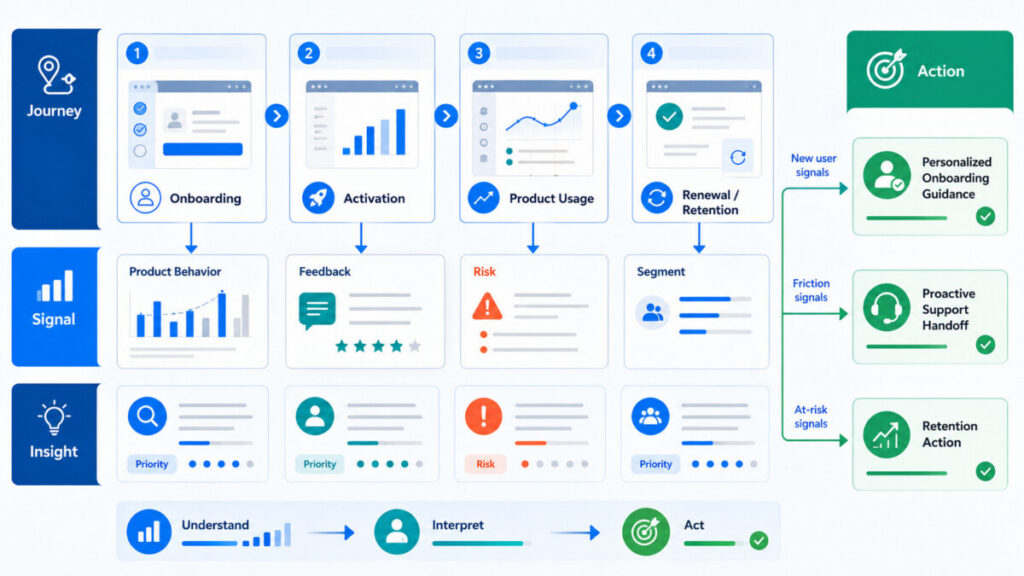
Model identifies cohort (e.g., new users stalling on feature activation).
System delivers adaptive tutorial nudge, bypassing generic onboarding flow.
If ignored, user moved into "at risk" micro-segment; support proactively offers chat.
Feedback loop: system tracks next actions, updating journey map and adjusting future interventions.
This isn’t just mapping—it’s living, learning, and optimizing the journey, shifting resource allocation to the spots that move retention.
Techniques for AI-Powered Personalization in SaaS Experience
AI-powered personalization in SaaS can be distilled into several layers, each building upon the last. Impact depends on technical depth, integration sophistication, and clarity of business goal.
Forms of personalization
Content personalization:
Adaptive guides, feature tooltips, and documentation surfaced based on user profile and in-app behavior.
UI/UX adaptation:
Dynamic navigation, onboarding checklists, layout simplification, or adaptive dashboards reflecting individual or cohort priorities.
Feature recommendations:
Individualized suggestions—whether next features to try, integrations to activate, or templates to deploy—driven by usage similarity to retained users.
Support channel adaptation:
Routing to live chat, self-service, or even direct-to-engineering tickets based on predicted complexity or user frustration signals.
Collaborative filtering: Recommends features, modules, or content based on behavior of similar users.
Decision trees and random forests: Segment users in real time, optimizing support flow or escalation rules.
Reinforcement learning: Continuously improves nudges, CTAs, or even interface tweaks based on observed user reactions.
Applied personalization: Selected use cases
1. Onboarding flow optimization: AI tracks drop-off at each onboarding step, smartly reorders or abbreviates the sequence for users likely to disengage, while allowing power users to skip ahead. Instead of fixed tutorials, users receive just-in-time micro-lessons matching actual stumbling blocks.
2. Adaptive dashboards: Dashboards reorganize themselves, highlighting metrics and modules that users repeatedly access—while minimizing noise from infrequently used features.
3. Contextual in-app messaging: AI dictates timing, channel, and offer of messages. A user struggling with report generation might get a one-click tutorial video, while another expressing frustration in chat is invited to a virtual onboarding session.
These techniques aren’t new in theory, but AI removes the friction and inconsistency of manual rules, letting personalization become genuinely adaptive rather than just reactive.
Measuring the Impact: Retention and Engagement Metrics Improved by AI
Adopting AI-driven personalization without robust measurement is like flying blind. The crux of any CX initiative, particularly those employing AI in SaaS experiences, is its ability to move the specific business metrics that matter.
What to measure
Retention rate (logo and revenue): Do users stay subscribed and do their spend increase or hold steady?
Churn (voluntary and involuntary): Did propensity scoring and AI-initiated interventions truly reduce cancellations?
Activation and adoption: Are more users discovering, utilizing, and benefiting from advanced features?
Engagement depth: Not just logins, but session duration, frequency, and feature diversity.
NPS (Net Promoter Score): Are advocates increasing after adaptive personalization is deployed?
Expansion revenue: Is upsell/cross-sell velocity increasing among users receiving AI-curated offers or recommendations?
Methodology: Before-and-after analysis
Establish a control group: Isolate users or accounts for whom personalization is withheld or limited.
Baseline retention/channel performance: Analyze trends prior to AI implementation, accounting for seasonality or external churn drivers.
Staggered rollout: Deploy AI personalization in phases (e.g., one region or plan at a time) to causally attribute changes.
Mix quantitative and qualitative signals: Pair hard metrics with survey verbatims, support transcripts, and customer interviews to surface root causes of improvement or regression.
Signals from academic and industry research
While hard numbers vary by product, vertical, and AI sophistication, emerging research and industry benchmarking find:
Early AI adopters in SaaS consistently report material reductions in onboarding drop-off rates and moderately higher net retention.
Gains are steeper where closed-loop feedback (user reaction to personalization) is used to refine the AI engine, rather than set-and-forget deployments.
Comparative improvement is largest in mid-market and enterprise use-cases where baseline churn is relatively high—consumer SaaS sees more moderate uplift due to shorter customer lifecycles.
Measure for deltas, not absolutes. Even a single percentage point decrease in churn can recoup significant cost, especially where CAC is high.
Implementation Considerations and Common Pitfalls
Translating AI in CX from pilot to production is where most SaaS companies find the true complexity—not in the models themselves, but in orchestration, governance, and operationalization.
Integration approaches
API-driven: Plug AI engines into existing platforms via exposed endpoints. Advantage: speed; risk: data mapping hassles.
Middleware or CX hub: Use purpose-built tools that orchestrate AI interventions across multiple touchpoints. Balances control with modularity.
Native AI: Platforms with built-in AI customization frameworks (e.g., product-led growth platforms with embedded ML). Eases integration, but may restrict flexibility.
Data and governance
Data requirements: AI thrives on volume, velocity, and variety—but dirty or sparse data leads to irrelevance or, worse, bad recommendations. Plan for ongoing hygiene and pipeline validation.
Privacy and compliance: As AI personalization encroaches on user-level granularity, GDPR/CCPA and enterprise data handling demands continuous risk assessment and opt-out pathways.
Feedback loops: Closed-loop systems (where user reactions inform the model) far outperform open-loop. Many teams neglect this, degrading personalization over time.
Operational trade-offs
Build vs. Buy: Building in-house offers control but incurs technical debt and opportunity cost. Off-the-shelf tools accelerate time to value but require process and data adaptation.
Complexity vs. ROI: Too much customization leads to fragile systems, exploding test cases, and inability to generalize learnings.
Change management: Teams underestimate resistance—from engineering (concerns about black-box AI), CX (loss of agent discretion), or compliance (data flows).
Common pitfalls
Underutilized data: Focusing on a narrow set of signals (e.g., logins, not context or sentiment) limits personalization potential.
Over-personalization: Hyper-targeted interventions can become confusing or creepy, overwhelming users and muddying the CX brand promise.
Neglected feedback loop: Without ongoing monitoring and recalibration, models drift, failing to reflect new user behaviors or product evolution.
The path to value is not paved with more model features or fancier algorithms, but with disciplined integration and rigorous, continuous CX measurement.
Practical Framework: Steps for Deploying AI Personalization in SaaS
For leaders charting a course from aspiration to sustainable execution, operational clarity is paramount. Below is a checklist distilling best-in-class process alongside practical, real-world project constraints.
Stepwise deployment framework
Scoping and goal setting
Define business objectives: retention, activation, expansion, CSAT.
Establish measurement baselines.
Identify journey points with largest potential for impact.
Data readiness and mapping
Audit available customer data (behavioral, transactional, feedback).
Clean and normalize touchpoint tracking.
Assess where additional instrumentation is needed.
Tech selection and integration
Evaluate platform compatibility (API, middleware, or embedded AI).
Balance time-to-market needs with customization requirements.
Design privacy-aware data flows.
Pilot and feedback
Select a controlled cohort for A/B or phased rollout.
Instrument detailed analytics and user-level feedback.
Monitor for CX surprises or unintended consequences.
Iterative optimization
Deploy closed-loop feedback: route reactions, survey responses, and support interactions back to tuning AI models.
Continuously test interventions against retention and qualitative KPIs.
Document learnings and share with cross-functional stakeholders.
Cross-team alignment and change management
Communicate implications for CX, product, support, and compliance teams.
Create visibility into how AI decisions are made and acted upon.
Foster trust by enabling override and human-in-the-loop escalation where needed.
Continuous improvement
Schedule periodic reviews (quarterly at minimum).
Watch for model drift, data anomalies, or evolving compliance requirements.
Re-scope interventions as product or journey structure changes.
Comparing AI personalization tools for SaaS CX
Tool/Platform
Strengths
Drawbacks
Best for
Segment + custom ML
Flexible, integrates with data stacks
Requires ML resources, complex setup
Advanced SaaS, in-house data teams
Gainsight PX / WalkMe
Journey mapping, in-app interventions
Less customizable, higher cost
Product-led orgs, mid-to-large SaaS
Intercom/Drift AI
Conversational, NLP-powered support flows
Limited deep personalization
Fast-mover SaaS, SMB
Amplitude Recommend
Real-time behavioral targeting
Integration complexity
Data-driven teams, multi-product SaaS
Custom REST API + LLM
Maximum control, frontier AI
Requires engineering/CX synergy
CX innovators, enterprise
Tool selection is not just about features, but cultural and organizational fit—whose data, whose workflows, whose risk trade-offs?
AI-Generated Insights for Smarter Business Decisions
AI doesn't simply personalize; it surfaces latent insights that have downstream implications for every function—product, support, marketing, and even finance.
Types of insights
Dynamic segmentation: Real-time clustering identifies micro-cohorts at risk for churn or ripe for upsell, far better than static plans or segments.
Funnel drop-off mapping: Pinpoints exactly where in the journey most disengagement occurs, tied to actual user paths rather than assumed intent.
Cohort behavior analysis: Surfaces differences between markets, company sizes, or industries, enabling tailored roadmap and customer success playbooks.
Sentiment extraction: NLP parses open-text feedback to quantify frustration, delight, or confusion by journey stage—enabling more surgical CX intervention.
Operationalizing insights
CX and product leaders can opt for campaign changes—not months after churn spikes, but within days of emergent friction signals.
Analytics teams can prioritize A/B test sprints where AI highlights outsized drop-off, rather than continuing broad-brush improvements.
Support and success can staff, script, or escalate based on projected journey health, not just NPS surveys.
Closing the feedback loop
Perhaps most critically, the same AI engine driving personalization should also shepherd ongoing improvement: capturing the effectiveness of each intervention and feeding those outcomes back into future models. This is where leading SaaS teams rise above. Not by treating AI as a black box, but by ensuring its insights are cross-functional, actionable, and cycling back into the journey design.
FAQ
How does AI improve personalization in SaaS customer journeys?
AI in CX enables SaaS platforms to interpret real-time behavioral and sentiment data, customizing every touchpoint—onboarding, UI layout, recommendations, and support—based on how each user actually interacts, not just who they are or what plan they're on. This dynamic adaptation is key to reducing churn and boosting engagement.
What retention metrics should be monitored after implementing AI-powered personalization?
Monitor logo and revenue retention, churn rates, deep engagement markers (sessions per user, key feature adoption), NPS, and qualified expansion or upsell rates. Measuring both lagging (retention, churn) and leading (NPS, usage velocity) indicators provides a full retention impact picture.
What are the main challenges SaaS teams face when integrating AI in CX?
Teams often struggle with fragmented and low-quality data, complexity of integrating AI with legacy or third-party systems, user and staff skepticism or resistance to AI-driven logic, and the requirement to stay compliant with evolving data privacy regulations.
How can SaaS platforms balance automation with maintaining a human touch?
Hybrid frameworks route straightforward cases and nudges via AI, but trigger human hand-off for exceptions, complex scenarios, or whenever sentiment and context suggest a deeply personal conversation is needed. Effective escalation paths preserve both efficiency and empathy.
Which types of AI-powered personalization have the most measurable impact on SaaS retention?
Personalized onboarding (addressing drop-off early), recommendations for new features or integrations, and adaptive in-app messaging consistently deliver the clearest gains in direct retention metrics and expansion opportunities.
Can AI-driven personalization scale for complex SaaS products serving multiple user personas?
Yes, but it requires modular AI models and clear logic paths for each segment, plus robust governance to prevent sprawl and confusion. Instead of one-size-fits-all or infinitely unique flows, successful teams define playbooks for high-value personas and automate within bounded, reportable swimlanes.
AI in CX isn’t about technology for its own sake. It’s about making every customer journey smarter, more relevant, and continuously improved—at a scale and speed no manual process could match. SaaS companies ready to move past static journeys now have the playbooks, cautionary tales, and technical tools to make measurable CX gains real.