


- Research platform
Sources of information
Data analysis
Actions

- Solutions
For whom
Problems / Issues

- Materials
Materials
- About us
About us
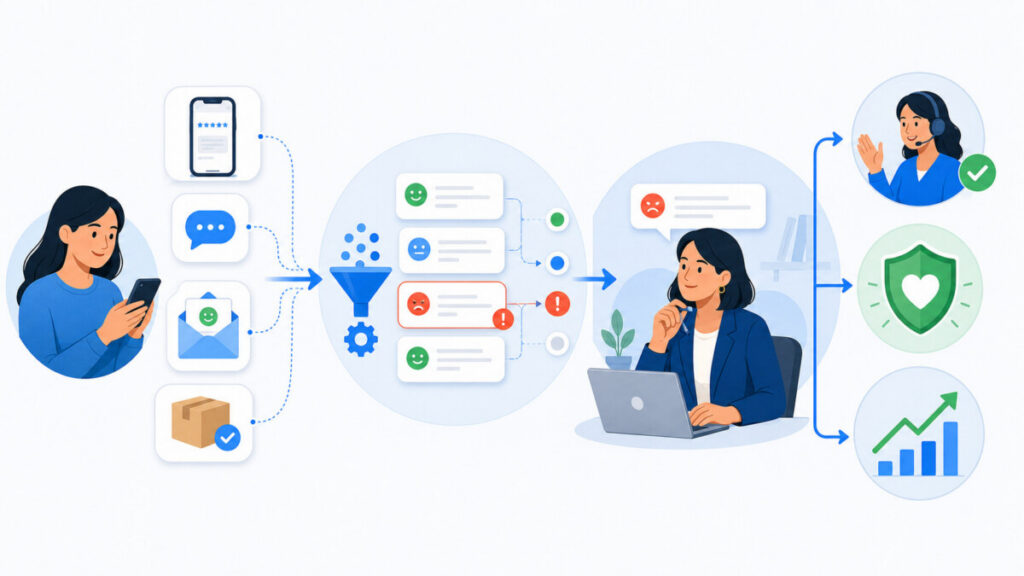
In customer experience management, striking the right balance between customer feedback automation and genuine human interaction determines whether feedback efforts drive loyalty—or simply disappear into the void. Technology brings scale and speed, but the absence of empathy can alienate even your most loyal customers. For growth-focused CX leaders and business operators, the real challenge isn’t whether to automate, but how to harness feedback automation while ensuring every customer still feels truly heard.
Automation has transformed how businesses gather and act on customer feedback—but only half the battle is won with smarter tools. Efficiency, while essential, can’t substitute for the trust and relationship-building that come from thoughtful human engagement. In practical terms, high-performing customer feedback programs unify automation and the human touch to create a system that’s both responsive and relational. On paper, automation promises cost savings and instant metrics. In reality, the experience only delivers when it also feels thoughtfully human.
For organizations set on sustainable growth, the question isn’t automation versus empathy—it’s how to design streamlined CX operations where automation does the heavy lifting, and human involvement delivers the value customers remember.
Customer feedback automation refers to the use of technology—dedicated platforms, integrated surveys, AI analysis—to systematically collect, sort, and sometimes even respond to customer insights. Done right, automated systems enable scalable Voice of the Customer (VoC) programs that aren’t possible through manual methods alone.
Consider a basic post-purchase survey. Automation means surveys are triggered for every transaction, regardless of volume. Results funnel directly into dashboards, and AI tags urgent topics, enabling near real-time service recovery. No manual chasing, no missed voices—simply a stronger foundation for closed-loop feedback.
But there’s a limit: automation collects what it’s told to collect. It doesn’t know when nuance matters, or when a program’s “success” is really masking emerging pain points. That's where technology alone falls short—and where human stewardship makes the difference.
If automation streamlines data, the human touch translates it into value. Customers sense when they’re interacting with a person—not just a system—and that distinction shapes how feedback is both given and received.
Personal responses are inherently more empathetic. Handwritten replies to critical reviews or live follow-ups after a negative survey score aren’t just gestures—they show the customer that their relationship with your business matters. This creates a trust dynamic with direct payoffs: higher loyalty, greater advocacy, and—in competitive markets—a reason to stay.
Even in digital-first channels, some situations demand human interaction:
Automated systems recognize keywords; humans discern intent. A complaint referencing “long delays” means something different for a first-time user versus a premium loyalist. Humans can piece together context, history, and emotional cues—critical for meaningful root-cause analysis and true service design improvements.
Automation rapidly gathers feedback; the human touch gives it meaning and relevance.
Feedback automation, when woven thoughtfully into CX programs, enables:
However, the move to automation isn’t risk-free.
Leaders in CX automation know that “set it and forget it” is a myth. The best programs intertwine technology-driven scale with deliberate, human-centered interventions at critical points.
There’s no universal formula, but mature customer feedback operations are built on intentional choices: when to automate, when to personalize, and how to keep human empathy part of even digital journeys.
Automate:
Manual/Personalized:
Empathy is a design choice, not just a delivery tactic. Ensure technology handoff points (e.g., an angry customer’s survey verbatim) are treated as signals for human reach-out, not just another data row. CX teams should own the handoff—not leave it to a workflow rule.
Differentiate technology and human responsibilities clearly:
Failing to clarify ownership is a common cause of missed or mishandled feedback, especially as organizations scale.
Efficient collection of feedback is only step one. Worthwhile change only happens when automated feedback systems are paired with capable human oversight, converting raw data into sustainable service improvements.
Most modern feedback platforms now include:
These help identify patterns, hotspots, and recurring pain points faster than manual methods.
Technology can flag that “shipping delays” are up, or that detractor scores have spiked. But why those delays, and what change will resolve them? Only human investigators can interview front-line staff, map process journeys, and identify the operational gaps underlying recurring feedback themes.
Human interpretation supports:
A functional feedback-to-action engine should look more like an feedback pipeline:
Without this “closed loop,” feedback programs quickly lose impact—and credence.

Blending automation and human touch should follow a practical, operational logic—not hunches or software vendor promises.
Below is a simple decision table for selecting the optimal approach:
| Feedback Channel | Customer Segment | Feedback Type | Recommended Approach | Rationale |
|---|---|---|---|---|
| Transactional Survey | All/Generic Customers | NPS/CSAT, Rapid-Scale Input | Automate | High volume, low complexity |
| Post-Issue Resolution | Dissatisfied/Detractor | Complaint, Negative Experience | Personalize/Hybrid | Needs empathy, trust recovery |
| In-App Feedback Widget | Digital-Only Users | Quick Bug Report | Automate | Immediate collection, low emotional load |
| Executive/Strategic Survey | Key Accounts | Relationship, Loyalty/Churn Risk | Personalize | Complex, strategic context |
| Social Media Monitoring | Broad Public | Brand/Mention/Complaint | Automate+Monitor | Scale needed, escalate major issues |
When deciding, ask:
Sometimes the best answer is hybrid—a real person equipped with the right triggered insights, reaching out promptly because the system told them when intervention was warranted.
Neither automation nor personal engagement is “set and forget.” Customer expectations and business priorities shift. The feedback strategy that works at 1,000 customers might break down at 50,000.
Track both operational and experiential KPIs:
If moving toward more automation, monitor for spikes in negative feedback about the feedback process itself—a leading indicator that the human touch is missing.
Responsive organizations use monthly or quarterly “Voice of Customer Governance” sessions to:
Real-world CX leaders aren't afraid to pull back automation in areas where it's failing, or to double down where it's thriving.
Customer feedback automation refers to using purpose-built technology—such as survey platforms, chatbots, and AI sentiment tools—to systematically gather and categorize customer input. Unlike manual collection, automation delivers immediate coverage at scale, minimizes human error, and accelerates reporting, but risks losing the nuances captured through direct human engagement.
Human interaction builds trust, demonstrates respect for the customer’s time and experience, and allows for richer, more nuanced understanding of feedback. Empathetic follow-ups and tailored responses foster loyalty—particularly when customers have faced challenges or expressed dissatisfaction.
Automation speeds up survey distribution (triggered surveys post-transaction), categorizes high-volume feedback, enables real-time sentiment analysis, and flags urgent issues for follow-up, giving teams the ability to act quickly on emerging trends and opportunities.
Frequent pitfalls include over-automating all touchpoints (leaving customers feeling ignored), failing to act on qualitative insights, insufficiently escalating critical feedback to humans, and relying too heavily on quantitative scores without context.
Assess by feedback channel, customer segment, complexity of issue, intent of interaction, and the potential impact on loyalty. Routine, technical, and low-emotion interactions suit automation; high-value relationships, emotional complaints, and ambiguous cases need a human touch or hybrid approach.
Use KPIs such as survey response rates, customer satisfaction (CSAT), Net Promoter Score (NPS), closed-loop resolution timings, sentiment change over time, and escalation handoff rates to measure both efficiency and customer impact of your feedback approach.
Understanding customer feedback automation is about more than speed and efficiency—it's about using technology to enable deeper, more human connections where they matter most. Sustainable growth comes from listening at scale, but also from knowing when a real person needs to take the mic. The blend isn't static; it’s a design choice organizations must revisit often to align technology with empathy, strategy with service, and data with real-world action.
Copyright © 2023. YourCX. All rights reserved — Design by Proformat
