


- Research platform
Sources of information
Data analysis
Actions

- Solutions
For whom
Problems / Issues

- Materials
Materials
- About us
About us
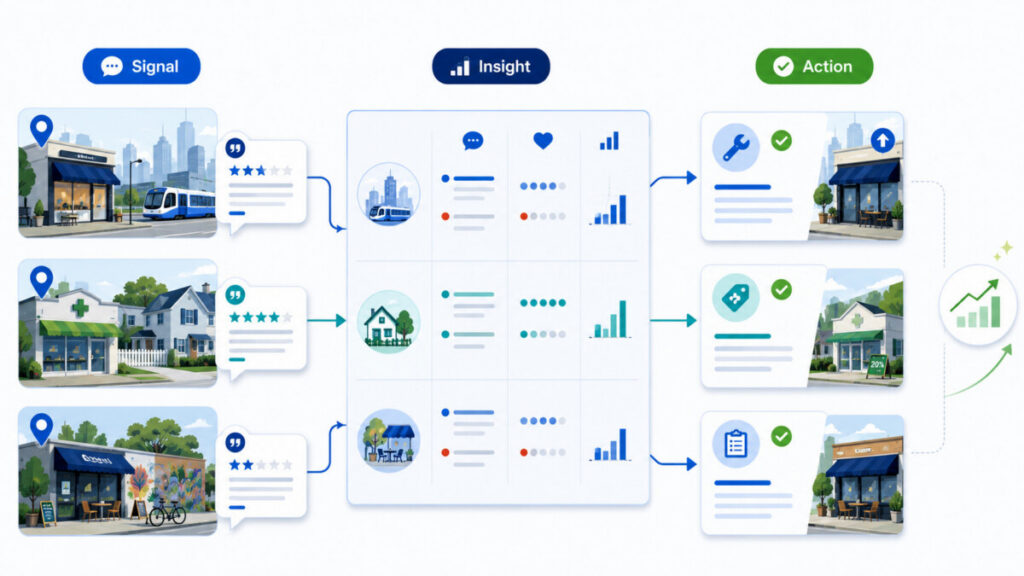
Hyper-local Voice of Customer (VoC) data––paired with rigorous regional analytics––enables business leaders to move beyond generic customer feedback and instead surface precise, actionable insights that directly inform regional growth strategies. Rather than relying solely on national or aggregate signals, organizations that systematically capture and operationalize local VoC can tailor offerings, resolve market-specific pain points, and accelerate growth where competitors merely coast.
Local Voice of Customer refers to feedback specifically collected, segmented, and interpreted at the city, town, neighborhood, or even store level. Its value emerges in contrast to high-level feedback, which often masks the diversity of customer needs, expectations, and perceptions across geographies. In this article, we’ll examine why this sharper focus matters, how leading organizations collect and act on local feedback, and what stepping stones build a disciplined, scalable local VoC program.
Collecting customer feedback at the local level isn’t just a CX practitioner’s ideal—it’s a route to competitive edge for any brand that operates across different geographies. Here’s why.
1. Local VoC reveals unique needs and pain points. Customers in Houston face different service realities than those in Seattle, even when buying from the same chain. Local environmental, cultural, or logistical factors shift expectations—think of power grid reliability in Texas, versus public transit complaints in a dense urban core. Hyper-local VoC surfaces these context-specific themes directly from front-line feedback.
2. National aggregates mask actionable variation. Most VoC programs report enterprise-wide NPS or satisfaction scores. But a +40 NPS nationally could hide a +70 in Boston and a -5 in Cleveland. Aggregated data smooths out these signals, leading to one-size-fits-all responses that may work nowhere perfectly.
3. Local insights drive faster, targeted change. Why was same-day delivery stalling in one metro while humming elsewhere? Regionally segmented feedback pinpointed that a distribution bottleneck—and not merely training—was at fault, prompting targeted logistics changes. In restaurant franchises, local reviews have highlighted menu misalignments (e.g., spice tolerance or dietary trends), informing rapid, tailored menu adjustments.
4. Regional nuances impact loyalty and spend. Customer experience is the sum of every interaction; when touchpoints fit local realities, loyalty metrics improve. Local VoC initiatives have enabled operators to preempt latent dissatisfaction before churn or negative reviews bite.
What this gets right: Local VoC doesn’t just tell you what customers want—it tells you _where_ you’re most at risk and _where_ you’re getting it right.
Building a reliable local feedback machine hinges on more than adding a ZIP code field to your NPS survey. To truly capture the voice of each region, diverse collection methods are needed.
Local feedback hinges on context.
Customers vent and praise where they live and work, not just at point of sale.
More advanced programs leverage:
Not everything scales—or should.
These approaches, combined and cross-validated, offer an ensemble picture of what truly matters to each market.
Having the data isn’t enough; its operational value lies in how it’s interpreted, visualized, and embedded into the business decision machinery.
Segment first, ask later.
Segmentation is necessary, but comparative benchmarking yields insight.
For all its promise, regional VoC data often dies in PowerPoint or ad hoc reports.
Data only matters if it changes decisions—or solves real problems.
The signal: Treat each region as its own market. The reward: Faster, more targeted response, higher relevance, lower churn.
The tech stack matters. Not all feedback tools are built for regional analytics, and “enterprise” doesn’t always mean “multi-location ready.”
| Platform Type | Regional Capabilities | Pros | Cons |
|---|---|---|---|
| VoC Suites (e.g., Medallia, Qualtrics) | Location tagging, advanced segmentation, geo-dashboards | End-to-end feedback ops, native analytics | Expensive, requires data governance |
| Survey Tools (e.g., SurveyMonkey Enterprise, QuestionPro) | Branch/city logic, API feeds, kiosk apps | Flexible, fast deployment | Limited integrations, basic analytics |
| Social Listening Platforms (e.g., Sprout Social, Brandwatch) | Geotag filtering, local sentiment analysis | Great for unstructured data | Limited to public/social channels |
| Local Review Management Solutions (e.g., Reputation, Yext) | Store/location focus, review aggregation | Effective for retail/F&B | Not designed for deep CX analytics |
Key selection factors:
Mastery in local VoC comes from rigorous evaluation—tying feedback to real outcomes.
The punchline: Don’t just collect. Attribute, report, and refine.

Local feedback is useless if it can’t be shared or compared. If branches collect feedback on separate systems, cross-market learning is lost. Consistent intake and data models are paramount.
Not all negative feedback means the same thing in every region. What reads as a “mild complaint” in one culture might be a major warning sign in another. Applying uniform rubrics risks missing—and misinterpreting—critical signals.
Fine-grained local data multiplies workload and analytic noise. Tech can help, but manual QC and periodic re-aggregation are essential to avoid drowning in detail.
More granular data often means stricter local laws: GDPR in the EU, CCPA in California, city-by-city privacy overlays elsewhere. Ensure location-specific consent flows, data minimization, and local storage where required.
Define business and regional objectives.
What do you want to learn or change in each market?
Align on key metrics.
KPI selection drives both collection and action. NPS, first contact resolution, repeat purchase rate—pick what matters most locally.
Standardize local feedback capture.
Choose tools, channels, and questions. Roll out training for location staff where needed.
Deploy a scalable technology solution.
Ensure integration across feedback, analytics, and operational systems.
Tag and segment feedback by geography.
Set up consistent location identifiers and metadata standards.
Build workflows for regular review and action.
Define who reviews, analyzes, and acts on local data—and how quickly.
Monitor and measure impact.
Run pre/post, pilot, and ROI analyses by region.
Update strategies, close the loop with customers.
Notify customers when their input leads to change—locally, not just company-wide.
Local Voice of Customer focuses on collecting, analyzing, and acting on feedback at the city, store, neighborhood, or regional level, rather than aggregating responses across an entire organization. The granularity allows businesses to hone in on region-specific needs, preferences, and pain points, whereas national programs often mask this crucial variation in customer experience.
Regional analytics enable businesses to segment customer feedback by geography, highlighting where customer experience is lagging or excelling. This precision empowers targeted interventions—whether it’s operational fixes, hyper-local marketing, or specific service training—making experience management more relevant and impact-driven in each market.
The ideal stack combines multi-location VoC platforms (with location tagging and dashboard capabilities), survey tools that support in-branch/in-market deployment, local review management solutions, and social listening tools capable of geographic filtering. Integration with broader BI systems is critical for translating feedback into business outcomes.
Actionability relies on clear workflows for review, ownership, and response. Decentralize analysis so local managers can act swiftly, yet centralize oversight to ensure consistency. Regularly communicate to feedback providers when changes have been made as a result of their input, closing the loop and avoiding feedback fatigue.
Common errors include inconsistent data capture across regions, forming data silos, neglecting cultural or demographic factors within local feedback, failing to attribute outcomes to specific interventions, and underestimating the importance of privacy/compliance at a hyper-local level.
Link pre- and post-intervention business outcomes (e.g., NPS, revenue, repeat purchase, complaint resolution rates) by region to specific feedback-driven actions. When possible, use control and experimental market comparisons. Always tie metrics back to the original customer insight and report results regionally, not just in aggregate.
Copyright © 2023. YourCX. All rights reserved — Design by Proformat
