Home / Blog / Unlocking the ROI of AI in Customer Experience: Real Case Studies from Leading SaaS Companies
Unlocking the ROI of AI in Customer Experience: Real Case Studies from Leading SaaS Companies
17.07.2026
Leading SaaS brands are quantifying the ROI of AI in customer experience (CX) through methods that optimize operational efficiency, personalize touchpoints, and radically reduce friction at every stage of the customer journey. Real business results—not just theoretical promise—are being realized by companies that align AI deployment with measurable CX and financial outcomes. As evidence accumulates, it’s clear: in SaaS, AI is not merely a tool for support automation but a strategic lever for growth and loyalty—if applied with rigor, specificity, and operational insight.
What matters most
Successful SaaS brands drive tangible ROI from AI in CX by targeting specific metrics—churn, NPS, lifetime value, support costs—not just automating for efficiency’s sake.
The highest returns come from strategic, end-to-end AI integration rather than isolated tools or partial automation.
Short-term wins include faster support and ticket routing, but real value compounds when predictive analytics, intelligent agreement management, and feedback loops are deployed.
Pitfalls remain: rushing to implement AI without clear CX goals, proper data hygiene, or change management undermines gains.
Disciplined measurement and cross-functional ownership are vital—track “before and after” KPIs and align tech, CX, and business stakeholders from the outset.
Quantifying the ROI of AI in Customer Experience for SaaS
ROI of AI in customer experience is not an abstract ideal—when executed rigorously, the impact is observable across both CX and financial KPIs. Forward-thinking SaaS companies make ROI tangible by focusing on metrics that tie directly to business outcomes and customer behaviors.
Core Metrics and Practical Impact
Customer Satisfaction (CSAT): AI’s ability to instantly resolve routine issues (via chatbots or knowledge base suggestions) consistently lifts CSAT by reducing customer effort.
Net Promoter Score (NPS): Proactive service and seamless journeys driven by AI can move the needle on NPS, especially when AI closes routine pain points or surfaces early warning signs.
Churn Rate: Predictive AI highlights accounts at risk; targeted interventions reduce churn, contributing to lifetime value and topline revenue stability.
Customer Lifetime Value (CLV): Adaptive personalization and relevant upsell recommendations—enabled by AI—grow CLV over time.
Customer Acquisition Cost (CAC): By automating qualification and personalization, AI can lower CAC through smarter targeting and onboarding.
Support Costs: Automated ticket triage, self-service capability, and virtual agents all directly reduce cost-per-resolution.
Operational SLAs: AI minimizes response and resolution times, supporting SLA compliance and customer trust.
Evidence-Based Attribution Approaches
Measuring the ROI of AI in CX requires a commitment to robust before-and-after analysis, test-control design, and continuous feedback:
A/B or multivariate testing: Segmenting customer cohorts into “AI-exposed” vs. “traditional process” arms clarifies impact.
Pilot-first approach: Deploying AI to a limited audience allows for controlled measurement of gains (e.g., reduction in average handling time or improved upsell rates).
Data tracking infrastructure: Implementing detailed event tracking and feedback triggers to measure changes in customer outcomes post-AI deployment.
Financial modeling: Tying operational improvements (like a % reduction in repeated tickets) to their dollar impact on overall margin or retention.
ROI quantification in SaaS is only as strong as the measurement discipline and the specificity of what AI is intended to change in the experience. Too broad a lens—or a failure to isolate for AI’s unique contribution—yields only anecdotal results. The leaders build measurement into the AI deployment itself, not as an afterthought.
Operational Wins: AI-Powered Automation in SaaS CX
AI’s operational impact in SaaS customer experience comes into sharpest relief where high volume, repeatable tasks previously bound teams to costly, reactive work. Automation, used judiciously, delivers direct and measurable efficiency improvements.
Smart Ticket Routing and AI-Enabled Self-Service
Case Example 1: Ticket Routing SaaS leaders deploying ML-based triage see incoming support tickets automatically classified and assigned based on intent, urgency, and available agent skill set. The returns:
Decreased first response times—sometimes by hours or even days in complex B2B settings—improving customer perceptions of responsiveness.
Dramatic backlog reduction, freeing human agents to handle nuanced interventions and escalations.
Improved SLA attainment, especially for priority customer cohorts.
Case Example 2: Chatbots and Virtual Agents Conversational bots now handle a significant share of repetitive, low-complexity inquiries. Two operational outcomes consistently surface:
Reduction in manpower costs: Some brands have measured a 10–30% drop in level-one ticket volume routed to humans.
24/7 coverage: AI agents resolve issues after-hours, boosting customer trust and lowering abandonment.
The best AI-powered self-service isn’t just a deflection engine; it is context-aware, gracefully escalating to humans when necessary—preserving CX quality and satisfaction.
Operational SLAs and Satisfaction Metrics Deployments are successful when backed by closed-loop feedback mechanisms. Post-interaction surveys capture shifts in satisfaction and ongoing areas for AI optimization.
Advanced Analytics: Unlocking Proactive and Personalized CX
The real strategic unlock of AI in SaaS CX is not just doing old things faster—it’s doing entirely new things: predicting churn, identifying save opportunities before customers articulate pain, and crafting hyper-personalized journeys.
AI-Driven Customer Data Mining and Predictive Insights
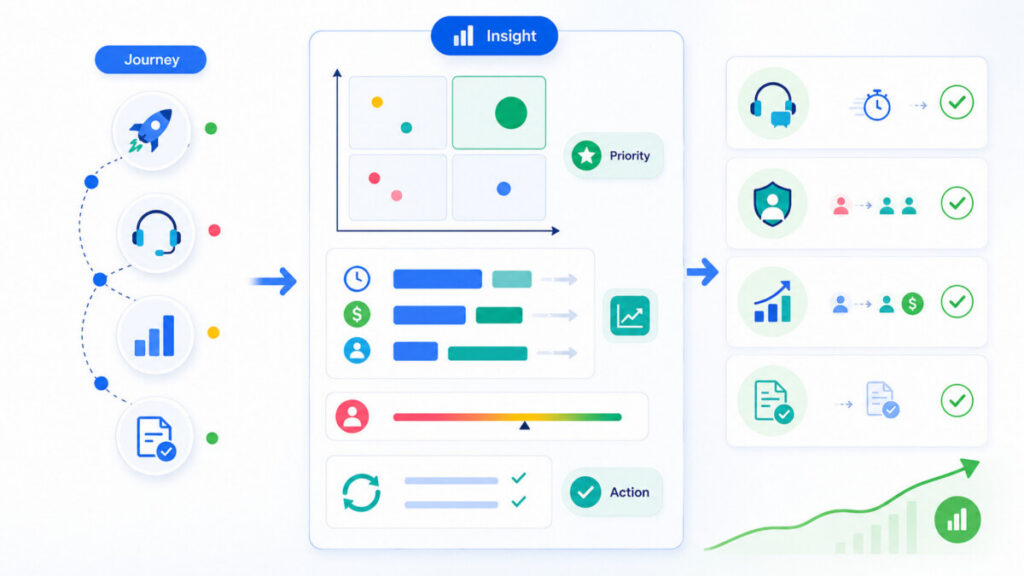
Journey Analytics and Segmentation Armed with voluminous behavioral data (in-app telemetry, support interactions, account changes), leading SaaS firms use AI/ML models to map granular customer journeys:
Dynamic segmentation: AI groups customers by lifecycle stage, health score, usage patterns—tailoring outreach at scale.
Behavior modeling: Predictive models surface “red flags” (e.g., sharp usage drop-offs) that signal churn risk or renewal objections.
Real SaaS Brand Example Some subscription management platforms use AI to comb through user actions and ticket histories, automatically generating next-best-action recommendations. Customer success teams leverage these to:
Predict churn: Receive AI-powered alerts when usage patterns deviate from retention benchmarks.
Upsell/cross-sell: Identify feature gaps or new needs, delivering relevant offers at optimal timing.
Personalize interventions: Algorithms suggest playbooks based on similar customer resolutions.
Quantified Results While public benchmarking is patchy, internal case studies routinely show:
Increased retention (sometimes by several percentage points in key cohorts),
Higher expansion revenue,
Improved NPS when outreach is data-driven and proactive.
The distinction: reactive CX is replaced by preemptive, insight-driven engagement—reducing firefighting and improving perceived value.
Intelligent Agreement Management: Transforming B2B SaaS Onboarding and Renewals
AI in SaaS CX has evolved beyond automating support—it now underpins new service layers, such as Intelligent Agreement Management. Companies like Docusign are not simply digitizing contracts; AI models extract, analyze, and automate decision points within agreements, revolutionizing critical B2B journeys.
What Is Intelligent Agreement Management?
This application blends document AI, workflow automation, and predictive analytics to streamline contract creation, negotiation, approval, and renewal:
Cycle time reduction: AI parses agreements for missing data, flags risks, and routes approvals, compressing days-long processes to hours.
Error minimization: Automated review reduces manual mistakes and compliance risks, especially vital in regulated sectors.
Frictionless onboarding and renewal: Customers navigate agreements with conversational bots offering real-time guidance, clarifications, or escalation—a far less daunting proposition for admins and end-users.
CX and Business Impact
Reduced onboarding friction leads to faster time-to-value for new customers—accelerating realization of ROI for both vendor and client.
Higher renewal win rates as proactive AI agents track upcoming deadlines, trigger early engagement, and personalize renewal offers based on usage and satisfaction cues.
Customer loyalty is reinforced not only through efficiency but through a sense that the SaaS partner “knows” and adapts to customer needs.
This goes beyond back-office optimization—intelligent agreement management becomes a signature part of the SaaS brand promise.
Strategic CX Integration: Maximizing Compounding Returns from AI
Deploying AI in silos squanders potential. SaaS companies winning the CX ROI race take a long view, knitting AI touchpoints into every phase of the customer lifecycle—onboarding, in-product engagement, support, renewals, and feedback.
The Case for End-to-End Integration
By weaving AI into the fabric of service delivery (not bolting it onto the periphery), these brands achieve:
Holistic customer view: Machine learning draws from a continuously updated ecosystem of touchpoint, product, and interaction data.
Real-time feedback loops: AI analyzes post-support surveys, NPS verbatims, and product reviews, automatically surfacing new pain points or moments of delight for cross-team learning.
Proactive repair and personalization: From auto-generated onboarding walkthroughs to tailored renewal offers, every journey phase adapts in response to measured sentiment and behavioral shifts.
Compounded vs. Siloed Value
Where AI is tightly integrated, benefits stack:
Operational savings lead to reinvestment in more personalized experiences.
Renewal and upsell playbooks continually optimize based on fresh churn prediction data.
Customer experience becomes a self-improving system—with each new data point, algorithms refine interventions, messaging, and support priorities.
By contrast, where AI sits at the edge (e.g., in a support chatbot only), gains are incremental if not quickly eroded by breakdowns elsewhere in the journey.
Practical Decisions: Trade-Offs, Pitfalls, and Best Practices in AI CX for SaaS
Not every AI-for-CX initiative yields positive ROI. The path to value is lined with tough choices—tech, team, and measurement.
Key Trade-Offs
Speed vs. Data Quality: Rapid AI deployment can backfire if foundational customer data is siled, messy, or inconsistent; algorithms learn from what they're fed.
Automation vs. Human Touch: Over-automating risks eroding empathy and undermining relationship value, especially in complex B2B journeys.
Buy vs. Build: Off-the-shelf AI accelerates pilots but may fail to capture brand, customer, or journey nuance. Heavier investment in bespoke models can pay off for differentiated service but requires both technical and CX maturity.
Common Mistakes
Insufficient change management: Failing to bring support, CX, and product SMEs along leads to shallow adoption and “model drift”—where AI no longer fits evolving processes.
Weak ROI tracking: Deploying AI without rigorous baseline measurement (and ongoing comparison) means success—if achieved—remains invisible or contested.
Ignoring Voice of Customer alignment: When AI initiatives are developed without ongoing customer feedback integration, solutions miss key friction points or over-prioritize internal efficiency at the expense of customer value.
Recommendations
Cross-functional teams: CX, data, product, and frontline operations should co-own deployment, tuning, and measurement.
Measurement discipline: Build in KPI tracking, closed-loop post-interaction surveys, and regular executive reviews—before launch, not after.
Pilot and iterate: Begin with a well-bounded use case, measure, adjust, and stage rollout based on learning, not vendor promises.
Frameworks and Checklists: Evaluating AI ROI in SaaS Customer Experience
Structured, repeatable assessment of AI value is essential—too many SaaS projects skip disciplined measurement, with vague “efficiency” as the only proxy for ROI. The following framework can help operationalize AI evaluation for maximum CX and business impact.
Stepwise Process: Assessing ROI of AI in CX
Define clear objectives tied directly to customer behavior or business outcome (e.g., reduce onboarding time by X%, lift NPS by Y).
Establish baseline metrics using historic data to set realistic targets and isolate AI impact.
Design a pilot with control groups to compare AI-enabled vs. traditional workflows.
Implement detailed tracking of operational (e.g., response time), experiential (CSAT, effort), and financial (cost per interaction, expansion rate) metrics.
Set measurement cadence—daily/weekly for early signals, monthly/quarterly for strategic impact.
Analyze and attribute gains, losses, or side effects to AI vs. other change efforts.
Optimize post-launch—iterate algorithms, workflow, and communication based on feedback and hard data.
Document lessons learned and update best practices, cross-functionally.
Example Template: AI ROI Tracking Table
AI Initiative
KPI Target
Outcome
Lessons Learned
Chatbot Support Automation
20% reduction in FRT
Achieved 18%
FRT up, CSAT stable; escalate sooner
Churn Prediction Engine
10% decrease in churn
8% decrease
Best accuracy at 90-day window
AI-Based Upsell Recommender
15% increase in ARPU
11% increase
Needs more product usage data
Intelligent Renewal Mgmt
25% faster renewals
27% faster
Most gains in mid-market segment
Structured frameworks don’t just justify spend—they provide the language for continuous improvement and company-wide learning.
FAQ
How do SaaS companies measure the ROI of AI in customer experience?
Leaders use a mix of before-and-after benchmarking, A/B or pilot-control comparisons, and continuous tracking of both operational and experiential KPIs (CSAT, churn, NPS, support costs). The challenge lies in isolating AI-generated improvements from broader process changes or shifting customer expectations. Instrumentation and rigorous attribution models are essential.
What are the most effective AI use cases in SaaS CX?
Top-performing applications include smart ticket routing, AI-powered self-service (chatbots), proactive churn prediction, personalized onboarding and renewal journeys, and intelligent agreement management. These use cases deliver ROI because they directly influence major CX and business KPIs (satisfaction, retention, revenue, cost).
Can AI-driven automation hurt the customer experience?
Yes. Over-automation can alienate customers if bots mishandle nuance, escalation is handled poorly, or journeys become impersonal. The best SaaS brands balance automation with seamless human fallback, context-aware service, and regular VOC (Voice of Customer) checks to surface and address negative impacts.
How quickly can SaaS brands see financial returns from AI in CX?
Timelines vary. Operational automations (e.g., ticket triage) may deliver savings or CSAT improvements within weeks to months, especially in large-volume environments. Predictive or strategic AI (churn, upsell models) often take longer to show ROI due to training needs, adoption cycles, and the time required for behavior change (typically 6–18 months for measurable financial impact at scale).
What technologies underpin successful AI CX implementations in SaaS?
Critical enablers include unified customer data platforms, robust event and journey analytics, domain-specific NLP models, flexible workflow automation engines, and scalable cloud ML infrastructure. Mature brands often blend in-house capability with best-of-breed partners—over-reliance on generic AI can blunt both differentiation and ROI.
What’s the biggest mistake SaaS companies make when rolling out AI for CX?
Neglecting measurement and change management. Without clear objectives, cross-functional ownership, and disciplined VOC/process feedback, even advanced AI can fail to move meaningful CX or business metrics. AI must be embedded in real journeys, not just layered atop existing pain points.
Unlocking the ROI of AI in customer experience is not accomplished with technology alone—measurable gains require focused strategy, relentless measurement, and ongoing cross-team ownership. Top SaaS brands lead because they relentlessly align AI with customer journeys, feedback, and business outcomes—raising the bar, not just their efficiency.