


- Research platform
Sources of information
Data analysis
Actions

- Solutions
For whom
Problems / Issues

- Materials
Materials
- About us
About us
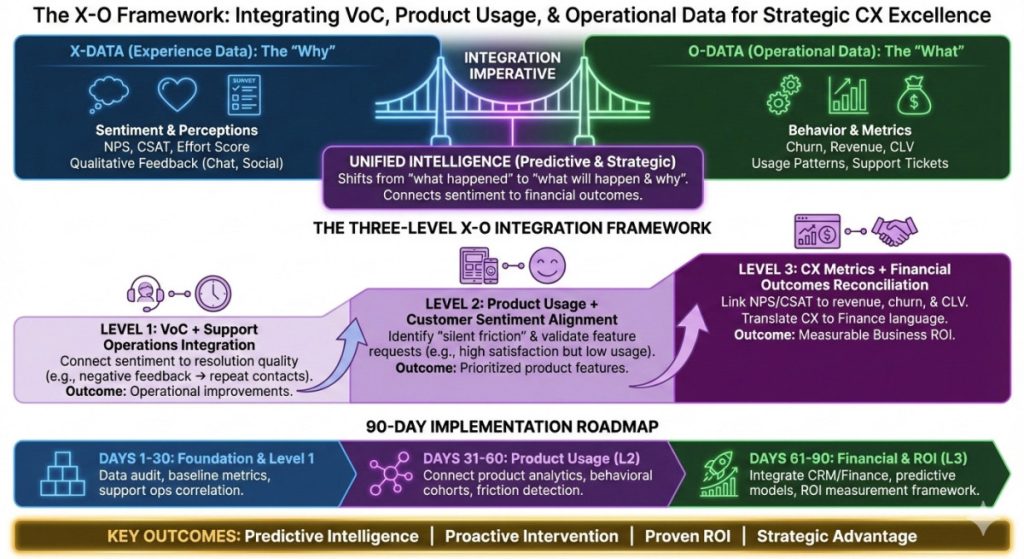
The X-O framework represents the strategic integration of Experience Data (X-data) and Operational Data (O-data) to create comprehensive customer intelligence that drives both satisfaction and revenue outcomes. This methodology transforms fragmented customer signals into a unified analytical system where Voice of Customer sentiment, product usage patterns, and financial metrics work together to reveal the complete picture of customer behavior and business impact.
A customer program is a structured initiative to collect, analyze, and act on customer feedback, and the X-O framework elevates these programs by integrating them into broader business strategies for enhanced customer experience, loyalty, and ROI. To run a successful VoC program, you need real buy-in from cross-functional stakeholders that customer feedback matters. The Voice of Customer Strategy has become a competitive necessity for businesses.
This article covers the practical implementation of X-O integration for mid-to-senior CX professionals operating in B2C and B2B environments who need to move beyond siloed customer feedback programs. Whether you’re a CX Manager struggling to prove ROI, a Marketing Director seeking deeper customer insights, or a Data Analyst tasked with connecting voc data to business outcomes, this framework provides the methodology to bridge satisfaction metrics with financial performance. Integrating VoC insights into your customer strategy is essential for anticipating customer needs, reducing churn, and driving growth. The scope focuses on actionable integration strategies rather than basic VoC fundamentals—we assume you already understand net promoter score mechanics and customer satisfaction measurement.
The X-O framework combines voice of the customer sentiment with product usage patterns and operational KPIs to create actionable insights that drive both customer experience improvements and measurable business ROI.
The future of VoC programs is expected to be AI-powered, enabling faster feedback loops and predictive signals.
By working through this material, you will gain:
Traditional customer programs fail when experience data and operational data remain in separate systems, analyzed by different teams, with conflicting definitions of success. CX teams celebrate rising net promoter score while Finance watches churn increase. Product teams ship features based on survey responses while customer support tickets reveal the actual customer needs being ignored. This disconnect isn’t a communication problem—it’s a data architecture problem that the X-O framework directly addresses.
X-data captures the emotional and perceptual dimensions of customer interactions through direct feedback mechanisms. Structured feedback, such as survey responses, is a key component of X-data and provides quantitative insights for product development and CX strategies. X-data is often collected through Voice of Customer (VoC) programs. This includes net promoter score surveys, customer satisfaction ratings, customer effort score measurements, open-text survey responses, social media comments, chat logs, and qualitative insights extracted from customer conversations. Natural language processing applied to unstructured feedback reveals customer sentiment patterns that quantitative metrics alone cannot detect.
The power of X-data lies in explaining motivations, frustrations, and pain points that drive customer behavior. Understanding customer expectations is essential for delivering relevant and personalized service improvements. When analyzing customer feedback at scale, you uncover why customers struggle with onboarding, what creates friction during checkout, or which aspects of your service create loyal customers. However, X-data has a fundamental limitation: high satisfaction scores don’t automatically translate to retention, revenue growth, or customer lifetime value. A customer might rate your support interaction highly while simultaneously considering a competitor.
O-data encompasses the measurable business metrics that quantify actual customer behavior and its financial impact. O-data details business events and processes and includes quantitative data that companies already collect, such as sales figures and website interactions. This includes churn rates, customer lifetime value, support tickets volume, first contact resolution rates, SLA performance, product adoption metrics, revenue per customer, and drop off points in the customer journey. Operational data shows what customers actually do—purchase patterns, feature usage, support frequency, renewal decisions—without explaining why.
The precision of operational data enables performance tracking and financial forecasting, but it lacks the context necessary for improvement. Analyzing O-data can drive operational efficiency and process improvements by identifying areas for cost reduction and workflow optimization. You can see that churn increased 15% last quarter, but o-data alone won’t reveal whether the cause was pricing, product issues, competitive pressure, or service failures. This gap between observing outcomes and understanding causes creates the integration imperative.
Combining X-data and O-data creates predictive intelligence rather than reactive reporting. When you correlate customer sentiment with product usage patterns and financial outcomes, you shift from asking “what happened” to predicting “what will happen” and understanding “why it’s happening.” This integration enables you to identify at-risk customers before they churn by detecting sentiment drops that precede usage decline. It allows product teams to prioritize features based on both customer voice and behavioral validation. It gives executives ROI proof connecting experience investments to margin improvements. Integrating X-data and O-data can also improve customer experiences by personalizing interactions based on individual customer contexts.
Understanding these data types separately sets the foundation for the three-level X-O integration framework that transforms siloed metrics into a unified customer intelligence system. The X/O framework provides insights for root cause analysis by linking negative feedback to specific operational failures.
Integrating X-data and O-data fosters a culture of continuous improvement by making customer insights actionable. Advanced analytics can be used to turn feedback from structured surveys, unstructured input, and passive data collection into actionable insights that drive prioritization and business outcomes.
The X-O framework operates through progressive integration levels, each building on the previous to create increasingly sophisticated customer analytics capabilities. Voice of the Customer (VoC) is the practice of collecting, analyzing, and acting on customer feedback to improve products, services, and overall experience. VoC programs are comprehensive, enterprise-wide initiatives that collect, analyze, and act on customer feedback across multiple channels, ensuring that insights are integrated into broader CX strategies. Collecting feedback systematically—across explicit opinions and implicit behaviors at various touchpoints—is a foundational step in the X-O framework. This approach ensures organizations achieve quick wins while establishing the infrastructure for advanced predictive modeling and business outcomes alignment.
The first integration level connects customer sentiment directly to support operations performance. This means layering customer satisfaction scores and customer effort score data with key metrics like first contact resolution rates, SLA adherence, escalation frequency, and repeat contact rates. The correlation patterns reveal operational causes behind experience failures.
When negative sentiment correlates with repeat contacts within 48 hours, you’ve identified a resolution quality problem—not a satisfaction measurement problem. Identifying customer pain points through feedback collection and data analysis helps align teams and guide actionable improvements. When customer effort score spikes align with specific issue categories in customer support tickets, you’ve found friction that training or process changes can address. Real-time coaching triggers become possible when sentiment analysis on customer conversations flags declining scores during live interactions, enabling supervisors to intervene before the call ends. Customer success teams leverage VoC programs to monitor account health and trigger proactive interventions, reducing churn and optimizing the customer journey.
This level of integration typically reveals that 40-60% of negative feedback traces back to specific operational failures in your support process—failures that o-data alone categorizes as “resolved” because the ticket closed. Sales teams can use VoC insights to better understand customer objections and improve sales messaging. The feedback loop between experience signals and operational metrics creates continuous improvement opportunities that neither dataset could identify independently. A successful VoC program requires a centralized team of insight producers and a decentralized team of insight consumers.
The second level integrates behavioral analytics with voc insights to identify silent friction points—areas where customers struggle but don’t explicitly complain. Product usage data including feature adoption rates, session duration, navigation patterns, and drop off points combines with feedback data from surveys, product feedback submissions, and support interactions to reveal the complete adoption picture.
This integration answers critical questions: Are customers who request specific features actually using them after launch? Do usage patterns among satisfied customers differ from those who report pain points? Which customer signals predict successful onboarding versus early abandonment? The product team gains prioritization clarity by validating feature requests against actual behavioral patterns—preventing development resources from flowing toward vocal minority requests while silent majority needs go unaddressed.
User insights emerge when you track cohorts based on both sentiment and behavior. Leveraging VoC analysis and combined data helps identify factors that influence customer satisfaction and create more loyal customers. High-satisfaction/low-usage segments represent untapped potential. Low-satisfaction/high-usage segments indicate friction with core functionality that threatens retention. These behavioral-sentiment matrices guide targeted interventions that usage or survey data alone would miss.
Mapping VoC insights to product roadmap prioritization ensures that customer needs remain at the center of innovation and development efforts. Organizations that integrate VoC insights into product design experience approximately 20-25% higher retention rates.
The third level creates the executive-relevant connection between experience improvements and financial impact. This integration links net promoter score movements, customer satisfaction trends, and effort score reductions to revenue outcomes, churn reduction, and customer lifetime value increases. By leveraging VoC analytics, businesses can better understand and enhance customer loyalty, leading to improved satisfaction and increased revenue. It translates CX language into Finance language through predictive analytics modeling.
At this level, you can demonstrate that a 5-point NPS increase among enterprise customers correlates with 12% higher renewal rates and $2.3M in protected annual revenue. You can show that reducing customer effort score by 0.5 points in onboarding drives 18% faster time-to-value and 8% lower first-year churn. These aren’t correlation anecdotes—they’re predictive models continuously refined through ongoing data integration.
Executive dashboards at this level display customer analytics alongside traditional financial metrics, enabling investment prioritization based on projected ROI. Organizations that invest in VoC analytics benefit in three major ways: retention and loyalty, revenue impact, and strategic alignment. Companies that act on VoC insights in near real-time see a 21% increase in customer retention compared to those that review feedback quarterly. Investing in VoC analytics leads to stronger customer relationships through increased trust and customer-centric actions. CX budget requests become business cases with revenue projections rather than satisfaction improvement proposals with vague competitive advantage promises.
A phased implementation approach ensures sustainable adoption while demonstrating quick wins that secure ongoing executive sponsorship. This roadmap structures the integration journey into foundation-building, expansion, and optimization phases with specific deliverables at each stage.
The first month establishes data connectivity and baseline correlations between experience and support operations.
A successful VoC program can uncover the status of your customer's experience with your business and key brand KPIs. It also requires buy-in from cross-functional stakeholders to ensure customer feedback is valued across the organization.
The second month extends integration to behavioral analytics, connecting how customers use your product to how they feel about it.
Integrating VoC insights into product and business architecture allows organizations to anticipate changes in user needs and refine their value proposition.
The third month connects experience improvements to business outcomes, establishing the measurement framework for ongoing ROI demonstration.
Organizations that act on VoC insights in near real-time see a significant increase in customer retention compared to those that review feedback quarterly.
Successful X-O integration requires more than connecting data sources—it demands intelligent orchestration that transforms raw signals into deeper insights. Advanced analytics are essential for processing and analyzing both structured feedback and unstructured input, enabling organizations to turn feedback into actionable insights that drive improvements in customer satisfaction, loyalty, and revenue. Effective VoC analysis turns unstructured input like call transcripts, chat logs, survey responses, and social media comments into structured insights that can guide decisions. The technology layer must handle varying data frequencies, ensure quality across sources, and enable the real-time responsiveness that modern customer experience strategies demand.
Customer experience platforms serve as the orchestration layer unifying voc data, behavioral analytics, and operational metrics into a coherent intelligence system. These platforms support voc programs by enabling systematic collecting feedback and structured feedback across multiple channels, ensuring that both explicit opinions and implicit behaviors are captured and analyzed to inform CX strategies. Platforms like YourCX provide the integration infrastructure connecting survey tools, product analytics, support systems, and CRM data through native connectors and flexible APIs.
The platform requirements for effective X-O integration include:
Gathering feedback from multiple sources creates reconciliation challenges when signals conflict or data quality varies. Survey scores might indicate satisfaction while support tickets reveal frustration. Product usage suggests engagement while churn prediction models flash warnings. A well-structured customer program ensures that feedback is collected and analyzed systematically, leading to process improvements that address customer needs and enhance overall experience.
Effective signal reconciliation requires:
Maintaining data governance across integrated systems demands clear ownership definitions, access controls, and privacy compliance documentation. The value of X-O integration depends entirely on the quality and trustworthiness of the underlying data. Structured feedback is essential for maintaining data quality and guiding process improvements that drive better customer outcomes.
Organizations implementing X-O integration consistently encounter specific obstacles. Anticipating these challenges and applying proven solutions accelerates successful deployment. Identifying customer pain points and implementing process improvements are key to overcoming organizational resistance, as they help teams focus on actionable changes that directly address customer needs.
A well-structured VoC program helps align teams around the same signals, ensuring that customer feedback is integrated into decision-making processes. Effective VoC programs require continuous engagement with insights to ensure that feedback leads to actionable changes in products and services.
Functional teams protect their data domains and resist sharing that might reveal performance issues or shift resource allocation. Implementing a structured customer program and systematically collecting structured feedback can help break down these data silos and foster collaboration across teams. The solution begins with identifying shared KPIs that matter to both CX and Finance teams—churn reduction serves both objectives, making it an effective unifying metric. Establish cross-functional governance with clear data ownership and success metrics that reward collaboration. When customer retention improves, the entire company benefits, and the integrated data that enabled it becomes valued rather than protected.
The volume of customer data, customer conversations, and behavioral signals can paralyze teams attempting to analyze everything simultaneously. Advanced analytics can help teams turn feedback from large volumes of data into actionable insights, reducing analysis paralysis. Begin with high-impact correlations rather than comprehensive integration. The relationship between NPS and churn provides immediate value and executive attention. Expand to more complex models only after demonstrating capability with simpler use cases. AI-powered platforms automate pattern detection, surfacing significant X-O correlations without requiring manual analysis of every signal.
CX leaders often struggle translating experience improvements into business language that executives understand and value. Demonstrating improvements in operational efficiency and aligning with customer strategy are effective ways to prove ROI to executive leadership. Focus on early wins showing clear financial impact—prevented churn, increased expansion revenue, reduced support costs. Present business cases using margin improvement, cost reduction, and revenue growth rather than satisfaction scores. The Level 3 integration specifically addresses this challenge by building the measurement infrastructure for ongoing ROI demonstration.
Initial integration success can deteriorate as data sources change, business priorities shift, and model accuracy degrades without maintenance. Establish regular X-O performance reviews examining correlation stability and prediction accuracy. Build feedback loops that continuously improve models based on outcome validation. Treat X-O integration as an operational capability requiring ongoing investment rather than a one-time implementation project. Ongoing process improvements and continuous engagement with insights are essential for maintaining long-term integration effectiveness, ensuring that feedback leads to actionable changes in products and services.
The X-O framework transforms customer experience from a cost center relying on satisfaction rhetoric into a profit driver demonstrating measurable business impact. By systematically integrating voice of customer insights with product usage patterns and financial outcomes, organizations create the intelligence infrastructure that turns feedback into revenue, customer sentiment into competitive advantage, and experience investments into business cases that Finance approves. This integration leads to more loyal customers and stronger customer relationships by leveraging VoC analysis to identify and act on the factors that drive satisfaction and trust.
Immediate next steps:
For organizations ready to advance beyond basic integration, explore advanced predictive modeling techniques that anticipate customer behavior 60-90 days ahead, industry-specific X-O applications adapting the framework to your vertical’s unique data patterns, and emerging AI capabilities in experience orchestration that automate insight generation and response triggering. Organizations that integrate VoC insights into their processes can create products that resonate deeply with customers and perform consistently in the market.
Copyright © 2023. YourCX. All rights reserved — Design by Proformat
