


- Research platform
Sources of information
Data analysis
Actions

- Solutions
For whom
Problems / Issues

- Materials
Materials
- About us
About us
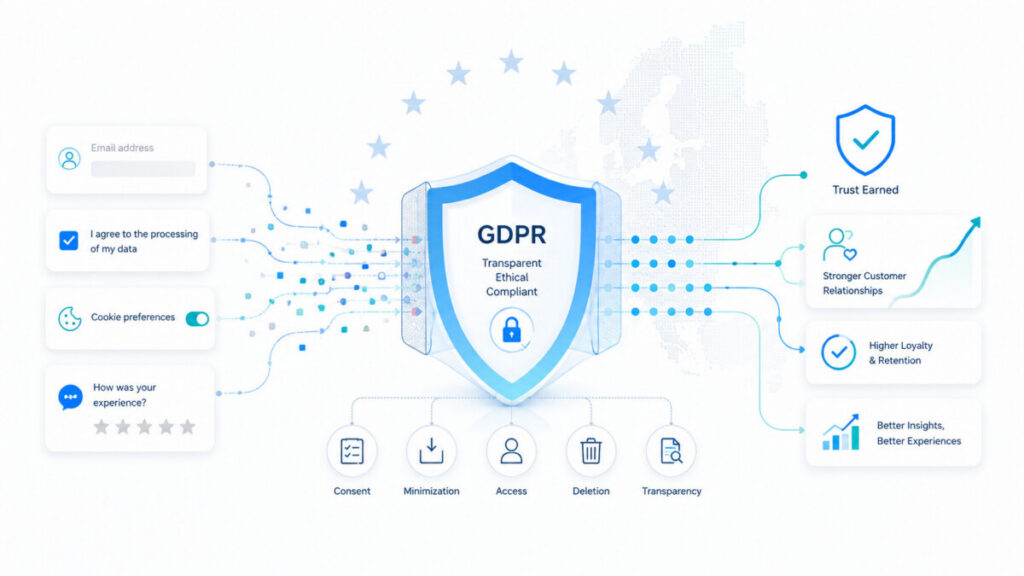
For organizations handling customer data, the EU General Data Protection Regulation (GDPR) sets both a legal standard and—more crucially—a framework for earning customer trust. GDPR-compliant data collection isn’t just about risk mitigation and regulation; done right, it lays the groundwork for stronger customer relationships and lasting brand differentiation. The payoff? Customers notice and reward transparent, respectful data practices with deeper loyalty and advocacy.
GDPR forces companies—large and small—to rethink how they collect, store, and use personal data. It sets out structured rules for data processing, clarity in customer communications, and high standards for user rights. But the real transformation occurs when businesses move past reluctant compliance and see GDPR as a blueprint for treating customers as partners, not just data points.
Ethical data collection under GDPR, woven into how organizations design journeys, communication, and feedback mechanisms, drives real gains in customer trust. The organizations that win on privacy are the ones that build privacy into every touchpoint, making compliance a mark of credibility rather than a regulatory burden.
At its core, GDPR should be seen not only as an obligation but as a customer experience strategy—a way to differentiate, minimize risk, and create the transparency modern consumers demand.
For any business processing EU personal data, three GDPR principles shape every customer data touchpoint: lawfulness, fairness, and transparency.
Lawfulness demands that all data collection have a clear legal basis. This commonly means obtaining valid consent, fulfilling a contract, or protecting legitimate interests, but the choice must be justified and documented.
Fairness requires treating customers and their data ethically, avoiding hidden practices or secondary uses not covered in your privacy statement.
Transparency—arguably the linchpin of trust—mandates that customers know exactly what data is collected, for what purpose, and how it will be used. This information must be provided in clear, plain language, accessible when the data is captured.
Further requirements include:
There are also specific rules around lawful bases for processing—including consent, contractual necessity, legal obligation, vital interests, public tasks, and legitimate interests—and around user rights:
Businesses that excel in customer experience make these requirements more than checkboxes; they integrate data protection upstream, so every digital journey respects and reflects these principles.
Why invest deeply in privacy? Because customer expectations are clear: data is personal, and misuse destroys trust fast.
When customers sense their data is in safe, respectful hands, loyalty follows. Multiple studies in the EU and globally indicate that consumers are more likely to purchase from, and recommend, brands they perceive as privacy-protective. That perception is shaped not only by compliance, but by the clarity of communications, the ease of managing preferences, and how a company responds to access or deletion requests.
Transparency sets the foundation. Disclosures buried in legalese or confusing opt-in checkboxes undermine confidence. In contrast, user-centric privacy dashboards and clear explanations about data collection often become differentiators—particularly for digital-native brands or those operating in sensitive sectors (like fintech or healthcare).
Competitive advantage emerges for organizations that do more than comply: those that communicate privacy as a brand value, integrate it into customer service and journey feedback, and use it to inform service design. Authentic respect for data is visible to customers, and word-of-mouth spreads quickly—both positive and negative.
Meeting GDPR’s letter is only the starting line. Customer-centric organizations drive competitive value by operationalizing privacy at every stage of the journey.
Consent isn’t a one-off checkbox—it’s a dynamic, ongoing agreement.
Customer-centric privacy means asking hard questions about data necessity at every touchpoint:
Avoid the temptation to bundle data collection “just in case." Collecting unneeded data not only increases legal exposure but also signals disrespect to your users.
Respecting user rights as operational imperatives, not legal hurdles, reveals maturity:
Leading CX teams embed these processes into support journeys, integrate them with feedback loops, and close the experience loop with confirmation communications. Customers notice when organizations don’t just respond to rights requests—they turn those moments into service wins.
Privacy can’t remain a legal back-office topic. Crafting a narrative around ethical data use and customer respect earns share of mind and market.
Privacy notices that read like manifestos—straightforward, jargon-free, and explicit about customer benefit—stand out and drive trust. Companies in sectors where trust is especially fragile (financial services, health, HR tech) routinely cite privacy in their marketing to differentiate—and the most mature CX teams surface privacy updates as part of proactive customer communications.
Ultimately, GDPR can be framed as both shield and sword: it protects your organization, but also empowers you to go further in earning trust, loyalty, and competitive advantage.
GDPR is not a point-in-time exercise. Organizations that treat compliance as a living program—iteratively updated and cross-functionally owned—are less likely to stumble or invite costly enforcement.
Continuous improvement means treating incidents—even minor ones—as opportunities to advance both technical protection and the customer experience. Customers judge you not by whether a breach could occur, but by how prepared, transparent, and responsive you are if it does.

No approach is perfect. The path to robust GDPR compliance is fraught with operational challenges and competing interests.
CX experts frequently recommend journey mapping all data collection touchpoints and running privacy impact assessments not just for technology projects, but for new campaigns, product launches, or partnership decisions.
Below is a pragmatic, step-by-step checklist to baseline your data ethics maturity and operationalize trust-building:
| Step | Key Activities | Frequency | Owner |
|---|---|---|---|
| Data Inventory & Mapping | Catalogue all personal data, sources, and flows. | Annual/Trigger | Data/IT |
| Consent Mechanism Review | Evaluate that all consent asks are clear, granular, and easy to withdraw. Document evidence. | Quarterly | CX/Legal |
| User Rights Protocols | Formalize and rehearse data access, correction, deletion, and portability workflows. Test regularly with real cases. | Biannual | Support/Legal |
| Security Measures | Audit encryption, backup, and access control practices. | Annual | IT/Security |
| Staff Training Schedule | Run privacy and security awareness sessions. | At onboarding and annual | HR/CX |
| Ongoing Monitoring | Monitor for regulation changes, run spot-checks, and review breach readiness. | Ongoing | Compliance |
Tip: Mature organizations layer this checklist atop a privacy-by-design program, embedding data ethics into every new product or campaign launch.
GDPR defines personal data broadly—it’s any information relating to an identified or identifiable individual. This includes obvious data points like name and email, but also IP addresses, location, device IDs, and even in some cases, behavioral and inferred data. Special categories of data (health, biometric, ethnic origin) face stricter controls. For businesses, this means mapping not only the data you purposefully collect, but also tracking analytics, cookies, and anything shared with partners.
When customers see clear privacy statements, simple consent flows, and easy-to-use tools for accessing or deleting their data, trust grows. Transparency, choice, and control signal respect—often turning what could be a source of skepticism into a relationship builder. In competitive sectors, these signals also become key differentiators.
GDPR consent is held to a higher, more specific standard. It must be freely given, specific, informed, and unambiguous—pre-ticked boxes or bundled checkboxes are not valid. Critically, GDPR also requires the ability to easily withdraw consent at any time, and mandates that companies keep records of when and how consent was given or revoked.
Under GDPR, you are required to notify your supervisory authority within 72 hours of becoming aware of a breach that may risk user rights. If the risk to individuals is high, you must also inform affected customers directly, providing clear communication on what data was involved, potential consequences, and steps taken to mitigate harm. Preparedness is key—pre-developed breach response playbooks make all the difference in customer perception and regulatory response.
At minimum, conduct a full data inventory and collection process review annually. However, audits should also occur when launching new services, adopting new technology, changing how customer data is used, or entering new markets. Any incident or customer complaint should also trigger an immediate review.
The most frequent errors include treating implied consent as valid (it isn’t under GDPR), failing to maintain complete data inventories (leading to shadow IT and overlooked processing), and having inadequately documented user rights procedures. Relying on generic privacy statements and ignoring third-party processor risks can also be costly missteps.
In summary: GDPR compliance isn’t merely about regulation, but about operationalizing respect for customer data at every journey moment. The brands that win on trust are those that elevate privacy from checkbox to value proposition—turning transparent, ethical data practices into a sustainable driver of customer loyalty, advocacy, and market differentiation.
Copyright © 2023. YourCX. All rights reserved — Design by Proformat
