


- Research platform
Sources of information
Data analysis
Actions

- Solutions
For whom
Problems / Issues

- Materials
Materials
- About us
About us
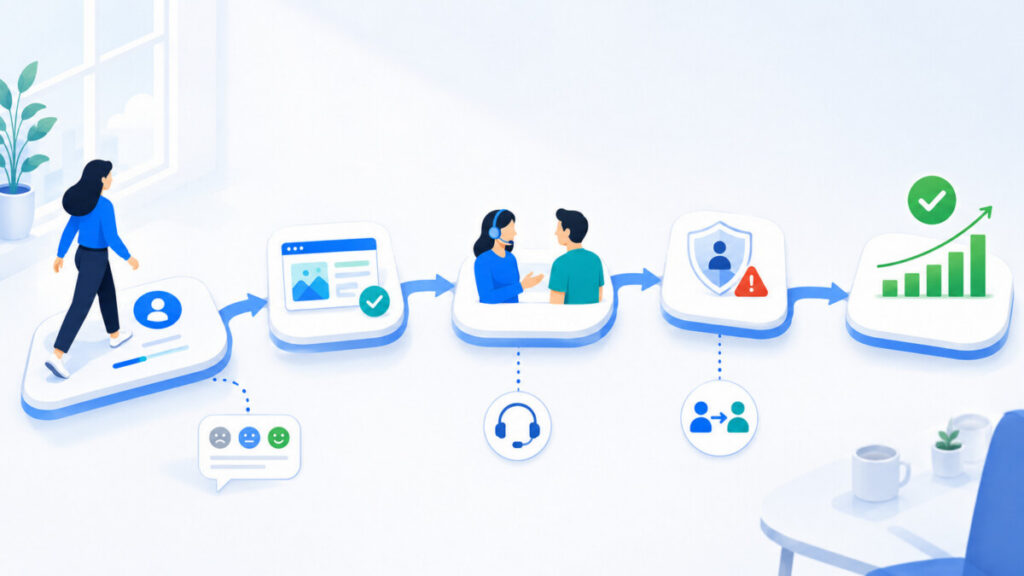
AI is fundamentally transforming customer experience (CX) in the SaaS sector. Instead of mere back-office automation, AI now enables SaaS companies to deliver deeply personalized journeys, anticipate user needs proactively, and support customers at scale—all reflected in real-world success stories with quantifiable impact. The result: not just better operational metrics, but higher loyalty, improved retention, and measurable gains in user satisfaction.
AI’s most salient roles in SaaS CX are threefold: personalization, automation, and predictive analytics. Used together, these functions initiate a sea change in how users perceive and interact with cloud software.
Personalization moves SaaS away from undifferentiated journeys. AI learns preferences, workflows, and interaction histories, enabling the software to adapt onboarding, nudge features, or serve recommendations that mirror each user’s intent.
Automation targets friction: AI chatbots, dynamic documentation, and auto-triage shrink wait times, offering “always-on” service without scaling up headcount. The emotional effect? Users spend less time stuck, more time achieving, and trust grows as support gets smarter.
Predictive analytics allow companies to move upstream of problems: identifying churn risk, surfacing latent needs, or activating retention plays before customers disengage. For teams, this flips the model from firefighting to foresight, emphasizing customer health over reactive support.
There’s a shift: Modern SaaS users expect not only feature depth but contextual, anticipatory service. Today’s buyers have options; a lack of personalization or slow, obscure support can tip the scales quickly. AI enables not just scalable service delivery, but memorable, emotionally resonant brand experiences—provided implementation aligns with real user journeys, not just technical possibility.
Personalization is the differentiator in a SaaS world rife with functional parity. AI-driven CX leverages event streams, account activity, and behavioral signals to customize everything from onboarding flows to periodic check-ins.
Key advantages:
Counterbalance: Over-automation risks alienating users. An onboarding journey that feels algorithmically “clever” yet cold can drive customers away as fast as neglect. Leaders weigh which touchpoints must remain human (e.g., success calls for strategic customers) and which can be orchestrated by AI (self-guided tours, in-app tooltips).
Real-world note: Some mature SaaS firms now use AI to detect not just what users do, but what they struggle with—surfacing hidden friction or sub-optimal flows for human review and redesign.
Support is usually where customer goodwill is lost or won. AI is rewriting the playbook in three tiers:
1. Intelligent Frontlines: Chatbots and virtual assistants now resolve a significant share of routine queries—in some leading SaaS helpdesks, upwards of 60% of password reset, configuration, or invoice requests are managed before human escalation.
2. Smarter Triage and Routing: AI reads ticket context, urgency, and sentiment to fast-track issues to the right specialist. Knowledge base articles are dynamically suggested, not with clunky keyword matching, but via natural language understanding—polarizing the gap between “answer found” and “still frustrated”.
3. CSAT and NPS Impact: For companies embracing AI-augmented support, the bottom line is clear: Response times drop, resolution rates on first contact rise, and both CSAT/NPS metrics climb. The gains are sharpest in businesses with complex product suites or global user bases—places where ticket volume and user diversity would overwhelm traditional models.
Operational nuance: Tools must be deeply integrated with both CRM and voice-of-customer feedback loops. AI that doesn’t learn from poor outcomes, or surfaces the wrong “intelligent suggestions,” can increase frustration. Best-in-class programs close this loop, routing negative sentiment for follow-up, refining chat scripts, and pushing new cases directly into escalation paths.
Retention is existential for SaaS. AI’s greatest value isn’t just reacting fast, but foreseeing trouble before it surfaces.
How it works:
Key performance indicators:
Trade-off: Predictive systems rest on quality, completeness, and timeliness of data. Outdated, sparse, or siloed logs yield spurious alerts. Top-performing SaaS firms prioritize unified data lakes and invest in experience management platforms that fuse product data with Voice of Customer signals for greater fidelity.
A major SaaS collaboration platform implemented AI-driven onboarding flows that adapt in real time to each organization’s industry, size, and prior integration patterns. New users receive contextually relevant setup steps, in-app recommendations, and timely reminders based on actual project workspace activity, not just user type. Results? Significant increases in activation rates and a marked rise in month-one adoption metrics, as measured by feature use and daily active sessions. Customers routinely cite “it feels like the tool knows our workflow” in feedback.
A cloud-based accounting SaaS vendor rolled out an AI-enhanced triage and support chatbot to manage escalating ticket volume during year-end reporting season. The bot resolved over half of common tax configuration and report generation issues autonomously, with escalations routed cleanly to dedicated specialists. Post-implementation: support costs dropped without reducing service hours, ticket backlog averaged under 24 hours (down from 72+), and CSAT scores improved quarter-by-quarter. Notably, negative comments about “waiting for help” vanished almost entirely from open-text NPS responses.
A growth-stage subscription management platform used AI analytics to flag early drop-off patterns among mid-market customers. When low-usage signals appeared, the system automatically triggered success manager check-ins and tailored product tutorials. Over six months, observed churn rates halved for the flagged segments compared to untreated cohorts. Client testimonials referenced “timely reach out” and proactive help as key reasons for renewing contracts, affirming the emotional resonance of intelligent intervention.
Sustained CX excellence in SaaS depends on AI’s capacity to adapt—to learn from every new touchpoint, complaint, and closed-loop survey.
Machine learning cycles in action:
Practical example: One SaaS analytics provider feeds VoC verbatims directly into model retraining, ensuring that pain points (“integration was confusing,” “export didn’t work as expected”) lead to actionable changes not just in the product, but in which help docs or tooltips appear proactively.
Organizational effect: Teams get early warning on trending issues, can iterate journey maps rapidly, and close the gap between individual customer pain and operational process fixes.
When this works: CX leaders incorporate customer feedback governance—formal review processes, action planning, and transparent communication on improvements based on AI insights.
Smart deployment of AI in CX isn’t plug-and-play. The most common hazards fall into three buckets:
Best practices:
The operational reality of AI in CX comes down to readiness, fit, and disciplined measurement. Below is a working checklist for SaaS CX leaders considering or optimizing AI deployments.
| Category | What to Assess | Questions to Ask |
|---|---|---|
| Data Infrastructure | Quality, integration, accessibility | Is product/support feedback unified and current? |
| Organizational Alignment | CX strategy, collaboration | Who owns CX outcomes across functions? |
| Measurement Capability | Baseline and ongoing metric tracking | Are CSAT, NPS, and churn tied to specific interventions? |
| Vendor/Solution Fit | Scalability, transparency, integration | Does the AI tool explain its actions? Integrate smoothly? |
| Change Management | Training, communication | Are front-line and back-office teams prepared for new workflows? |
Decision logic: Skip “AI for AI’s sake”; choose use cases that close real user journey gaps. If you can’t measure it, you probably can’t justify it.
By personalizing user journeys, anticipating support needs, and identifying churn risk, AI in CX enables SaaS vendors to create timelier, more relevant, and more emotionally resonant touchpoints—leading to higher satisfaction, loyalty, and retention.
Core hurdles include fragmented data, over-automation that sacrifices human nuance, change management for teams, and customer trust in machine-driven touchpoints. Effective programs address data hygiene, orchestrate human/AI handoffs, and build CX skills throughout the organization.
Key KPIs include CSAT, NPS (especially text feedback), retention/churn rates, first-contact resolution, ticket backlog, and upsell/cross-sell conversion. Tracking both operational and emotional outcomes is critical to understanding true AI enhancement.
Notable stories include SaaS platforms delivering AI-personalized onboarding that lifts activation metrics, support desk automation that slashes response times and boosts CSAT, and churn prediction tools triggering proactive outreach that halves customer attrition. Each case centers emotional resonance—users feel seen and supported, not just processed.
Through behavior-based learning, AI adapts interactions to each customer’s journey—serving the right message, recommendation, or support at the right time—while handing off strategic or nuanced moments to human agents. Success demands continual model training with fresh feedback and tight human oversight.
No. While AI automates high-volume, routine tasks with growing sophistication, the most effective SaaS CX models retain humans for complex, context-rich, or emotionally sensitive interactions. Hybrid approaches deliver efficiency while sustaining empathy and trust.
AI in CX for SaaS isn’t about replacing people with algorithms. It’s about scaling the human elements of care, anticipation, and personalization, using intelligence—artificial and authentic—to build experiences customers talk about, renew with, and recommend. Success stems from orchestrating the technology as a tool for genuine connection, not just cost reduction or speed. SaaS brands that recognize this are already reaping the deepest gains.
Copyright © 2023. YourCX. All rights reserved — Design by Proformat
