


- Research platform
Sources of information
Data analysis
Actions

- Solutions
For whom
Problems / Issues

- Materials
Materials
- About us
About us
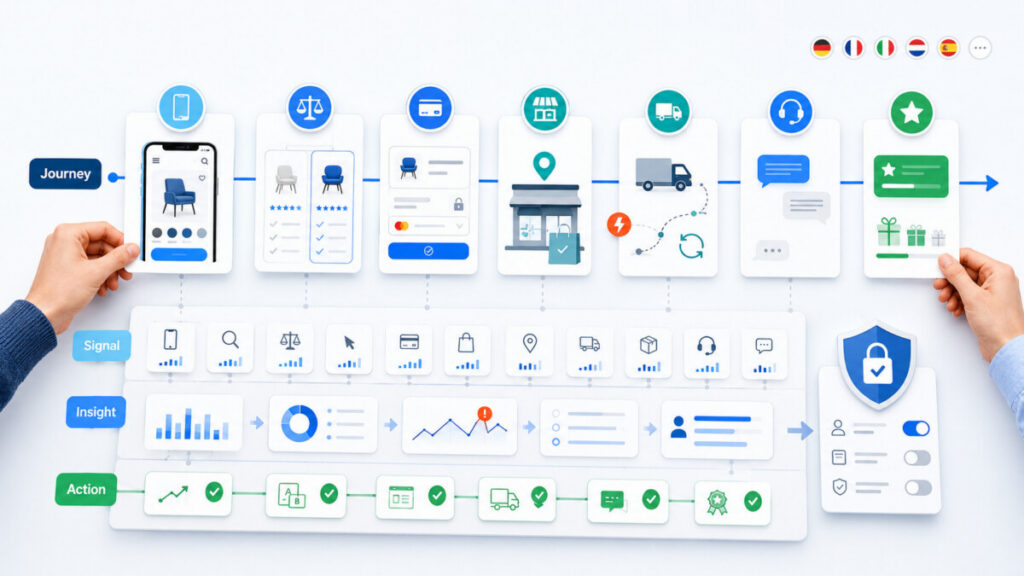
European e-commerce leaders aren’t winning by accident. Their edge comes from a mix of advanced journey mapping and rigorous data integration, enabling them to pinpoint friction, deliver personalization, and navigate privacy compliance with confidence. That pays off in reduced churn, greater customer value, and trust—a playbook increasingly critical in a market defined by both fierce competition and demanding regulatory scrutiny.
Optimizing the customer journey isn’t a niche exercise for European retailers—it’s become an operational imperative. The region’s digital commerce landscape is fragmented, multilingual, and localized. Payment preferences, delivery expectations, and privacy attitudes can shift markedly across borders, requiring a nuanced approach to customer experience management.
Why does this matter for growth and retention? Markets are saturated. Differentiation increasingly comes not from product variety or price, but from the quality, consistency, and adaptability of the overall experience. European consumers expect frictionless, personalized service, but will quickly defect if mishandled or if their privacy feels at risk. This makes journey optimization both a revenue engine and a risk-mitigation strategy.
Yet, subtle regional challenges abound:
Forward-thinking players who invest in customer journey optimization pull ahead: they reduce operational inefficiency, identify emerging pain points sooner, and continuously adapt to evolving consumer behavior.
European retailers at the top of their game don’t guess where friction lies—they use granular, data-driven journey mapping. Consider a digital-native apparel player operating across DACH and Benelux. Their CX team combines clickstream analytics, voice of customer surveys (collected post-purchase and post-interaction), and qualitative session recordings to map journeys for both logged-in and guest users.
This multi-source approach reveals not just where customers abandon carts, but why: product comparison confusion, checkout field ambiguity, or delayed promotional pop-ups that frustrate returning users. Equally, it highlights moments of delight—fast-loading wishlists, one-click repeat purchase, or real-time order tracking.
Tools used here range from experience analytics platforms (heatmapping, session replay) to direct customer feedback (NPS, in-app surveys) and custom dashboards blending operational and behavioral data. The real strength is in closing the loop: observed friction points are not just flagged, but traced to root causes—sometimes as technical as mislabeled fields or as operational as delayed CS responses.
Omnichannel is no longer an aspiration; it’s a baseline. For mature European brands, mapping journeys means tracking movement across web, mobile apps, and brick-and-mortar stores—as well as call centers and social DMs.
Take a pan-European electronics retailer mapping an upgrade journey: the customer might research on mobile during their commute, visit a store for a demo, then make a purchase online (using click-and-collect), and finally engage in a loyalty program via email.
Effective mapping here is not linear. It involves:
Journey maps that surface these breakdowns are visual, dynamic, and easily updated—not static PDFs. Best-in-class teams use journey orchestration platforms that connect real-time operational data with CX metrics to maintain living documents that drive action, not just insight.
Journey mapping, done well, is deeply cross-functional. Leading European e-commerce teams avoid silos by running regular, multi-department mapping workshops—with CX, marketing, IT, and operations all at the table.
Collaboration is enabled by:
This approach not only generates better journey insights; it fosters a culture of collective accountability.
Fragmented data is the enemy of good CX. European leaders increasingly deploy Customer Data Platforms to unify customer profiles, integrate behavioral, transactional, and service data, and enable single-source-of-truth analytics.
Mature CDP deployments:
With this unified foundation, journey optimization moves from best-guess to evidence-based orchestration—enabling timely, relevant interventions and reducing “dead spots” where customer context is lost.
Traditional rule-based personalization suffices for simple journeys; scaling it across channel complexity and multiple geographies requires AI. Top European e-commerce players now harness:
Notably, predictive segmentation enables tailored campaigns without over-personalizing to the point of creepiness—a particular sensitivity in European markets with strong privacy cultures.
Example: a multi-country beauty retailer leverages AI to adjust product upsell and replenishment prompts based on season, prior browsing, and loyalty tier—generating higher conversion while containing costs.
True omnichannel personalization hinges on reliably connecting customer actions across devices and touchpoints—a challenge that intensifies in Europe, where browser privacy and cross-domain tracking limits have teeth.
Advanced identity resolution involves:
A grocery retailer with physical and digital presence saw basket sizes increase after investing in CDP-powered identity resolution, enabling cart continuity across app, site, and in-store self-checkout. The result: fewer abandoned journeys, smoother handoffs, and more unified service recovery when issues crop up.
Privacy is not a cost center in European e-commerce—it is table stakes. The GDPR’s scope includes every aspect of customer journey analytics, data integration, and personalization. Beyond mere consent management, obligations include:
Regional overlays (Italy’s focus on consent logging, Germany’s intolerance for implicit consent, France’s ePrivacy requirements) mean journey initiatives must be built with regulatory flexibility and robust audit trails.
Rather than treating compliance as a hurdle, the best European e-commerce organizations use it to differentiate. Tactics include:
Brands known for transparency and respectful personalization consistently report higher trust, NPS, and loyalty scores across competitive benchmarks.
Optimizing the journey starts and ends with the right analytics discipline.
Primary metrics include:
KPI selection often differs by journey stage (consideration, purchase, post-purchase) and should always include an interpretation layer—a dashboard that surfaces both trends and their operational context.
Static journey analysis yields little value in fluid markets. Leaders combine "hard" analytics (conversion rates, journey drop-offs) with "soft" signals (qualitative VoC, NPS verbatims, session recordings) in a continuous loop:
Teams should avoid treating analytics as an add-on. The highest impact comes when analysts and CX professionals drive change in tandem, not in sequence.
Pitfalls abound—but so do opportunities to course-correct:
The right approach is always contextual: start where the greatest friction lies, align technology with business and compliance goals, and build incrementally to avoid overreach.
Here’s a checklist distilled from leading European e-commerce operations—a practical workflow to embed advanced journey optimization, combining mapping, data, AI, compliance, and measurement.
| Step | What to Do | Key Deliverable | Tips and Trade-offs |
|---|---|---|---|
| 1 | Map the Full Customer Journey | Dynamic, shared journey map spanning web, mobile, store, and service | Involve all channels; update regularly with new pain points and delight moments. |
| 2 | Integrate Data Sources (Deploy CDP if possible) | Unified customer profiles with real-time updates | Layer in localization and compliance logic early. Avoid data silos by including offline data where possible. |
| 3 | Implement AI/ML for Personalization | Predictive segmentation and next-best-action orchestration | Pilot small, expand with customer feedback loops. Don't overshoot for full automation—balance scale and empathy. |
| 4 | Ensure Privacy Compliance | Documented compliance reviews, updated consent management, privacy impact assessments | Bring legal/compliance partners into design, not just post-factum. Integrate opt-out mechanisms into journey maps. |
| 5 | Continuous Measurement & Feedback Integration | KPI dashboards, closed-loop analytics, regular test-and-learn cycles | Mix quantitative and qualitative data; prioritize actionable over exhaustive metrics. |
| 6 | Foster Cross-Team Alignment | Multi-department forums, shared OKRs, joint journey reviews | Maintain CX champions in every team—embed journey mindset into daily operations. |
Regularly review and refine this workflow as new channels, capabilities, and regulations emerge. The goal is not a “final” journey, but an adaptive one.
Leading retailers combine quantitative data (clickstream, transaction logs, drop-off analysis) with qualitative insights (NPS surveys, session replays) to map experiences across all relevant channels. Dynamic mapping tools—updated with real-time data and cross-team feedback—enable continuous, actionable journey management.
CDPs unify fragmented customer data into a single, actionable profile. This integration allows for consistent personalization, real-time segmentation, and predictive analytics—making it possible to tailor every touchpoint, track soft and hard KPIs, and maintain robust consent and privacy controls across channel boundaries.
GDPR prohibits indiscriminate data collection and requires explicit, granular consent for profiling and personalization. Regional laws add further requirements, such as strict logging of consent and particular rules for cookies (ePrivacy). Journey analytics must be privacy-centric, with clear opt-out paths and explicit user communication.
AI powers dynamic recommendations, next-best-action engines, advanced segmentation, and real-time service triage. In European e-commerce, this often includes personalization of content based on local trends, automated detection of conversion issues or churn risk, and adaptive messaging aligned with explicit consent levels.
The most relevant KPIs include journey-based CSAT, stage-specific NPS, average order value (AOV), retention/repeat purchase rate, and customer lifetime value (CLTV). Select metrics based on journey stage and business goals, and integrate both quantitative outcomes and VoC/feedback for context.
Top pitfalls include over-engineering personalization (leading to privacy fatigue or legal risk), ignoring offline or non-digital touchpoints, failing to localize compliance practices, over-relying on generic solution stacks, and tracking too many metrics without a focus on actionable insight.
Unlocking success in European e-commerce hinges on sophisticated customer journey optimization, blending advanced journey mapping with cutting-edge data integration. The following takeaways present actionable insights and strategies drawn from leading European online retailers’ experiences.
By leveraging these proven tactics, European e-commerce companies can transform fragmented interactions into cohesive journeys that delight customers and drive quantifiable business results. The in-depth analysis above explores practical frameworks, technology applications, and best practices to help you unlock these customer journey wins.
Copyright © 2023. YourCX. All rights reserved — Design by Proformat
