


- Research platform
Sources of information
Data analysis
Actions

- Solutions
For whom
Problems / Issues

- Materials
Materials
- About us
About us
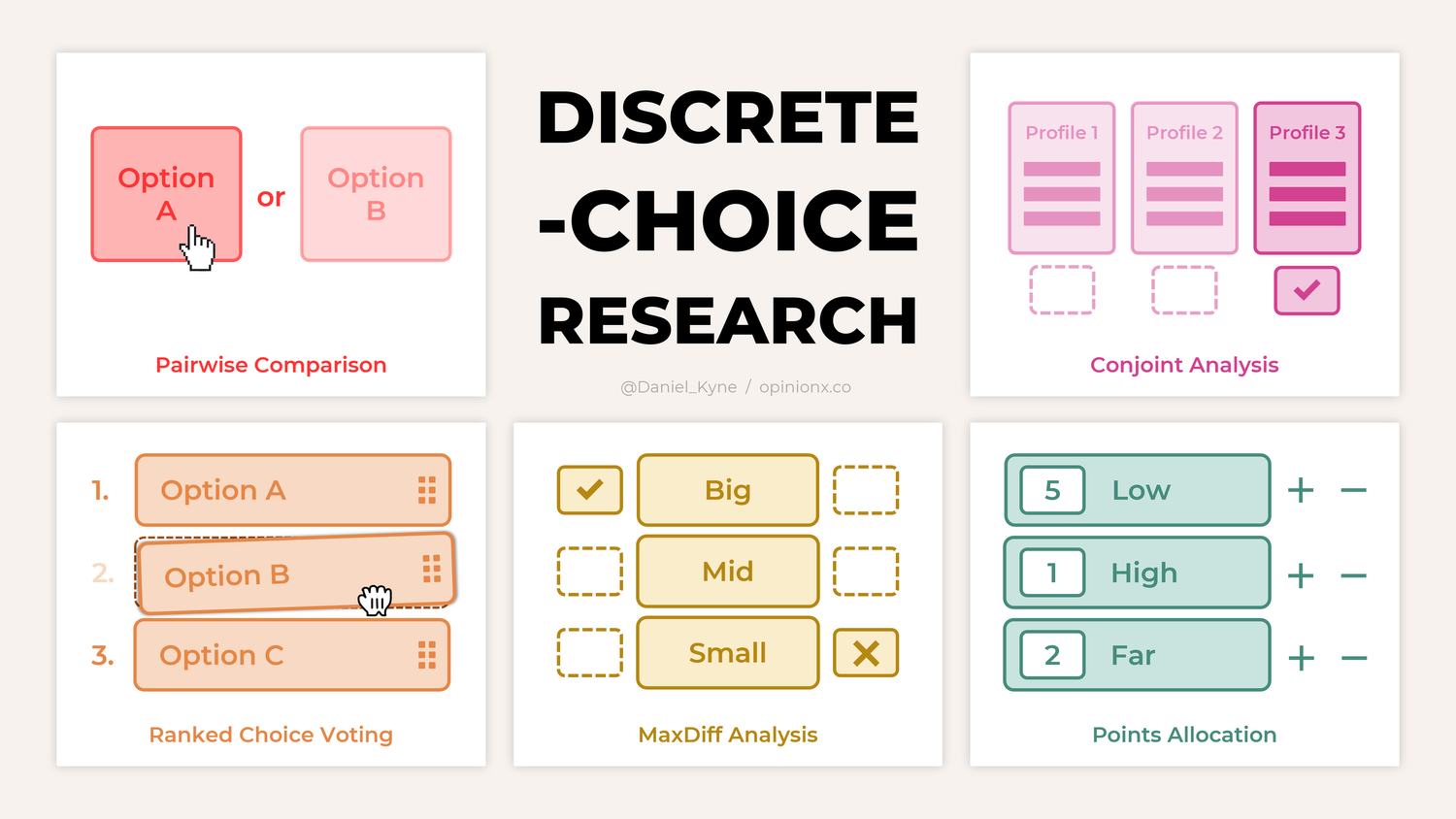
In market research, understanding the differences between conjoint analysis vs discrete choice is key for capturing consumer preferences well. Both methods reveal how people decide among different options, but they use very different techniques. If you're considering which method to use for your next research project, knowing their differences and contexts is important.
This article will explain the basic definitions and outlines of conjoint analysis and discrete choice modeling. It will offer a clear view of both methods and how they're used in real situations. You'll discover which method suits your research needs better. We will also point out software tools that can make your analysis easier. By the time you finish reading this, you will have enough knowledge to choose the best approach that matches your goals for research.
Conjoint analysis and discrete choice are both used to study how consumers make decisions. Traditional conjoint analysis requires at least two attributes, each with multiple attribute levels, and these are combined to create product profiles. Conjoint analysis shows how consumers view different product features by presenting respondents with sets of product profiles, each representing different combinations of attributes and levels. Researchers can then find which features matter most to people and how combinations of features affect choices. Conjoint analysis and discrete choice analysis are often used interchangeably in market research, but they have distinct methodologies.
Discrete choice analysis is a common form of choice based conjoint. It focuses on presenting respondents with a choice set of product profiles, each with different combinations of attributes and levels. The choice set in discrete choice conjoint analysis is designed to reflect the business objectives and learning goals of the client. Discrete choice conjoint analysis simulates real-life decisions by presenting respondents with multiple product profiles, each product or service having a profile consisting of various attributes and levels. This survey process uses different combinations of attribute levels in product profiles to realistically simulate consumer decision-making. It is built on utility maximization, where each choice aligns with a certain utility value based on preferences. This method helps see how different factors like price can sway choices.
Both methods aim to understand consumer behavior by examining choice data. They show how factors like demographics and product features impact decisions. Companies use these methods to enhance products, pricing, and marketing strategies. This ensures alignment with target markets.
Understanding utility maximization is key in both methods. Consumers aim for the product that gives them the highest satisfaction based on different features. By studying these choices, businesses can make predictions on how shifts in features and markets may alter consumer behavior, resulting in better strategies.
As we explore more of the differences between these two methods, we will look at their specific methods and uses in various markets.
It is key to understand the methodologies and applications of conjoint analysis vs discrete choice. Each methodology has strengths and serves varying research needs. Both act as valuable tools in market research. Experimental design is crucial in both conjoint analysis and discrete choice modeling, as it involves selecting appropriate attribute levels and combinations to create efficient and realistic choice experiments.
Market researchers play a central role in designing these studies, defining clear research objectives, and managing the research process to ensure actionable insights. The survey design in discrete choice conjoint (DCC) involves defining the goal of the study, identifying the products or services to be tested, and specifying the business decisions it will inform.
Conjoint analysis often helps in product optimization. This allows understanding how attributes affect consumer preference. It’s especially effective in pricing research. Marketers can see how price changes influence consumer choices. This method also aids businesses in identifying optimal product features. Conjoint analysis can be used for pricing studies, product optimization, and healthcare options, and is often used in healthcare to determine patient preferences for different treatment attributes.
Discrete choice modeling does well to understand consumer preferences in many scenarios. This is important in market segmentation. Businesses can find different consumer segments based on choices. Discrete choice also examines the competitive landscape by seeing how alternatives and competitive products impact buying decisions. Market researchers use DCC to predict market share, test product configurations, and identify needs-based segments.
Companies can utilize both methodologies in sectors like consumer goods, automotive, and healthcare. For example, in automotive research, conjoint analysis can show which car features consumers value. Discrete choice methods can reveal preferences for different car brands when they compete. Studies can include more attributes and different attributes, such as brand and other attributes relevant to competitive products, and these should be realistic, mutually exclusive, and comprehensible to respondents.
Choosing between these methodologies often relates to the research context and goals. Conjoint analysis suits simple product configurations and pricing schemes. Discrete choice modeling works for deep analysis of behavior, and consumer segmentation. The sample size and number of respondents are critical for ensuring the accuracy and effectiveness of discrete choice analysis, as they directly impact the reliability of results.
As we move to the next section, considering methodologies is important. The specific scenarios for one approach to outperform the other must be kept in mind. This assists in making an informed choice regarding conjoint analysis vs discrete choice based on research needs.
Choosing between conjoint analysis vs discrete choice modeling depends on the specific goals and context of your research. Knowing the strengths and limits of each method helps in getting meaningful insights from your study.
Conjoint analysis works well when the focus is on what consumers value in product attributes. This method is great for assessing trade-offs in a competitive environment, showing how consumers prioritize features during decisions. It lets researchers design realistic product scenarios that guide future development and marketing strategies. For example, a company launching a new smartphone might use conjoint analysis to find out which features like battery life, camera quality, and price are most appealing to their target audience.
Discrete choice modeling is best for research needing deep insights into consumer preferences and decision-making processes. This method shines when the aim is to analyze several alternatives in actual market contexts and see how changes in product offerings or prices might affect consumer choices. Discrete choice is favored for being a more natural task and more realistic than traditional ranking or rating methods, as it closely mirrors the choices consumers make in real-world settings. Discrete choice conjoint analysis simulates real-life decisions by presenting respondents with various scenarios and a choice set of product profiles, asking them to select their preferred product or 'none of these'. Choice-based tasks typically consist of 8 to 12 tasks, each with 2-5 alternatives, and the total number of scenarios presented depends on the experimental design. A well-considered choice set is the foundation of all good discrete choice models. Including a 'none' option in the choice set can improve the simulated decision-making experience and better reflect real-world shopping behavior, where customers might refuse all options.
Discrete choice fits market simulations well, enabling market simulation to estimate market share and predict how the choices consumers make among one alternative or multiple options affect outcomes. For example, it can show how a price increase influences demand among competitor products and how individual-level preference estimation can improve market share estimation and segmentation strategies.
Furthermore, knowing the significance of statistical interactions is important in picking the right method. If research looks into how consumer value on a specific attribute changes based on another attribute’s level, discrete choice modeling is the choice. It allows for deeper analysis of interactive scenarios that could miss important insights when using conjoint analysis only.
In conclusion, the decision of conjoint analysis vs discrete choice should be based on research goals’ complexity, the competitive environment’s nature, and the analysis depth needed. By matching research needs to the strengths of each method, insightful direction for strategic decisions can be achieved.
Studies often draw parallels between these methods. Each serves distinct purposes but can overlap in specific contexts. Thus, understanding each methodology’s unique contribution is critical in research planning.
When you need to test multiple attributes at once, use conjoint analysis. It works great in providing consumer insights through realistic product evaluations. Meanwhile, discrete choice is the method to consider when the goal is to dig deeper into preferences among multiple options.
Overall, both conjoint analysis vs discrete choice present valuable insights. Their proper application can markedly impact business strategies. Understanding consumer behavior from these frameworks can drive effective marketing campaigns.
In today’s markets, choosing the right method can set your study apart. Each skillfully applied technique leads to better strategies founded on strong consumer insights. Future-proofing products and services relies on such insights, so make informed choices.
In summary, selecting between conjoint analysis vs discrete choice modeling hinges on your research context. Each method offers different strengths for diverse research questions. Long-term benefits arise from using the right methodologies effectively based on research needs.
When looking at the differences between conjoint analysis vs discrete choice modeling, it is crucial to examine the strengths that each method has. These methods have their own roles in studying consumer behavior. Discrete choice modeling is an advanced analytical technique that uses statistical models such as the multinomial logit model and hierarchical bayes to estimate utility scores and part-worth utilities, providing a robust framework for understanding consumer choices.
Conjoint analysis gives strong insights into what consumers like. It helps researchers to model different scenarios and see how various product features sway consumer decisions. Utility scores and part-worth utilities are calculated to indicate how much each attribute level contributes to the overall preference, and these are often estimated using hierarchical Bayesian modeling. This insight is key for businesses aiming to find the best mix of product features that boost customer satisfaction and increase the chance of a purchase.
In contrast, discrete choice modeling works well in imitating real-world choices. This method accounts for the complexities and compromises that buyers face in real-life shopping. In markets where many products compete, this approach is very useful. Discrete choice modeling uses random utility theory, showing how buyers value various features against each other. Hierarchical Bayesian (HB) estimation and multinomial logit models are commonly used in DCE to calculate individual-level preference coefficients, which helps account for heterogeneity in the market. DCE can handle complex problems with many attributes and levels, making it suitable for detailed market analysis, and is often preferred over traditional conjoint analysis for its ability to simulate real-world decision-making processes.
Moreover, discrete choice modeling helps measure interaction effects precisely. Analysts can look at how one feature’s impact varies based on another feature’s level. For example, if research shows that buyers prefer high quality with low prices, this can powerfully influence pricing strategies and product design. Market share estimation is improved by individual-level preference estimation through hierarchical Bayesian models, and willingness to pay can be measured for specific improvements.
The preference model provides the full story by integrating utility scores, relative importance, and relative preference to understand consumer decision-making. This comprehensive approach ensures that businesses do not rely solely on individual metrics, but instead gain a complete understanding of what drives choices in the market.
In conclusion, deciding between conjoint analysis vs discrete choice should depend on the study goals. While conjoint analysis dives deep in understanding preferences, discrete choice models handle real-world decision-making and features interactions better. Companies need to evaluate their demands to pick the right method for useful market analysis.
As we look deeper into practical uses, checking the tools and software for analyzing these methods will offer great insights on how businesses can apply these techniques in a smart way.
When choosing between conjoint analysis and discrete choice, think in two layers: running the study and estimating/simulating preferences.
In practice: start with a platform that streamlines research execution (often the real bottleneck), then add specialized modeling tools only if the project requires it.
In summary, knowing the differences between conjoint analysis vs discrete choice is key for making smart market research choices. Both methods give insights into consumer preferences. However, they work better in different situations and may provide different results based on specific needs. We looked at the definitions, methods, and pros and cons of each, plus practical uses that help you pick the best approach for your project.
As you work on market research, keep in mind the important factors that guide your choice: the type of product, the audience you target, and the level of detail you need. It's time to take this knowledge and apply it to your analysis, whether you prefer conjoint analysis vs discrete choice. Picking the correct method can boost your understanding of consumer habits and improve your marketing efforts.
In the end, choosing between conjoint analysis vs discrete choice, make sure you use the right tools and methods to make informed decisions. Use these insights to drive understanding of consumer preferences toward success.
YourCX is a comprehensive research platform specializing in customer experience (CX) analytics and feedback management, providing businesses with essential tools to understand and enhance customer satisfaction.
Discover how to elevate your customer interactions across all channels - visit YourCX today!
Copyright © 2023. YourCX. All rights reserved — Design by Proformat
