


- Research platform
Sources of information
Data analysis
Actions

- Solutions
For whom
Problems / Issues

- Materials
Materials
- About us
About us
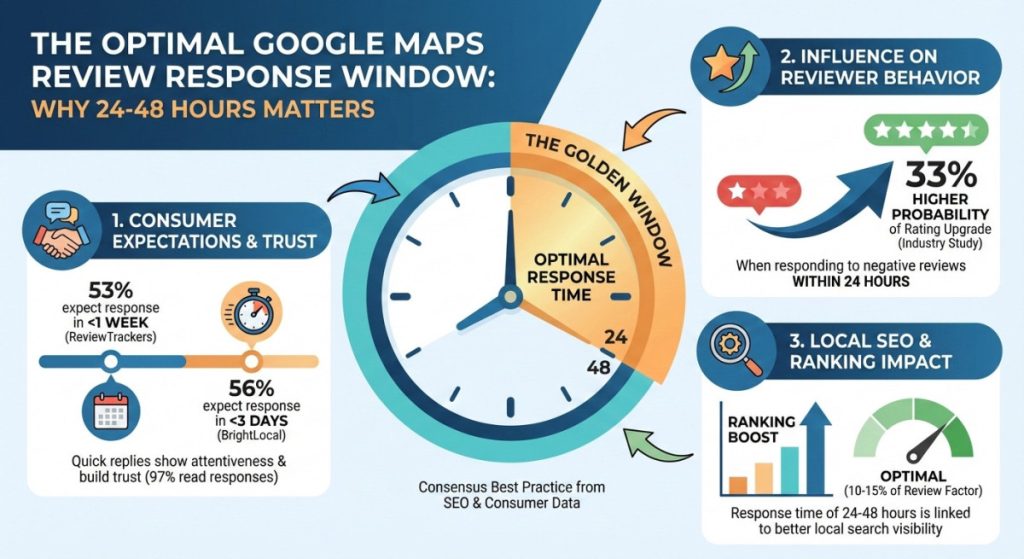
Optimal management of reviews on Google Maps requires consistent activity and speed of response, especially for negative reviews. But do we need to stick to a rigid 48-hour limit? In principle, no. While quick response is crucial to building trust, the 48-hour standard is more of a marketing suggestion than a hard Google algorithmic requirement. Algorithms give preference to company profiles that are active and responsive to feedback, which signals customer care and timeliness of information.
Indeed, some studies (e.g., BrightLocal) confirm that consumers rely heavily on reviews (81% of consumers check them before buying) and that companies actively responding to reviews generate more engagement (e.g., more clicks in search results). Note, however, that there is no direct scientific evidence linking these benefits to the precise 48-hour limit.
With this guide, you'll understand why strategic speed and consistent presence are the best way to build a positive business image and increase traffic and conversions from Google Maps, rather than blindly following anecdotal time limits.
The guide discusses in detail the concept of strategic activity as a recommended approach to responding to all types of Google Maps reviews, the differences in prioritizing negative and positive reviews, and procedures for monitoring reviews in real time. It does not cover automating responses, buying reviews, or manipulating Google guidelines.
This guide is designed for business owners managing a Google business card, customer service managers responsible for company reputation, and local marketing professionals. Whether you manage a single location or a chain of stores, you'll find practical solutions for managing reviews that focus on quality and timeliness rather than arbitrary limits.
A consistent and timely response to Google Maps reviews directly affects customer trust and position in local search results. Companies with high ratings (e.g., above 4.5 stars) generate higher engagement. In addition, a quick (but thoughtful) response to negative reviews is key: every day of delay in dealing with a disgruntled customer reduces the chances of regaining their trust and repairing the company's image.
Strategic activity in response to Google Maps reviews means responding quickly and consistently to user reviews.
This standard of activity stems from analysis of consumer behavior and the expectations of potential customers checking a company profile before making purchasing decisions. Google's algorithms locally favor profiles with regular, authentic responses, which translates into a higher position in Google Maps.
Google Maps review management is the process of monitoring, analyzing and responding to reviews in a timely manner, with the goal of building a positive company image and increasing conversions from local search results.
Positive reviews (4-5 stars) build customer trust and provide purchasing arguments for new users. They contain details about the company's services, service or products, providing valuable material for potential customers. Priority of response: Make sure to respond within 1-2 business days with a personalized thank-you note relating to a specific service.
Neutral reviews (3 stars) often include constructive criticism and suggestions for improvement. The company has a chance to demonstrate its professionalism and willingness to improve your services. Urgency of response: Require a response within 1 business day with a concrete proposal to solve the problem or an invitation to contact you privately.
Negative reviews (1-2 stars) have the greatest impact on company reputation and consumer decisions. Failure to respond quickly is interpreted by potential customers as a lack of concern for customer satisfaction. They demand the highest priority and an almost immediate response (as soon as possible).
This ties in with Customer Experience goals, as each type of feedback has a different image value, but all require a professional response within an established high-priority response procedure.
Catering and HoReCa require the fastest possible response due to the emotional nature of the experience. Negative reviews about service or food quality require immediate attention; positive comments require a quick thank you, preferably within 24 hours.
E-commerce and retail operate under a standard of high prioritization for all types of feedback, with a drive to respond within 24hours. Customers expect efficient communication similar to chat or email support.
Professional services (medical, legal, finance) may operate with a more subdued but consistent dynamic (response in a maximum of 2 business days) due to the nature of the industry and the need to verify information according to Google's regulations.
Building on the previous section, each industry has different dynamics of expectations, but consistent adherence and timeliness (rather than a rigid 48h limit) remains key to maintaining professionalism in the eyes of potential customers.
Analyzing the types of reviews and their different image requirements, consistent and timely activity is becoming a universal standard for professional Google Maps review management. The priority is not the algorithmic limit, but the customer's expectations.
Data from 2024 shows that 93% of users have made a purchase decision based on online reviews, and consumers choose companies with a rating of at least 3.3 stars. Companies that proactively and regularly respond to reviews have a higher average rating on average, as they demonstrate customer care.
YourCX research shows that responding within the first 4 hours significantly increases the chances of improving the relationship with a dissatisfied customer (by 67%). At the same time, not responding to negative feedback is interpreted by 78% of potential customers as a sign of not caring.
In the case study, it was proven that drastically reducing the response time (e.g., from more than 72 hours to less than 2 hours) yielded measurable results, such as an increase in the average rating from 3.2 to 4.6 stars and a 20% increase in the number of purchases. This indicates the great importance of speed, rather than a specific, rigid limit.
Google locally favors profiles with regular and authentic responses as a signal of activity and commitment to customer service. Two business days (about 48 hours) is a timeframe that, if consistently adhered to, provides consistency without undue stress on the team, allowing for a thoughtful response in line with Google policy. Activity in the company profile, including regularly reviewing and responding to consumer feedback, indirectly affects position in local search results and Google maps.
In the first 24 hours after posting a review, the customer is actively checking to see if the business owner has responded to their feedback. A period of up to 48 hours is seen by most consumers as the maximum acceptable response time for a professional company.
Once this psychological limit is exceeded (48 hours), there is an impression of ignoring the customer and a decrease in trust, which directly affects the decisions of consumers choosing between competing companies on Google search. What's more, 68% of Internet users are willing to pay up to 15% more for the services of companies that demonstrate better customer service, including quick response to feedback.

Referring to the established need to respond quickly and professionally, effective management requires a systematic approach to monitoring feedback on Google Maps and a clear division of responsibility within the team so that no critical feedback escapes attention.
When to use: Companies with an active Google Business Profile account and a regular influx of consumer reviews.
| Aspect | Manual monitoring | Automatic tools |
|---|---|---|
| Cost | Low - team time only | Higher - subscription to CX platforms |
| Response time | Depends on the procedure (e.g., 2 checks per day); urgent feedback handled as a priority (usually within hours). | Immediate notifications |
| Quality of response | High personalization and authenticity of the message, tailored to the context. | Requires thoughtful templates and constant monitoring to maintain personalization. |
| Scalability | Limited to 10-20 reviews per day | Unlimited |
For small companies, a manual approach with Google alerts is recommended, for larger organizations a hybrid approach combining automatic alerts with personal verification of the content of each response.
This brings us to the most common practical challenges faced by companies implementing systematic response time management.
Google Maps' feedback management practice generates common problems that can threaten the consistency of activity and urgency of responses.
Solution: Set clear messages in the Google business card description indicating response times on weekdays, which manages expectations. Any weekend feedback should be handled as a priority on Monday morning (e.g., by 12:00 pm).
Justification: Customers understand the time constraints of small businesses, but expect clear communication about service standards in the company profile.
Solution: Introduce hard prioritization according to the rule: negative feedback → neutral feedback → positive feedback. Then use prepared response templates, taking care to personalize their content.
Justification: While our goal is to respond consistently to all reviews, the order of service is critical to a company's reputation with potential customers - criticism must be handled first.
Solution: Utilize free Google Business Profile notifications in conjunction with minimal but consistent inspection standards (e.g., 2 checks per day - morning and evening) instead of continuous monitoring.
Justification: It is better to respond less frequently, but consistently and at a set rhythm, than to respond chaotically and exceed customer expectations.
Solution: Respond quickly (preferably within a few hours, e.g., 4-8) with immediate information to start the clarification process. Then complete the details within a set timeframe (e.g., up to 48 hours) once all the facts are gathered.
Justification: The customer needs to know that his or her case is being taken seriously and the clarification process is underway, even if full resolution requires more time for the team to continue working.
Consistent proactivity and urgent response is the key to optimal feedback management in Google Maps. While 48 hours is often seen as the maximum psychological limit of acceptability for most reviews, negative reviews require a response as soon as possible (aiming for a few hours) to effectively protect the company's reputation. Consistency in adhering to this standard builds customer trust and positively impacts position in local search results.
Regular training of your customer service team in responding to consumer reviews is paramount to the long-term success of your online reputation management strategy.
To get started:
Related topics: Once you've mastered response times, it's worth exploring the topics of online reputation management, creating a Customer Experience strategy and optimizing your company profile on Google Maps. Together, these elements form a comprehensive strategy for local presence in Google search.
No, Google's algorithms do not remove reviews for non-response. Google only removes reviews when they violate Google's guidelines (spam, fake reviews, offensive content). The lack of response only affects the perception of the company by potential customers.
A business owner cannot remove customer reviews. A given user can remove his/her opinion on his/her own, and the company can report the opinion to Google support if it violates Google's terms of service.
Keep a calm tone, without referring to emotions. Apologize for the negative experience, invite direct contact and offer a solution. Avoid blaming the customer or undermining their version of events.
You can use templates, but each response should include personalization (customer's name, reference to a specific service). Completely automatic responses are easily recognizable and can lower customer confidence.
Copyright © 2023. YourCX. All rights reserved — Design by Proformat
