Predictive CX: How AI Leverages the X-O Framework to Anticipate Churn Before It Happens - YourCX

Predictive CX: How AI Leverages the X-O Framework to Anticipate Churn Before It Happens

30.12.2025

Executive Summary

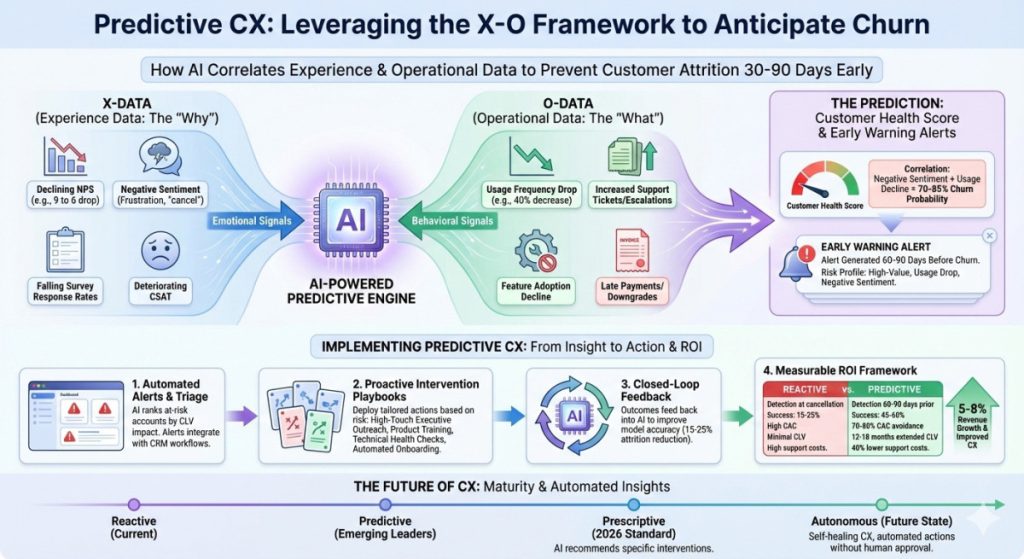
AI leverages the X-O Framework by correlating Experience Data (declining NPS, negative sentiment in customer interactions) with Operational Data (reduced product usage, support ticket patterns) to predict churn 30-90 days before it occurs. This predictive CX approach builds on our previous coverage of X-O Framework integration, transforming how companies anticipate and prevent customer attrition. Businesses leverage CX Analytics and Customer Data Platforms (CDPs) to collect, organize, and analyze customer data from various sources, enabling them to make real decisions that improve customer experience and drive growth.

This article covers predictive models, Customer Success intervention playbooks, and ROI measurement frameworks for churn prevention. CX leaders, Customer Success managers, and data analysts seeking actionable churn prevention strategies will find practical implementation guidance here. The business case is clear: predictive analytics reduces customer acquisition costs by preventing churn, while increasing customer lifetime value through proactive engagement.

Direct answer: AI anticipates churn by detecting when declining customer satisfaction scores (X-data) correlate with behavioral signals like usage drops (O-data), triggering automated alerts that enable intervention weeks before customers leave. CX Analytics provides valuable data and metrics, allowing businesses to gain a deeper understanding of their customers' needs and preferences.

Key outcomes from this article:

  • Identify early churn signals through X-O data correlation patterns
  • Deploy intervention playbooks tailored to risk profiles
  • Measure cost savings and retention improvements from predictive CX
  • Build an AI implementation roadmap for your organization
  • Prepare for 2026 predictive CX trends including automated insight generation
  • Improve customer experience and increase satisfaction and loyalty by identifying pain points and areas of dissatisfaction

Understanding the X-O Framework for Predictive CX

The X-O Framework, covered in depth in our previous article, establishes the foundation for how AI in customer service moves from reactive analysis to predictive action. By integrating Experience Data with Operational Data, organizations create the unified customer data layer required for accurate churn prediction. Analyzing a company's customer experience history using Customer Experience Analytics (CX Analytics) provides deep insights into customer behavior and preferences, which is foundational for predictive CX.

Experience Data (X) as Churn Predictors

Experience Data captures the emotional and perceptual state of your customers across their journey. Understanding the customer journey is crucial, as customer journey analytics involves tracking and analyzing customer interactions and touchpoints throughout their journey with a business. Specific metrics that signal churn risk include:

  • NPS decline patterns: A customer whose score drops from 9 to 6 within 60 days shows a 3x higher churn probability than stable promoters
  • Sentiment analysis: Negative keywords in support interactions (frustration, cancellation, competitor mentions) serve as early warning signals
  • Survey response patterns: Declining response rates or engagement drops in feedback channels indicate diminishing investment in the relationship
  • Customer satisfaction deterioration: CSAT scores trending downward across multiple touchpoints reveal systemic experience failures

These X-data signals reflect the emotional state preceding behavioral changes, making them leading indicators rather than lagging metrics.

Operational Data (O) as Behavioral Signals

Operational Data provides concrete evidence of how customers interact with your product and support operations. Key behavioral signals include:

  • Usage frequency changes: A 40% drop in monthly active usage often precedes churn by 45-60 days
  • Support ticket patterns: Increased frequency or escalation severity indicates unresolved friction
  • Feature adoption decline: Customers who stop exploring new capabilities signal reduced product investment
  • Billing and payment patterns: Late payments, downgrades, or payment method removal indicate financial disengagement
  • API usage and integration health: For B2B software, declining API calls suggest reduced product embedding in customer workflows
  • Logistics data: Delivery times, fulfillment accuracy, and other logistics metrics can reveal operational issues that negatively impact customer experience and signal potential churn

AI can identify operational friction linked to churn, such as frequent delivery delays and billing errors, enabling immediate remediation.

These O-data metrics confirm behavioral shifts that correspond to emotional changes captured in X-data.

The Correlation: Creating the “Customer Health Score”

The Customer Health Score synthesizes X-data sentiment and O-data behavior into a single metric identifying highest churn probability. This score weights multiple signals—NPS trends, usage frequency, support interactions, and feature adoption—into an actionable risk classification.

Organizations using health scoring report 20-30% higher prediction accuracy compared to single-data-source models. The score enables Customer Success teams to prioritize accounts and allocate resources where intervention yields the greatest retention impact.

The Correlation That Predicts Churn

The most reliable churn predictor emerges when declining sentiment correlates with reduced product usage. Statistical analysis across industries shows:

  • Customers with both negative sentiment trends and usage decline show 70-85% churn probability within 90 days
  • Either signal alone produces 30-40% false positive rates
  • Combined X-O correlation reduces false positives to 15-20% while maintaining high recall

This correlation pattern enables AI models to anticipate churn 60-90 days before the actual event, providing intervention windows that reactive approaches cannot match.

How AI Anticipates Churn Using X-O Data Correlation

AI’s advancement from reactive data analytics to proactive prediction represents a fundamental shift in customer experience management. Machine learning algorithms process X-O correlations at scale, detecting subtle patterns human analysts would miss across thousands of customer accounts.

Machine Learning Pattern Recognition

ML algorithms excel at identifying correlations between declining NPS and usage frequency drops that indicate churn trajectory. Key capabilities include:

  • Multi-signal processing: AI evaluates dozens of X and O signals simultaneously, weighting their relative importance based on historical churn patterns
  • Real-time detection: Modern systems process customer interactions and usage data within minutes, enabling same-day alert generation
  • Threshold calibration: Models set churn probability scores (e.g., 70%+ triggers immediate alerts) based on your specific customer base characteristics
  • Segment-specific learning: Algorithms distinguish between enterprise and SMB churn patterns, industry-specific behaviors, and cohort-based trends

Platforms leveraging ai for churn prediction report 15-25% reduction in attrition rates compared to rule-based systems.

Predictive Model Architecture

Effective predictive CX requires robust data orchestration connecting disparate systems:

  • API integration requirements: Seamless connections between CRM, product telemetry, support platforms, and survey tools ensure unified customer views
  • Training data quality: Models require 12-24 months of historical data with confirmed churn labels for accurate pattern learning
  • Continuous improvement: Accuracy increases 5-10% annually through feedback loops incorporating intervention outcomes

The YourCX platform provides the infrastructure for these advanced AI correlations through seamless data orchestration, automating the correlation between X-data sentiment shifts and O-data behavioral changes.

Early Warning Alert Systems

Automated alert systems transform AI insights into actionable notifications for support teams:

  • Risk profile delivery: Alerts include specific customer context—recent sentiment scores, usage trends, contract value, and recommended intervention type
  • CRM integration: Workflows automatically create tasks, update account health fields, and trigger escalation procedures
  • Customizable thresholds: Organizations configure alert sensitivity based on customer segment, contract value, and team capacity
  • Prioritization logic: AI-driven insights rank at-risk accounts by expected customer lifetime value impact, ensuring resources focus on highest-impact retention opportunities

Implementing Predictive CX in Customer Success Operations

Moving from reactive support to proactive intervention requires systematic changes to team workflows, resource allocation, and success metrics. Analyzing and optimizing customer support interactions is a critical part of the customer journey, as these touchpoints significantly impact satisfaction, loyalty, and retention. Organizations that implement predictive CX effectively report operational efficiency gains of 20-30% in Customer Success operations. Effective customer experience strategies also require intentional collaboration and shared accountability between teams.

Customer Success Intervention Playbooks

Deploy intervention strategies based on risk profile, customer segment, and churn signal type:

  1. High-touch executive outreach: For enterprise accounts showing churn signals, schedule executive business reviews within 5 business days to address strategic alignment concerns
  2. Product training sessions: Customers with declining feature adoption receive targeted enablement focused on underutilized capabilities that drive retention
  3. Technical health checks: Accounts showing integration issues or API usage decline receive proactive technical reviews and optimization recommendations
  4. Automated onboarding refreshers: Lower-tier accounts with usage pattern concerns receive self-service resources and automated guidance

Each playbook defines trigger conditions, response timelines, responsible team members, and success metrics.

ROI Measurement Framework

MetricTraditional Reactive ApproachPredictive Intervention
Churn detection timingAt cancellation request60-90 days prior
Intervention success rate15-25%45-60%
Customer acquisition cost impactFull replacement cost incurred70-80% cost avoidance
Customer lifetime value preservationMinimal12-18 months extended average
Support costs per at-risk accountHigh (escalation-driven)40% lower (proactive resolution)

Organizations implementing predictive CX report 15-20% customer satisfaction improvements and 5-8% revenue growth from reduced churn and expanded customer lifetime.

Team Workflow Integration

Effective implementation requires workflow changes across the Customer Success organization:
  • Daily churn alert review: Team leads triage new alerts each morning, assigning high-priority accounts and reviewing intervention outcomes from prior actions
  • Escalation procedures: High-value accounts exceeding 80% churn probability trigger same-day executive notification and cross-functional response coordination
  • Closed-loop feedback: Intervention outcomes feed back into AI models, improving prediction accuracy and refining threshold calibration
  • Metrics tracking: Teams monitor intervention-to-retention rates, time-to-response, and customer health score improvements to optimize playbook effectiveness

Common Implementation Challenges and Solutions

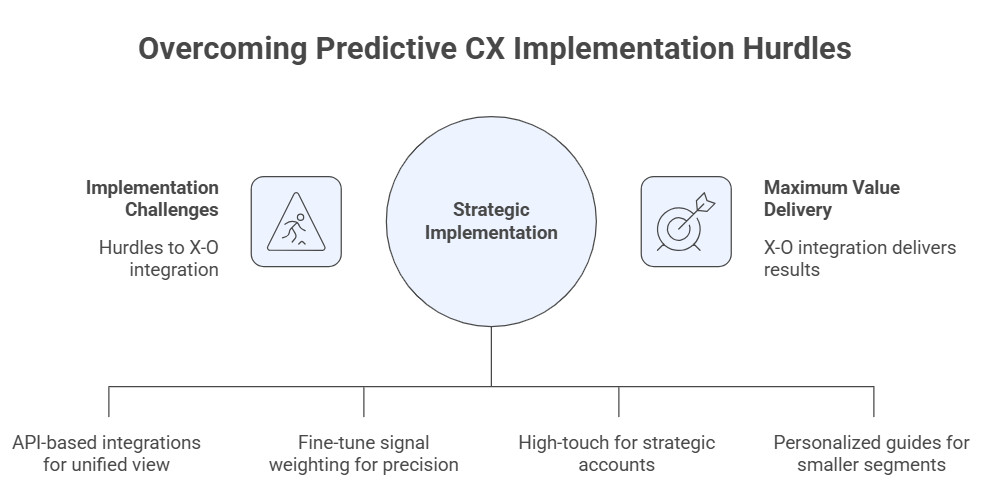
Deploying a predictive CX model is a strategic shift that comes with predictable hurdles. Based on our experience, here is how to navigate the most common obstacles to ensure your X-O integration delivers maximum value.

1. Data Silos (The Lack of a Unified Customer View)

In most organizations, Experience Data (X) and Operational Data (O) live in isolated systems. Without a unified data layer, AI cannot detect the correlations that predict churn.

  • The Solution: Implement a centralized Customer Data Layer through API-based integrations. The YourCX platform is specifically designed to orchestrate these disparate data streams, creating a "single source of truth" where sentiment and behavior meet.

2. "Alert Fatigue" and False Positives

If a predictive model is too sensitive, it generates excessive alerts, leading Customer Success teams to lose trust in the system.

  • The Solution: Start with conservative thresholds (e.g., 85% churn probability). As the model learns and your team validates the outcomes, you can fine-tune the signal weighting—such as prioritizing sentiment trends over static NPS scores—to increase precision.

3. Team Capacity and Actionability

Identifying an at-risk customer is only half the battle; having the resources to intervene is the other.

  • The Solution: Use the X-O model to prioritize interventions based on customer value and risk level:
    • High-Touch: Direct human intervention for strategic, high-LTV accounts.
    • Low-Touch: Automated, personalized "recovery journeys" (e.g., targeted tutorials or feature adoption guides) triggered for smaller segments to ensure no signal goes unanswered.

The Future of CX in 2026: Automated Insight Generation

The evolution from manual analysis to AI-driven automated insights represents the next maturity stage for predictive CX. Organizations that stay ahead of these market trends will drive growth through superior retention and customer loyalty.

Predictive CX maturity progression:

  1. Reactive (current state for most): Respond to churn after cancellation signals
  2. Predictive (emerging leaders): Anticipate churn through X-O correlation
  3. Prescriptive (2026 standard): AI recommends specific interventions based on customer context
  4. Autonomous (future state): Systems execute closed-loop interventions without human approval for routine cases

Key 2026 developments:

  • Real-time customer health scoring: Continuous scoring across entire customer base, updated within minutes of new signals
  • Revenue integration: Churn predictions feed directly into financial forecasting and business planning systems
  • Self-healing customer experience: This involves automated interventions that trigger based on early risk signals. For example, if a customer encounters a recurring technical error (O-data) and subsequently provides a low satisfaction score in a micro-survey (X-data), the system can automatically issue a proactive credit, a discount, or a personalized "we're fixing it" video message. This happens in real-time—often before the customer even thinks about reaching out to support—effectively "healing" the relationship before the friction leads to churn.
  • Multimodal AI: Voice sentiment from support calls combines with product usage data for 10-15% accuracy improvements

Industry projections indicate 30-40% churn reduction potential for organizations achieving autonomous predictive CX maturity.

Conclusion and Next Steps

Predictive CX transforms customer retention from reactive firefighting to proactive relationship management. By leveraging ai to correlate Experience Data with Operational Data, organizations anticipate churn 60-90 days before it occurs—providing intervention windows that preserve customer lifetime value and reduce acquisition cost pressure.

Immediate actions:

  1. Audit current X-O data availability across feedback, support, and product systems
  2. Identify integration gaps preventing unified customer health visibility
  3. Pilot predictive models with high-value customer segments where retention impact justifies investment
  4. Establish closed-loop feedback processes connecting interventions to churn outcomes

Related topics for continued exploration: Advanced ML model tuning for churn prediction accuracy, customer health scoring methodologies aligned to your business model, and CX automation strategies for scaling intervention capacity. To discover the full value of predictive CX, evaluate platforms that provide the infrastructure for seamless X-O data orchestration and automated insight generation.

Other posts:

SHOW OTHER POSTS

Copyright © 2023. YourCX. All rights reserved — Design by Proformat

linkedin facebook pinterest youtube rss twitter instagram facebook-blank rss-blank linkedin-blank pinterest youtube twitter instagram