


- Research platform
Sources of information
Data analysis
Actions

- Solutions
For whom
Problems / Issues

- Materials
Materials
- About us
About us
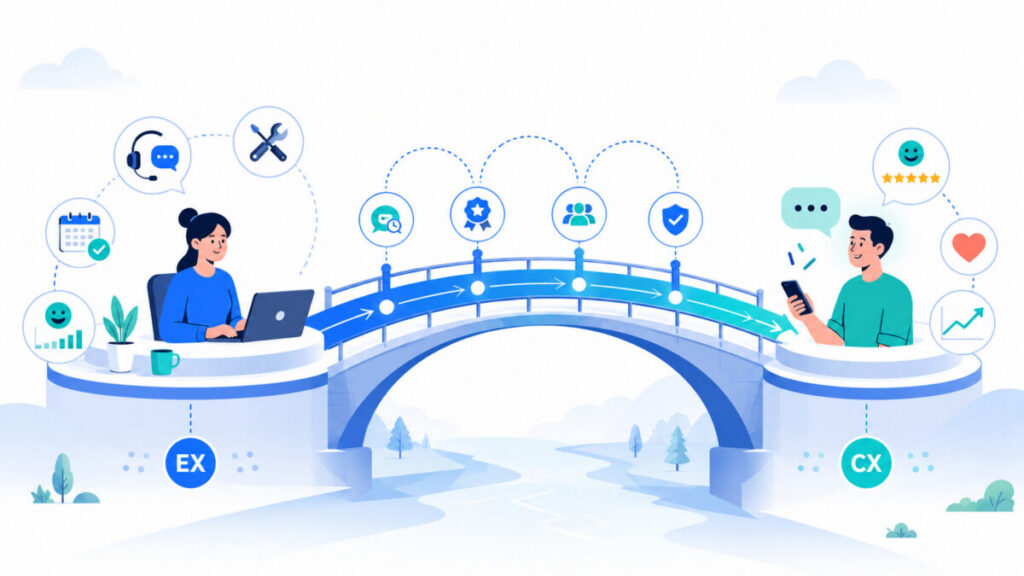
The quality of the Employee Experience directly translates into Customer Experience, sales performance and customer retention. It is the company's employees who design, deliver and fix the customer experience every day - in every channel and in every process. According to Gallup research, teams with excellent employee experience achieve 23% higher profits than teams with the lowest engagement. Ignoring this correlation costs companies not only money, but also customer loyalty.
Employee Experience is the sum total of an employee's experiences and emotions related to a company - from the moment of contact as a candidate, through the recruitment process, onboarding, daily work, development, and offboarding.
Key elements of EX include:
It is worth distinguishing between Employee Experience and employer branding. Employer branding is the external promise and image of the employer in the labor market - what the company communicates to candidates. EX is the employee's real-life experience at work every day. A discrepancy between promise and reality quickly leads to a decline in engagement and turnover.
Managing employee experience has become crucial in modern HR, as a positive employee experience directly translates into business results for the company, including talent engagement and retention.
Customer Experience is the totality of a customer's impressions, emotions and evaluations resulting from all interactions with a brand, product and service - before, during and after purchase. It is crucial to consciously manage customer experience as a whole customer-brand relationship, covering all points of contact.
CX encompasses the entire customer path:
Customer experience encompasses everything that happens between a company and a customer at every stage of the buying process, influencing purchasing decisions and building long-term relationships.
It is worth distinguishing CX from related concepts. Customer service is just one point of contact. UX (User Experience) refers to the use of a product or interface. Customer Experience Management is the overall management of the customer journey across all channels.
A good customer experience is key to building brand image and customer trust - what makes up a great customer experience includes consistency, empathy and effective problem solving, among other things, so every interaction matters.

EX and CX act as a connected vessel. Positive employee experiences enhance the customer experience, and negative ones destroy it.
The chain of dependencies looks as follows:
Organization culture and leadership → Employee Experience → employee behavior → Customer Experience → satisfaction, customer loyalty and business results
There is the concept of the "service profit chain," in which satisfied employees lead to better service, greater customer loyalty and better business performance.
The concept of "internal customer" explains why problems in internal processes (HR, IT, logistics) "leak" to the outside. When an employee has to use outdated procedures or wait for answers from other departments, these delays become apparent to the end customer.
In practice, this means that investing in the customer experience area without improving EX often fails.
A negative employee experience reflects directly on the customer:
Overstaffing - an overly large backlog and understaffing leads to longer response times, lower call quality and an increasing number of complaints.
Poor work tools - slow systems, lack of data integration force the consultant to ask the customer to repeat information. Errors increase, personalization decreases.
Lack of autonomy - when an employee can't handle simple issues (discount, exchange) on his own, the customer hears "I have to consult my supervisor" and loses patience.
Poor internal communication - marketing promises a promotion, and customer service doesn't know the details. The customer feels cheated.
High turnover - constant introduction of a new employee reduces the quality of service and breaks the continuity of the relationship, especially in B2B and Customer Success.
Lack of Voice of Employee - when their voice doesn't matter, frontline employees stop reporting process problems. The company doesn't see what spoils the customer journey.
59% of employees worldwide report a lack of engagement, costing the economy about 9% of global GDP annually in lost productivity.
Building a positive employee experience is an investment in tangible customer benefits:
Higher engagement - satisfied customers are born from satisfied employees. Engaged employees are more likely to show initiative and seek better solutions for the customer.
Empathy and accountability - a good organizational culture gives space to listen to the customer instead of "ticking off" requests. Employees who feel supported show more empathy, solve problems faster and build better relationships with customers.
More efficient processes - good work tools reduce response times and improve First Contact Resolution (FCR).
Better quality of advice - product and communication training translate into higher service levels.
Faster elimination of problems - Voice of Employee combined with Voice of Customer helps identify and remove pain points in the customer journey.
Stability of contact - Lower turnover and absenteeism means the customer is dealing with the same, experienced employee.
Satisfied and engaged employees are 87% less likely to leave a company. Organizations that consistently ensure a consistent and positive employee experience see measurable benefits, such as double-digit increases in financial performance and customer satisfaction.
The table below shows how the different elements of EX translate into specific aspects of CX and what metrics are worth tracking.
| Employee Experience area | Impact on Customer Experience | Example metrics | Possible corrective actions |
|---|---|---|---|
| Recruitment and onboarding | New employee's readiness to serve customers | eNPS, onboarding time, FCR | Buddy program, product training |
| Organizational culture and leadership | Pro-client approach, empathy in contact | NPS, CSAT, employee engagement | Leadership development program |
| Work tools | Speed and error-free service | CES, response time, number of errors | Implementation of a unified CRM |
| Internal processes | Consistency of information, no delays | Lead time, complaints | Simplification of procedures |
| Development and training | Quality of advice, competence | CSAT, quality score | Regular communication training |
| Remuneration and recognition | Motivation, proactivity | Turnover, absenteeism | Appreciation systems, quality bonuses |
| Internal communication | Consistency of message to customer | NPS, complaints | Regular briefings, common KPIs |
| Wellbeing and work-life balance | Stability of service quality | Absenteeism, CLV | Flexible schedules, psychological support |
| Autonomy of front-line employees | Speed of problem solving | FCR, CSAT | Greater decision-making authority |
Implementing integrated work tools (one window instead of five systems) reduces average handling time and improves FCR. Regular Voice of Employee surveys help identify process barriers that block effective call management.
Transparent bonus policies and better schedules impact staff availability and quality of counseling. Combining HR data (turnover, absenteeism) with store performance (NPS, conversion) helps optimize the labor model.
Ergonomics of warehouse positions and realistic performance standards translate into on-time delivery. Improved working conditions for warehouse employees reduce mistakes and complaints.
Simplified reporting and better access to customer data allows salespeople to spend more time on relationship building instead of administration.
Reducing the number of customers per Customer Success Manager and investing in communication automation lowers churn and increases NRR. High levels of engagement within the CS team correlate with more frequent contract renewals.
Simplified decision-making procedures and greater autonomy for advisors reduce time to issue credit decisions. Empathy training improves NPS of branches.

Practical tips for combining EX and CX data:
Select EX metrics:
Select CX metrics:
Combine team-level data - compare eNPS in the contact center with NPS scores at different stages of the customer journey, turnover in the sales team with customer retention.
Analyze correlations and trends - a drop in eNPS in Q2 vs a drop in CSAT in Q3 in the same unit can indicate causation.
Build EX-CX dashboards - simple summaries in BI tools help observe correlations.
Analyze comments - artificial intelligence can help analyze text and sentiment from employee and customer surveys.
Employee experience (EX) is an early indicator of customer experience (CX), which means improving EX can lead to better CX scores. The goal is not to find fault, but to identify the causes of CX problems in processes, tools and work culture.
Voice of Employee (VoE) is the systematic collection of employee feedback on work, tools, processes and culture. It includes pulse surveys, interviews with frontline employees and regular feedback sessions.
Voice of Customer (VoC) is the continuous monitoring of customer feedback at customer journey touchpoints - post-purchase surveys, after contact with the BOK, complaint surveys.
A model for combining VoE and VoC:
Transparently communicating to employees what the company has done based on their feedback is key to maintaining high engagement in EX programs.
Total Experience (TX) approach is becoming crucial in business, as lack of integration between customer, employee and user experiences leads to reduced operational efficiency.
Choose 2-3 actions from this list and implement them in the next 90 days. Don't wait for a big transformation project - small, measurable changes in the areas where EX and CX are most closely aligned yield quick results.
EX and CX is a joint engagement project for the entire organization. Improving the Employee Experience isn't just about a "nice atmosphere" - it's about hard processes, clear goals, good work tools, meaningful workloads and real listening to the employee's perspective.
Total Experience (TX) is a holistic approach to experience management that integrates customer, employee and user experiences. Total Experience strategy brings tangible benefits to companies: increased customer and employee loyalty and higher satisfaction levels.
CX, HR, Sales, Customer Success and Operations leaders need to work together on EX-CX projects. Organizations that invest in employee experience report higher financial performance and better customer satisfaction rates. Companies that successfully combine EX and CX gain a competitive advantage in the marketplace.
You can't build an outstanding Customer Experience on a poor Employee Experience.
EX is about the employee's experience in the relationship with the company as an employer - from recruitment to offboarding. CX is about the customer's experience in the relationship with the company as a product or service provider. Despite the different perspectives, the same processes, tools and organizational culture affect both areas.
EX influences CX through employee behavior at customer touch points. An engaged employee with good tools serves the customer faster, with more empathy and solves problems more effectively. An overloaded consultant without authority generates customer frustration.
Yes. Studies show a strong correlation between employee engagement and customer loyalty. An engaged employee is more likely to show initiative, communicate better with customers and pay attention to detail, which increases NPS and retention.
The most important breakdowns are eNPS NPS, employee engagement CSAT, turnover and absenteeism FCR and response time, satisfaction with CES work tools. Analysis should take place at the level of specific units (branch, contact center team).
Map the employee's journey in key teams that have customer contact. Run a simple Voice of Employee program. Combine EX data with basic CX metrics. Select 1-2 critical barriers in tools or processes and remove them.
Voice of Employee (VoE) is the systematic collection of employee feedback on working conditions, tools, processes and organizational culture. It includes pulse surveys, interviews with frontline employees and regular feedback sessions.
Collect VoC after key interactions, conduct periodic VoE surveys, hold workshops with frontline employees. Collate findings - when customers and employees point to the same problem, you have a complete picture and a concrete direction for new solutions.
Definitely yes. Studies show that organizations with high levels of EX report better NPS and CSAT scores. Employees who feel valued and have good tools provide higher quality service, which customers rate higher.
This is the responsibility of the whole company, not one department. In practice, it requires HR, CX, IT, operations and sales to work together. Some organizations are creating roles linking these areas or establishing cross-functional Total Experience teams. The key is to get the best people from different departments involved in joint initiatives.
Copyright © 2023. YourCX. All rights reserved — Design by Proformat
